Kakao Mobility recently faced controversy over encroaching on local businesses, leading to the withdrawal of its acquisition of two designated driver companies and putting a brake on its business expansion. However, among the designated drivers on the ground, there are different voices. They say that the existing phone-based designated driver companies are more oppressive than Kakao Mobility.
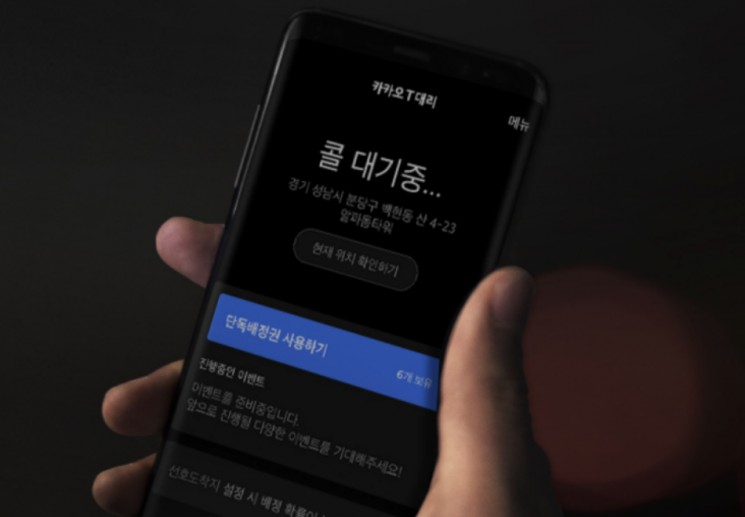
Kim Juhwan, chairman of the Designated Driver Union, said in a phone interview with Asia Economy on the 5th, "On the ground, many drivers feel that while Kakao Mobility is a problem, the existing companies are more problematic." The domestic designated driver market mainly operates through phone 'calls.' Designated drivers sign contracts with designated driver companies and use control programs contracted by their affiliated companies. Kakao Mobility connects users and designated drivers through the ‘KakaoT’ app.
Chairman Kim criticized the existing designated driver companies for taking commissions ranging from at least 35% to 50% under the names of program fees, designated driver insurance premiums, and commuting fees. Kakao Mobility’s commission is 20%. He said, "Because the system of the existing designated driver market was poor, platform companies could enter. At first, the drivers on the ground actually welcomed Kakao Mobility’s entry."
The union argues that designated driver companies are muddying the essence by playing the ‘underdog cosplay’ in the National Assembly and other political circles. The Korea Designated Driver Federation, a group of designated driver companies, has applied to the Win-Win Growth Committee to designate the designated driver brokerage business as a small and medium-sized enterprise suitable industry, requesting restrictions on Kakao Mobility’s business expansion.
Designated drivers claim that not only regulations on Kakao Mobility but also unfair practices by existing companies that impose excessive burdens must be eradicated. While the political circles such as the National Assembly focus only on regulating platform companies, existing companies in the Daegu and Busan regions quietly raised the commissions drivers pay. For a fare of 15,000 won, the commission, which was previously 3,000 won, increased to 3,500 won. The reason given was that management deteriorated due to Kakao Mobility’s market entry.
Moreover, there are ambiguous aspects regarding the local businesses that should be protected. The market share of existing designated driver companies remains significantly higher than Kakao’s. According to the industry, existing designated driver companies hold a 70-80% market share, while Kakao Mobility holds about 20-30%. From the drivers’ perspective, even if they want to receive calls from Kakao Mobility, which has lower commissions, they are more dependent on phone-based designated driver companies that receive more calls.
Of course, Kakao Mobility also faces various criticisms from drivers regarding its AI dispatch algorithm and paid membership ‘Pro Service’ as it expands its business in the designated driver market. However, there are concerns that focusing solely on the platform companies’ encroachment will leave the chronic problems of the designated driver market unresolved. While platform companies have positive functions such as checking existing dominant operators, existing operators may use political circles to hinder innovation. Chairman Kim emphasized, "Kakao Mobility should also increase its social responsibility, but it must balance power with existing companies," adding, "The designated driver market must be normalized by improving high commissions and other issues."
© The Asia Business Daily(www.asiae.co.kr). All rights reserved.