Joint Development by the Korea Atomic Energy Research Institute and the Korea Institute of Ocean Science and Technology
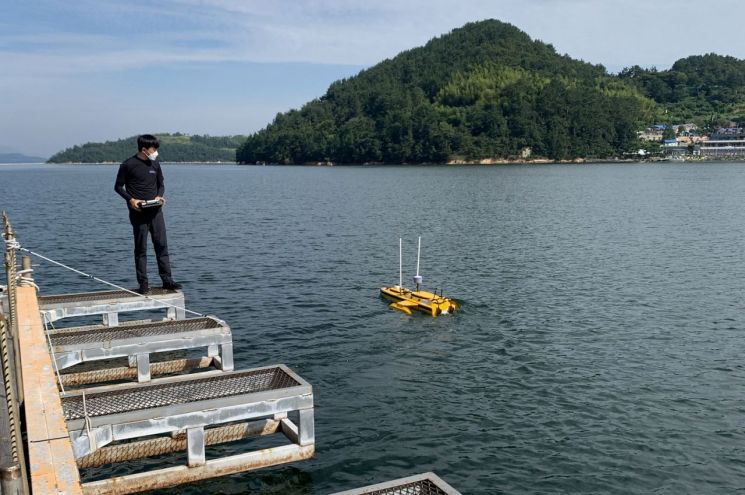 Researchers from the Korea Atomic Energy Research Institute and the Korea Institute of Ocean Science and Technology are conducting performance verification of the marine radiation unmanned automatic monitoring system. Photo by Korea Atomic Energy Research Institute
[Asia Economy Reporter Kim Bong-su] Amid growing concerns about radiation contamination in Korean waters following Japan's discharge of contaminated water from the Fukushima nuclear power plant into the ocean, national research institutes have developed an unmanned automatic monitoring system that can automatically track and monitor this in real time.
The Korea Atomic Energy Research Institute (KAERI) announced on the 4th that it has recently completed performance verification of a jointly developed unmanned automatic marine radiation monitoring system in collaboration with the Korea Institute of Ocean Science and Technology (KIOST).
The marine mobile radiation sensor developed by KAERI was mounted on an unmanned automatic robot developed by KIOST. The boat-shaped robot autonomously explores wide ocean areas to detect radioactive contamination sources. Unlike existing fixed marine monitoring equipment using buoys, the newly developed equipment can actively monitor while moving across wide sea areas. If the research team’s final goal of establishing the monitoring system is realized, it is expected to enable real-time monitoring of Korean seas and rapid response in emergencies.
There is growing concern among fishermen, the fisheries industry, and the public as it is obvious that Japan’s radioactive contaminated water will flow into Korean seas once discharged. However, continuous communication and power supply are difficult at sea, and large, heavy radiation measuring equipment had limitations for real-time monitoring.
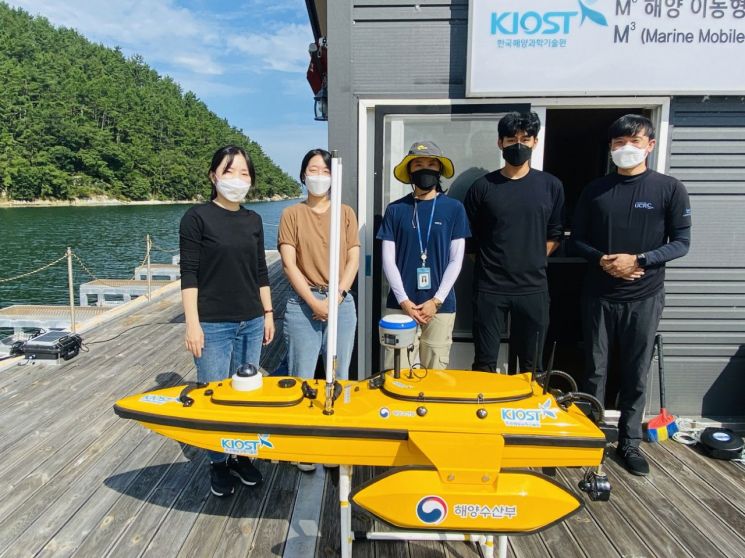 Researchers from the Korea Atomic Energy Research Institute and the Korea Institute of Ocean Science and Technology have jointly developed an unmanned automatic marine radiation monitoring system.
The marine mobile radiation sensor weighs one-quarter and has one-third the volume of conventional radiation sensors. Weighing about 560 g and smaller than a palm, it has excellent mobility. Until now, communication and power supply at sea were not smooth, so radiation sensors were mainly installed near the coast. However, the newly developed sensor applies low-power signal processing and wireless communication techniques, enabling operation for more than 24 hours on its own battery, so it is not restricted even if continuous power supply and communication fail.
The boat-shaped unmanned robot can be directly controlled by the user or autonomously move along pre-entered coordinates depending on the purpose. It can move for up to 4 hours at a maximum speed of 16 km/h and transmit data up to 8 km away. There are plans to enhance the equipment by increasing battery capacity and enabling satellite communication to transmit information without restrictions even in distant seas. In a performance verification experiment conducted last September, it successfully detected a radioactive contamination source 3 m away while moving autonomously.
Dr. Jang Mi of KAERI explained, “By securing baseline environmental radiation data of our seas and utilizing it to establish a wide-area marine radiation monitoring network in emergencies, it is possible to monitor radiation contamination levels quickly and accurately.”
© The Asia Business Daily(www.asiae.co.kr). All rights reserved.
![Clutching a Stolen Dior Bag, Saying "I Hate Being Poor but Real"... The Grotesque Con of a "Human Knockoff" [Slate]](https://cwcontent.asiae.co.kr/asiaresize/183/2026021902243444107_1771435474.jpg)
















