After Long Excavation and Maintenance, Transformed into the Largest Domestic Relic Model and a Historical Space Featuring a Moat
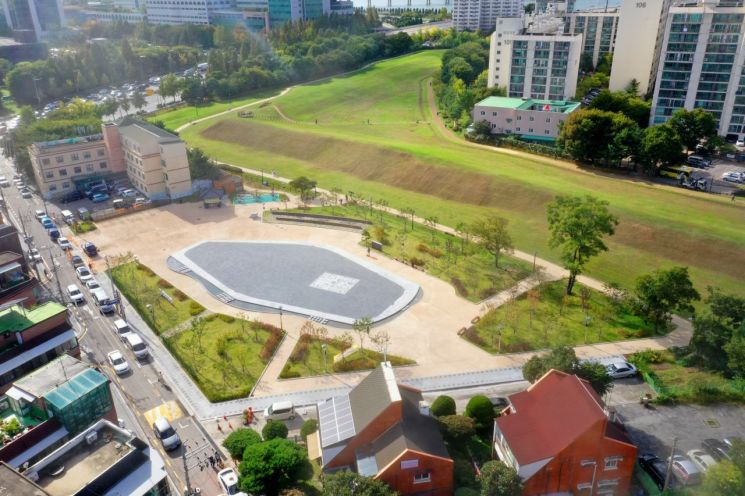 Panoramic view of Pungnap Toseong Dongsung Wall Park. In the center of the park, a model map reproducing the actual appearance of the Pungnap-dong earthen fortress at 1/30 scale has been created.
[Asia Economy Reporter Jongil Park] Songpa-gu (Mayor Park Seong-su) announced on the 3rd that it will newly create the Pungnap-dong Earthen Fortress East Wall section (around Pungnap-dong 240) ? which had been an empty lot for a long time ? into a historical and cultural park and present it to residents.
The area around the Pungnap-dong Earthen Fortress East Wall was purchased in 2005. After the demolition of the previously used solar house site, it was utilized as a parking lot or exercise space until full-scale excavation began in 2015.
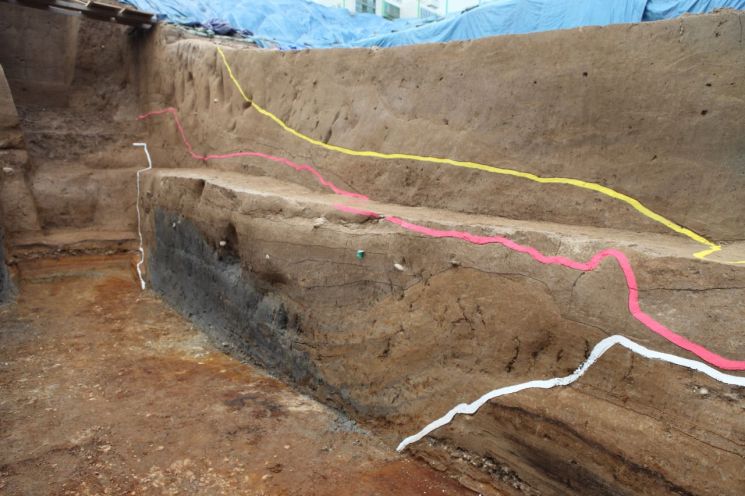
As a result, a Baekje Hanseong period circular structure connected to the fortress wall was confirmed 4.5 meters underground, revealing the first moat of the Pungnap-dong Earthen Fortress. The discovered moat measures up to 14 meters in width and 2 meters in depth, and through pottery and other artifacts excavated together, it was confirmed to have been constructed in the early 4th century.
Based on these achievements, Songpa-gu began the basic design for the construction project in 2018. After reviews by the Cultural Heritage Administration and Seoul City, expert verification, and collecting residents’ opinions, full-scale maintenance began in 2020.
After 16 years of restoration and maintenance, the Pungnap-dong Earthen Fortress East Wall Park has recently returned to the residents. It has been reborn as a space where people can experience historical culture and relax within the city.
The district created a model map of the Pungnap-dong Earthen Fortress approximately 40 meters long and 20 meters wide at the center of the East Wall Park, which covers a total area of 5,230 square meters. This is a 1:30 scale reproduction of the actual Pungnap-dong Earthen Fortress and boasts the largest scale of relic model facilities in Korea. In particular, reflecting the excavation results so far, the fortress gate, palace, government offices, workshops, and ponds were engraved or inlaid in stone.
Additionally, the model map depicts the Pungnap-dong Earthen Fortress fully connected to the non-existent West Wall section, and a curved waterway (曲水路) was created along the outer edge to allow visitors to feel the flowing moat water.
Furthermore, convenience facilities reflecting residents’ opinions, such as exercise equipment and sitting wall stands, were installed. To prevent damage to the cultural assets buried underground, low-growing trees and shrubs were planted. Referring to seed data excavated from the Three Kingdoms period relics, traditional tree species such as plum, apricot, peach, and maple were planted to decorate the landscape of the area.
The district plans to link the East Wall Park with the cultural heritage digital restoration project and provide content that allows residents to view the Pungnap-dong Earthen Fortress in three dimensions by incorporating augmented reality (AR) and virtual reality (VR) technologies.
Park Seong-su, Mayor of Songpa-gu, said, “The Pungnap-dong Earthen Fortress East Wall Park will be an important hub for the Songpa Dullegil and Pungnap Earthen Fortress trails, serving as a new resting place and a landmark for exploring Baekje culture. We will continue to do our best to make Songpa a city where residents’ lives and historical culture harmonize.”
© The Asia Business Daily(www.asiae.co.kr). All rights reserved.
![Clutching a Stolen Dior Bag, Saying "I Hate Being Poor but Real"... The Grotesque Con of a "Human Knockoff" [Slate]](https://cwcontent.asiae.co.kr/asiaresize/183/2026021902243444107_1771435474.jpg)
















