Controversy Over Recognition of Win-Win Consumption Support Fund for Purchases at Large Mart Malls on Naver
Government and Card Industry Seeking Ways to Exclude Sales Performance, but Technically Difficult and Time Is Tight to Reflect Before Cashback Payment on the 15th
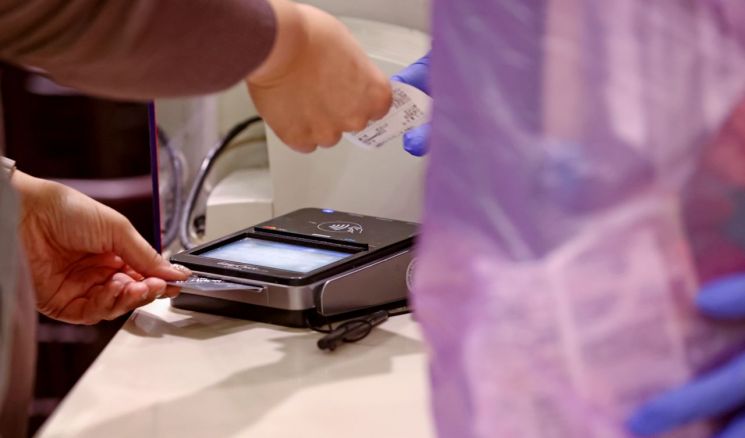
[Asia Economy Reporter Ki Ha-young] With the cashback for the Win-Win Consumption Support Fund scheduled to be paid on the 15th, the government and the card industry are struggling to find a way to exclude the sales performance of large marts and other stores listed on Naver. It is technically difficult to exclude the performance of specific merchants only, and there is a tight deadline to reflect this before the cashback payment, causing difficulties.
According to the card industry on the 2nd, the Ministry of Economy and Finance, card companies, and Naver have met several times and are actively seeking solutions to exclude consumption through large online malls such as those on Naver Shopping from the Win-Win Consumption Support Fund performance.
The Win-Win Consumption Support Fund is a policy that returns 10% of the excess amount spent over 3% compared to the average monthly card usage in the second quarter of this year (April to June) when using credit or debit cards during October and November. It refunds up to 200,000 KRW, and the cashback is paid on the 15th of the following month.
As this policy aims to revitalize consumption weakened by COVID-19, the government has expanded the applicable targets as much as possible but excluded large marts, department stores, large online malls, and luxury specialty stores to promote the local economy.
However, controversy arose as purchases made with credit cards or Naver Pay at Emart Mall and other stores listed on Naver were recognized as eligible for the Win-Win Consumption Support Fund. Due to the payment structure of Naver Shopping, card companies cannot distinguish whether transactions within Naver Shopping were made at Emart Mall or by small business operators. Only Naver Financial, an electronic payment gateway (PG) provider, appears to the card companies.
An industry official said, "After this issue surfaced, the government decided to exclude these from the Win-Win Consumption Support Fund performance and is negotiating with Naver and others to explore various technical methods, but nothing has been finalized yet."
The problem is that it is technically difficult to exclude consumption from specific merchants only from the Win-Win Consumption Support Fund performance. Simply sharing the names of sub-merchants from Naver to card companies or the first PG company does not solve the issue. For example, if a customer adds products from different merchants on Naver Shopping to the cart and pays once with Naver Pay, it is physically difficult to selectively identify only the large mart transactions.
The tight remaining time is also an obstacle. Cashback for last month's card usage must be paid on the 15th, and a solution must be found before then to minimize consumer confusion. From the card companies' perspective, a solution must be found by this week at the latest to secure the physical time needed to exclude Naver Pay payments from card usage performance.
Meanwhile, the Win-Win Consumption Support Fund is showing results after operating for a month. According to the Ministry of Economy and Finance, as of the 29th of last month, the total amount scheduled for card cashback payments was 302.5 billion KRW. The number of people who applied to participate in the cashback program by last month was 14.88 million, which corresponds to 34.5% of the 43.17 million adults aged 19 and over who hold credit or debit cards. Some criticize the participation rate as low, analyzing that there is little incentive to spend 1 million KRW to receive 100,000 KRW.
© The Asia Business Daily(www.asiae.co.kr). All rights reserved.
![Clutching a Stolen Dior Bag, Saying "I Hate Being Poor but Real"... The Grotesque Con of a "Human Knockoff" [Slate]](https://cwcontent.asiae.co.kr/asiaresize/183/2026021902243444107_1771435474.jpg)















