Financial Services Commission Chairman Holds Banking Industry Meeting with Commercial Bank CEOs and Related Institution Heads
[Asia Economy Reporter Kim Jin-ho] The Financial Services Commission (FSC) is drawing attention by presenting a carrot of new growth opportunities following the stick of total household loan volume regulation imposed on the banking sector. Given the government's firm commitment to household loans, this is interpreted as granting banks' long-standing wish to expand non-interest income.
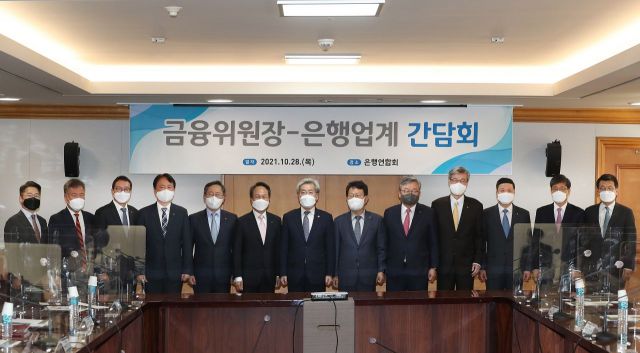
According to the financial sector on the 30th, the FSC held a 'Banking Industry Meeting' chaired by Chairman Ko Seung-beom on the 28th, where it proposed three measures aimed at 'the future of banking and securing competitiveness.' The meeting was attended by Chairman Ko, seven heads of major commercial banks (Jin Ok-dong of Shinhan Bank, Heo In, Kwon Kwang-seok of Woori Bank, Park Sung-ho of Hana Bank, Kwon Joon-hak of Nonghyup Bank, Lim Sung-hoon of Daegu Bank, Seo Ho-sung of K-Bank), and the chairman of the Korea Federation of Banks along with other related institution leaders.
Chairman Ko first stated that banks would actively expand their concurrent and ancillary businesses to innovate their business models in response to the changing environment. Specifically, he mentioned improving the trust business system so that banks can act as comprehensive asset managers and opening up investment advisory services, which had been limited to real estate. Both businesses have been repeatedly requested by the banking sector for entry permission.
Chairman Ko added, "We will also review the business performance and environmental changes of platform businesses operating under innovative financial services and expand banks' ancillary businesses to a reasonable level." This is interpreted as opening the door for services such as the MVNO (Mobile Virtual Network Operator) service temporarily provided by Kookmin Bank under innovative financial services and the food delivery platform soon to be launched by Shinhan Bank to continue operating.
He also pledged active support for changes aimed at the digital transformation of banks. He emphasized, "We will create institutional conditions for a digital universal bank that provides all financial services through a single app," and "We will actively support digital new business investments such as rationalizing network separation and promoting information sharing between financial and non-financial sectors." This means creating an environment where customers can conveniently handle various tasks from banking to insurance through one app.
He also stressed the need to continue financial innovation based on fair competition. Financial companies, including banks, should lead changes as agents of financial innovation, and the government promised to make continuous efforts to create a fair competitive environment. Since his inauguration, Chairman Ko has consistently advocated applying the principle of 'same function, same regulation' to resolve regulatory differences between financial companies and big tech firms.
The banking sector welcomes the FSC's carrot proposal. They believe it will alleviate concerns about expanding non-interest income amid increasingly stringent regulations on household loans, which are the core source of bank revenue. A banking sector official said, "Expanding non-interest income is a common concern for all banks," adding, "(The FSC's proposal) is seen as an opportunity to ease profitability concerns arising from strengthened household loan regulations."
Recently, the FSC announced additional household debt measures centered on the early implementation of the borrower-based Debt Service Ratio (DSR). It also stated plans to further tighten the total household loan volume management target from the high 6% range this year to 4-5% next year. From the banks' perspective, this means their capacity to sell household loans will decrease further compared to this year.
© The Asia Business Daily(www.asiae.co.kr). All rights reserved.

















