After 3 Weeks of Preparation, 'Full Return to School' to be Promoted from Post-Suneung
Expansion of Small-Scale Face-to-Face Activities, No School-Level Events Allowed
Goal of 'Complete Normalization' from First Semester Next Year
Emergency Plan to be Announced and School Density Restricted if Cases Surge
Increase in Student Confirmed Cases from 'School' Infection Raises Concerns over Full Return to School
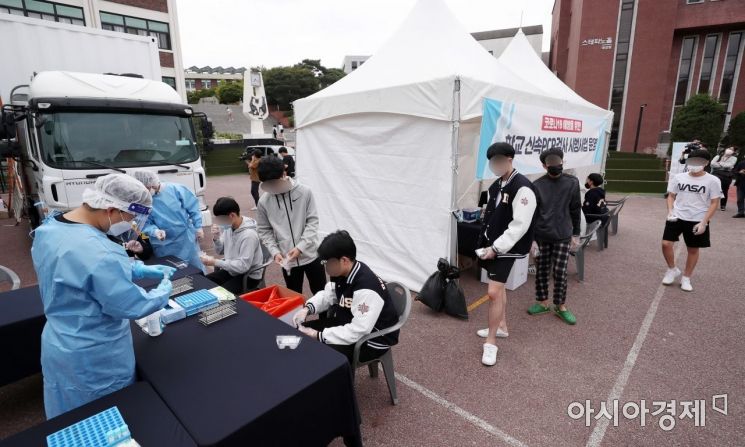 On the morning of the 28th, students at Dongseong High School in Jongno-gu, Seoul, underwent rapid self-molecular diagnostic gene amplification (rapid PCR) and saliva-based COVID-19 tests as they arrived at school. The Seoul Metropolitan Office of Education expanded the "Mobile Specimen Collection Teams for Educational Facilities" from one team to more than four teams and designated the period until the 6th of next month as an "Intensive Multi-layered Quarantine Period," including a pilot operation of rapid PCR testing at five dormitory-operated schools.
 /Photo by Joint Press Corps
[Asia Economy Reporter Han Jinju] From November 22, the week after the College Scholastic Ability Test (CSAT), all kindergarten, elementary, middle, and high school students nationwide will return to full in-person attendance. Outdoor play and physical activities in kindergartens, as well as group activities and discussion classes in elementary, middle, and high schools, will also resume.
The main points of the Ministry of Education's 'Step-by-step Plan for the Restoration of Daily Life in the Education Sector,' announced on the 29th, are ▲ full in-person attendance from November 22 ▲ allowance of small-scale experiential activities in curricular and extracurricular activities ▲ partial relaxation of quarantine guidelines for cafeterias and attendance suspension.
Three-week grace period before full in-person attendance from November 22
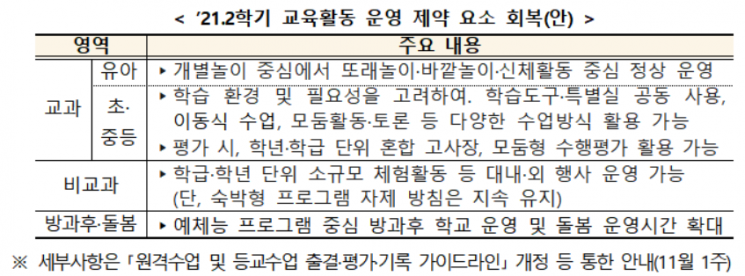
After a three-week preparation period starting in November, full in-person attendance will be possible in the metropolitan area from the 22nd. The social distancing phase will be eliminated, and the school density standard will change to 'full in-person attendance allowed.'
However, considering the COVID-19 outbreak situation and school readiness, the decision to operate full in-person attendance can be made autonomously depending on the region and circumstances. For example, in oversized or overcrowded elementary schools in the metropolitan area with more than 1,000 students, it is possible to have only three-quarters of grades 3 to 6 attend school after gathering opinions from members.
Small-scale face-to-face activities in curricular and extracurricular activities will also be expanded. In kindergartens, peer outdoor play and physical activities will operate normally, and in elementary, middle, and high schools, group and discussion classes as well as small-scale experiential activities will be allowed. For example, forest experiences, club activities inside and outside school, and small-scale festivals conducted by several classes are possible. School-wide events, large-scale experiential activities, and overnight experiential activities will be allowed starting from the first semester of next year.
If confirmed cases surge or the medical system collapses, and the quarantine authorities announce an 'emergency plan,' school density restrictions will be implemented. The emergency plan is activated when the operation rate of intensive care units or hospital beds worsens, when severe cases or deaths increase rapidly, or when the scale of the outbreak surges.
Lee Sang-soo, Director of the School Innovation Support Office at the Ministry of Education, explained, "Specific standards for school density after emergency plan measures will be decided through consultation with metropolitan and provincial offices of education and quarantine authorities," adding, "Although a preparation period will be provided, if a sudden situation occurs, the preparation period may be somewhat shortened."
The Ministry of Education plans to apply the principle of full in-person attendance from the first semester of next year to transition to complete restoration of daily life. School-level activities such as festivals and competitions, overnight experiential learning such as school trips will be allowed, and full operation of after-school programs will also be considered.
Relaxation of cafeteria and attendance suspension criteria... Concerns coexist amid increase in student confirmed cases
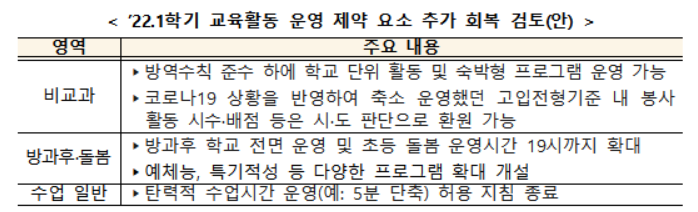
The number of home study days will also be adjusted by metropolitan and provincial offices of education. Currently, up to 57 days are allowed. Quarantine guidelines related to cafeteria use and attendance suspension will also be partially relaxed. As the number of students dining increases with expanded attendance, seating in all seats will be allowed on the condition that partitions are installed. The attendance restriction criteria will also change to allow students to attend school if cohabitants who have not tested positive are under self-quarantine. Attendance will only be restricted if the student themselves is confirmed positive or must self-quarantine.
From November 1, restrictions on study room operating hours will be lifted. In academies, the standard of spacing seats one seat apart will be changed, and operating hour restrictions will be lifted from November 22. Special quarantine inspections of academies will also be conducted from November 4 to 17, two weeks before the CSAT.
There are also voices of concern about the expansion of in-person attendance. The daily nationwide COVID-19 confirmed cases have remained at around 2,000 for three consecutive days, and from October 21 to 27, the average daily number of student confirmed cases was 269, the second highest ever. The proportion of infections traced to schools among student confirmed cases has also increased from 7.5% in August, 16.5% in September, to 24.5% in October. The relatively low vaccination rate among children and adolescents compared to adults, and the fact that those under 12 years old are not eligible for vaccination, are also risk factors.
The Ministry of Education intends to emphasize basic quarantine rules such as social distancing within schools, ventilation in classrooms, and wearing masks (KF80 or higher). Mobile PCR testing teams will be expanded in the metropolitan area and in overcrowded and oversized schools. To strengthen quarantine personnel mainly in the metropolitan area, a 'School Life Quarantine Guidance and Inspection Team' responsible for life guidance at the education support office level will also be operated. For school dormitories, on-site inspections and PCR tests for residents will be conducted, and the plan to change from 'preferably one person per room' to 'multi-person rooms operated within the range where distancing is possible' is under review.
© The Asia Business Daily(www.asiae.co.kr). All rights reserved.



















