First Four-Day Workweek Pledge in Presidential Race by Sim Sang-jung
Lee Jae-myung Agrees on Need for Four-Day Workweek but Says "Too Early for a Pledge"
Experts Say "Discussions Ahead of Election Act as Institutional Catalysts... Discussions Alone Are Important"
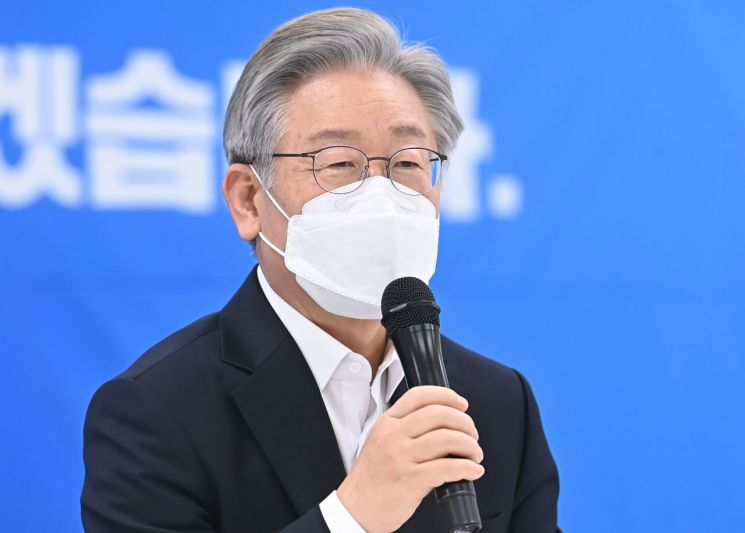
[Asia Economy Reporter Park Hyun-joo] Lee Jae-myung, the leading presidential candidate of the Democratic Party of Korea, has drawn attention to the possibility of realizing a four-day workweek as he mentioned its introduction.
On the 27th, in an interview with a media outlet, Candidate Lee said, "A four-day workweek for a humane life and reduction of working hours is something that must be done someday," adding, "Although it will be a long-term national task, we should strive to introduce it as soon as possible in line with the Fourth Industrial Revolution."
The opposition parties criticized Candidate Lee for this. On the 28th, Lee Jun-seok, leader of the People Power Party, said at the party's Supreme Council meeting, "If you tear off the sweet mask of the four-day workweek that Candidate Lee talks about, a reduction in wages and a decrease in jobs due to the deterioration of the business environment are naturally expected." On the same day, Heo Eun-ah, the senior spokesperson for the People Power Party, also issued a statement criticizing it as "a half-baked agitation that ignores fundamental problems and only aims to gain votes."
As the controversy grew, Candidate Lee showed a step back when meeting reporters after attending the '2021 RoboWorld' event held at KINTEX in Goyang, Gyeonggi Province, saying, "(The four-day workweek) is premature as an immediate presidential pledge."
◆ 8 out of 10 office workers positive about the four-day workweek... South Korea ranks 3rd in working hours among OECD countries
However, some predict that discussions about the four-day workweek will not die down during this presidential election season. Above all, there is a growing public consensus on the four-day workweek.
According to 'Saramin,' a job search platform, a survey conducted in August on 4,155 adults showed that 83.6% responded positively to the four-day workweek. The main reasons were "guaranteeing the right to rest and establishing a work-life balance culture" (72.4%, multiple responses allowed) and "improving work efficiency through sufficient recharging" (51.7%). Following these were △health management (32.1%) △stimulating domestic demand and economic growth due to increased holidays (21.2%) △childcare (20.1%), among others.
It is well known that South Korea's working hours are among the longest in the world. As of last year, the annual working hours were 1,908, ranking third among OECD countries after Mexico (2,124 hours) and Costa Rica (1,913 hours). The average working hours among OECD member countries is 1,687 hours.
Thus, discussions about the four-day workweek have emerged to guarantee workers' health rights and the right to rest. The Korean Health and Medical Workers' Union, which had announced a general strike in September and negotiated with the government, also urged improvements to the shift work system and guarantees for the four-day workweek.
The four-day workweek proposes reducing the current statutory working hours of 40 hours per week to 32 hours per week. Including 12 hours of overtime, the maximum working hours per week can be up to 44 hours.
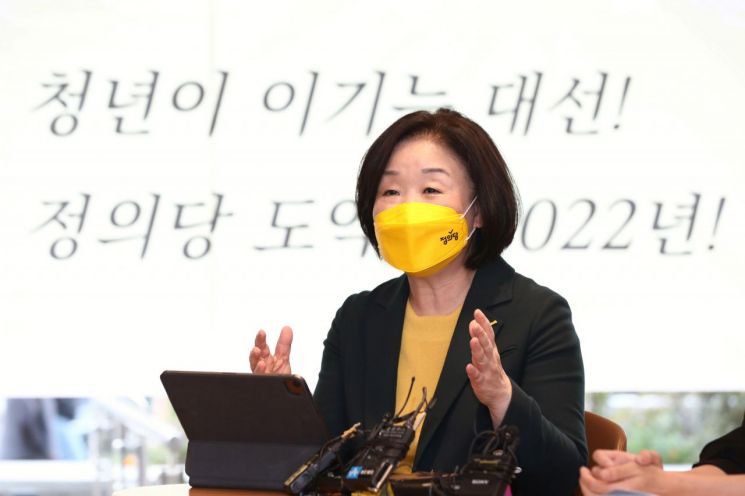
◆ The first four-day workweek pledge in the presidential election was by Sim Sang-jung... Experts evaluate it as significant in making labor issues a key topic
The initial breakthrough in the discussion of the four-day workweek during the presidential election season was made by Sim Sang-jung, the presidential candidate of the Justice Party. On the 6th of last month, Sim held a press conference and stated, "South Korea has stopped reducing working hours for 18 years since the agreement on 40 hours per week in 2003," adding, "We will abolish the outdated Labor Standards Act that does not reflect changes in the times and enact a new labor law to introduce a nationwide four-day workweek."
As discussions about the four-day workweek intensified following Candidate Lee's remarks, Sim issued a press release on the 29th, saying, "Seeing that everyone, regardless of party, is adopting this, it seems that Sim Sang-jung's four-day workweek is indeed the trend," emphasizing that the four-day workweek is her pledge.
In fact, Candidate Lee had previously expressed his intention to reduce working hours. At a press conference on August 22, he said, "Korea has the longest working hours, and even the 52-hour workweek is actually long," adding, "We need to reduce working hours in the long term, such as by adopting a four-day workweek."
He continued, "The four-day workweek is about setting a future-oriented standard for working hours in South Korea, one of the OECD countries with the longest working hours. To achieve this, it is an agenda to fundamentally transform our socio-economic system, including sharing profits between large and small businesses and guaranteeing income for precarious workers and self-employed persons. I want to emphasize that this is not an agenda to be superficially copied and used for show."
Some expect that this discussion will open the way for debates on reducing working hours.
Experts see the four-day workweek moving from research discussions to policy discussions. Kim Jong-jin, senior research fellow at the Korea Labor and Society Institute, said, "The fact that a leading presidential candidate mentioned the four-day workweek means that it is a hot topic in our society," explaining, "It means that even if not immediately next year, it is time to discuss the four-day workweek."
He also evaluated that such discussions have significant meaning in making labor issues a key topic. Researcher Kim said, "It is very meaningful that labor issues are being discussed during the presidential election season. Discussions held before elections can promote the introduction of systems," adding, "Even if the four-day workweek is not introduced, it is important that active discussions are taking place in various areas such as working hours and work types."
© The Asia Business Daily(www.asiae.co.kr). All rights reserved.


















