Lee Mentions "Inevitable Trend"
Lacks Specifics on Method and Timing
Some Criticize as 'Premature Policy'
People Power Party Clearly Opposes
Lee Jun-seok Says "Temptation to Win 2030 Votes"
Points Out Wage Cuts and Job Losses
[Asia Economy Reporter Oh Ju-yeon] With about four months left until the presidential election, discussions on reducing working hours, represented by the 'four-day workweek,' have surfaced in the political arena. The four-day workweek had been publicized mainly by ruling party candidates since the Seoul mayoral by-election in April, but interest has grown recently as Lee Jae-myung, the ruling party's presidential candidate, mentioned the introduction of the four-day workweek as an "inevitable trend." On the other hand, the opposition party opposes it, citing that it is premature, so the debate over pros and cons is expected to intensify as the election approaches.
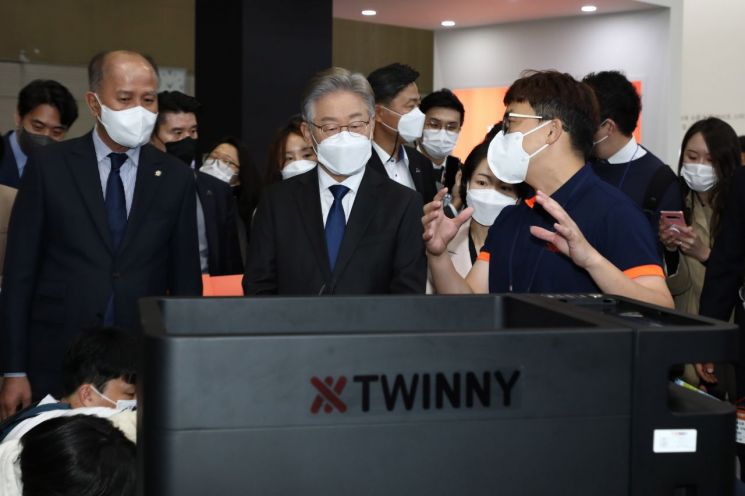
Park Chan-dae, Lee’s chief spokesperson, appeared on CBS Radio on the 29th and said, "It is a topic to be considered as a long-term national task." This was an elaboration on Lee’s statement the previous day that "Although it may be difficult at the moment, I believe that at some point, the four-day workweek will be introduced." Park added, "Although it has never been prepared as a concrete policy or deeply reviewed, considering a humane life, reduction of working hours, and the Fourth Industrial Revolution, there is a point where we need to think about the four-day workweek." Other ruling party presidential candidates, such as Sim Sang-jung of the Justice Party and Kim Jae-yeon of the Progressive Party, have also proposed the four-day workweek as a campaign pledge from early on.
However, since the four-day workweek has not prominently appeared in the ruling party’s primary process so far, detailed reflection on methods and timing has not yet been made. This is why some criticize it as an "immature policy." In the April 7 by-election, Cho Jung-hoon of the Era Spirit Party suggested giving incentives to private companies, and Park Young-sun, then Seoul mayoral candidate, proposed a four-and-a-half-day workweek starting with Seoul city-affiliated institutions and expanding to the private sector. In other words, depending on who proposes it and for what purpose or method, the introduction of the four-day workweek can take various forms and intensities.
On the other hand, the People Power Party has a clear opposing stance. On the same day, Kim Ki-hyun, the floor leader, appeared on YTN Radio and criticized, "They talk about the four-day workweek and then take back their words saying ‘not now.’ Is this how lightly they treat their words?" Lee Jun-seok, the party leader, also focused on pointing out the policy’s flaws. The previous day, Lee said, "In a situation where the 2030 generation does not support them, they hastily try to win their votes by tempting them with the promise of implementing the four-day workweek." Lee’s opposition argument is based on wage cuts and job losses.
However, considering that the four-day workweek is being proposed worldwide as a solution to the climate crisis and that health and rest rights have become more important after COVID-19, there is a strong possibility that it will attract significant attention in the upcoming presidential election. As of last year, South Korea’s annual working hours were 1,908 hours, which is 221 hours more than the OECD average of 1,687 hours, ranking third after Mexico and Costa Rica.
© The Asia Business Daily(www.asiae.co.kr). All rights reserved.

















