"Guaranteeing the People's Right to Know" Transparency in the Judicial System Increases
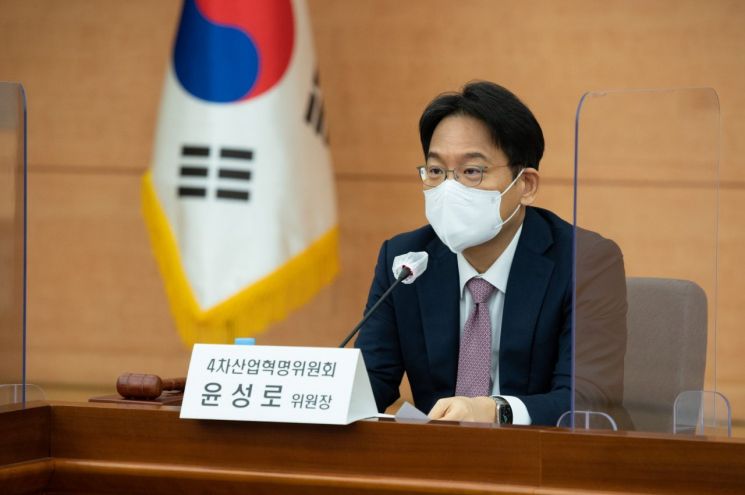 The Presidential Committee on the Fourth Industrial Revolution announced on the 28th that it had approved the agenda item "Internet Access to Court Rulings and Proposals for System Improvement." Photo by Yoon Seong-ro, Private Sector Chairman.
[Asia Economy Reporter Cha Min-young] The Presidential Committee on the Fourth Industrial Revolution proposes to the judiciary and the executive branch to make currently undisclosed court rulings accessible online. This is intended to guarantee the people's constitutional right to know and ensure fair trials for citizens.
On the afternoon of the 28th, the Fourth Industrial Revolution Committee held its 25th plenary meeting at the Government Seoul Office, chaired by private sector chairman Yoon Seong-ro, and approved the agenda titled "Proposal for Internet Access to Court Rulings and System Improvement."
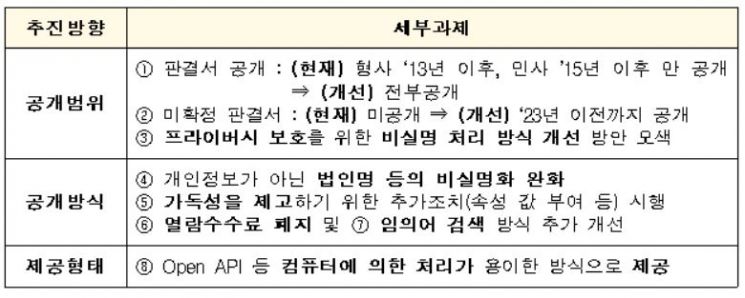
Currently, criminal case rulings have been disclosed only since 2013, and civil case rulings only since 2015; the plan is to improve this to full disclosure. They also plan to propose that undisclosed, non-final rulings be made public up to the content before 2023.
They will also explore ways to improve anonymization methods to protect personal privacy. Since opening non-final criminal rulings requires social consensus, a caveat was added emphasizing the need for personal information protection measures for parties involved in cases.
The Fourth Industrial Revolution Committee expects that if the judiciary and executive concretize and implement this proposal, unnecessary lawsuits will decrease, transparency in the judicial system will be secured, and fairness and reliability will be enhanced. They also anticipate an improvement in the quality of legal services by integrating digital new technologies.
They pointed out the need to abolish court ruling viewing fees and further improve the convenience of arbitrary word search methods. They also urged diversifying the provision methods beyond the existing text PDF format to include computer-friendly open API formats, enabling more convenient use of content in legal tech services and others.
Yoon Seong-ro, private sector chairman of the Fourth Industrial Revolution Committee, said, "There has been a long-standing demand in the private sector for disclosure of court ruling data. I hope this agenda leads to follow-up discussions by the judiciary and executive branches, and through this, a foundation will be established to utilize court ruling data more safely."
© The Asia Business Daily(www.asiae.co.kr). All rights reserved.
![Clutching a Stolen Dior Bag, Saying "I Hate Being Poor but Real"... The Grotesque Con of a "Human Knockoff" [Slate]](https://cwcontent.asiae.co.kr/asiaresize/183/2026021902243444107_1771435474.jpg)
















