Professor Sim Sang-jun's Research Team at Korea University Successfully Improves Microalgae Resistant to High Concentrations of CO2
Proven Usable in Industrial Fields... "Will Help Achieve a Carbon Neutral Society"
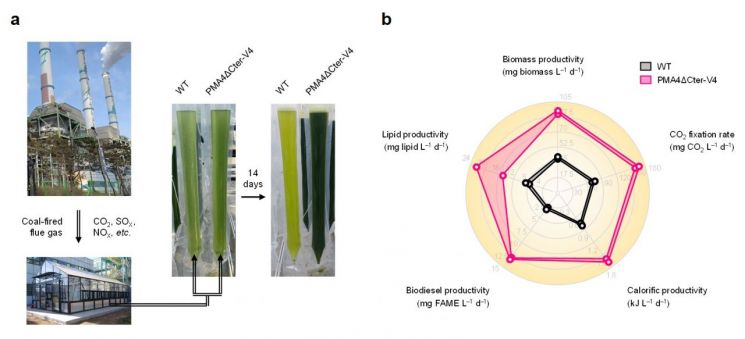 Field Test for Demonstrating Microalgae Carbon Dioxide Conversion Performance and Valuable Substance Production Using Actual Industrial Emissions Containing High-Concentration Carbon Dioxide
 Outdoor Mass Cultivation Results for Practicality Verification as a CO2 Conversion Platform Using Genetically Engineered Microalgae Strain (PMA4ΔCter-V4) and Wild-Type Strain (WT)
(Detailed Description of the Figure)
(a) Outdoor mass cultivation evaluation for actual biomass and valuable substance production using coal combustion flue gas containing high-concentration CO2 and other toxic components.
(b) Enhanced high-speed CO2 conversion (2.23 times) and biomass production (2.28 times) performance of the developed microalgae due to improved high-concentration CO2 tolerance. Productivity of representative microalgae-derived valuable substances such as biodiesel, solid fuel, and lipids also increased by 4.68 times, 2.2 times, and 2.21 times, respectively.
[Asia Economy Reporter Kim Bong-su] A microalgae that not only survives high concentrations of carbon dioxide but also absorbs it and converts it into biofuel has been developed. It consumes much larger amounts of carbon dioxide much faster than before, and the biofuel production volume has also significantly increased, raising the possibility of practical application.
The National Research Foundation of Korea announced on the 28th that Professor Shim Sang-jun's research team at Korea University developed an improved microalgae capable of rapidly biosynthesizing high-value-added substances directly from high concentrations of carbon dioxide emitted in industrial sites. They revealed a biological carbon dioxide reduction technology that can rapidly convert harsh high concentrations of carbon dioxide in microalgae into high-value-added substances such as biofuels.
Microalgae is a general term for photosynthetic microorganisms. Just as plants absorb carbon dioxide and use it as nutrients, microalgae also absorb carbon dioxide and use light as energy to produce various substances.
The problem is that microalgae have low tolerance and die when exposed to high concentrations of carbon dioxide. There were limitations in efficiently reducing and converting the large amounts of high-concentration carbon dioxide generated across industries.
The research team found that the low tolerance of microalgae to carbon dioxide is due to the low expression of plasma membrane hydrogen ion-ATPase under high carbon dioxide concentration environments. Plasma membrane hydrogen ion-ATPase is a hydrogen ion (H+) pump located in the cell plasma membrane. It is a protein that plays a key role in regulating intracellular acidity (pH) in plants and fungi.
By introducing the gene for this ATPase derived from plants into microalgae and engineering it to continuously express this biological pump, the carbon dioxide tolerance increased more than threefold compared to wild-type microalgae. This biological pump smoothly expelled hydrogen ions, which continuously accumulate inside microalgae as a result of carbon dioxide dissolution and related metabolism, out of the cell, allowing microalgae to maintain activity even in acidic environments.
The research team also confirmed the enhanced carbon dioxide tolerance effect through outdoor mass cultivation experiments. When directly exposed to coal combustion gas containing high concentrations of carbon dioxide, the engineered microalgae converted carbon dioxide into biomass and biofuel more than twice as fast as wild-type microalgae.
Professor Shim Sang-jun said, "The developed carbon dioxide tolerance-enhanced microalgae strain was verified through large-scale cultivation field tests using actual industrial exhaust gas," adding, "It can be utilized as a practical biological rapid carbon dioxide reduction and conversion technology to achieve carbon neutrality by 2050."
This research achievement was published online on the 18th in the international journal Nature Communications.
© The Asia Business Daily(www.asiae.co.kr). All rights reserved.
![Clutching a Stolen Dior Bag, Saying "I Hate Being Poor but Real"... The Grotesque Con of a "Human Knockoff" [Slate]](https://cwcontent.asiae.co.kr/asiaresize/183/2026021902243444107_1771435474.jpg)















