Raising the "Rich Countries' Responsibility" in Climate Issues
India's Carbon Emissions Account for 4% of Global Cumulative Emissions Since 1850
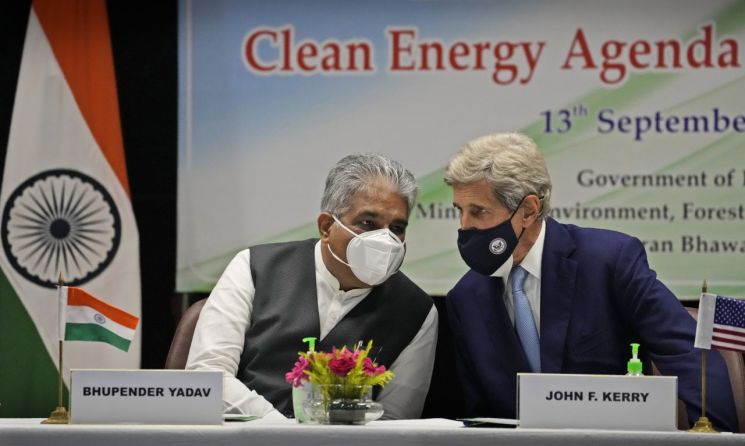 On the 13th of last month (local time), Bhupender Yadav, India's Minister of Environment (left), and John Kerry, the U.S. Special Presidential Envoy for Climate, are seen conversing at a climate response meeting held in New Delhi, India.
 [Image source=AP Yonhap News]
[Asia Economy Reporter Kim Suhwan] India, the world's third-largest carbon emitter, emphasized that setting a Net Zero (net greenhouse gas emissions '0') target cannot be a solution to climate change and that wealthy countries bear the greatest responsibility for climate issues.
According to the AP News on the 28th, Bhupender Yadav, India's Minister of Environment, held a press conference the day before and conveyed the Indian government's position, stating, "Wealthy countries must recognize their own 'historic responsibility' regarding environmental issues."
Minister Yadav added, "India will also participate in efforts to address climate change."
This stance from the Indian government comes ahead of the 26th United Nations Climate Change Conference of the Parties (COP26), scheduled to be held in Glasgow, UK, from the 31st of this month to the 12th of next month.
It is evaluated that India, prioritizing economic growth over solving environmental problems, is showing a passive attitude toward climate change response.
Unlike countries such as the United States, the United Kingdom, and China, India has yet to announce specific carbon reduction targets.
R.P. Gupta, a senior official from the Ministry of Environment who attended the press conference, pointed out, "Accumulated emissions in the atmosphere are the cause of climate change," and "Net Zero itself cannot be a solution."
He added that it is more important to focus on how much carbon each country emits into the atmosphere during the process of reaching the target.
AP News pointed out that although India is currently the world's third-largest carbon emitter, its share of the world's cumulative carbon emissions since the 1850s is only 4%.
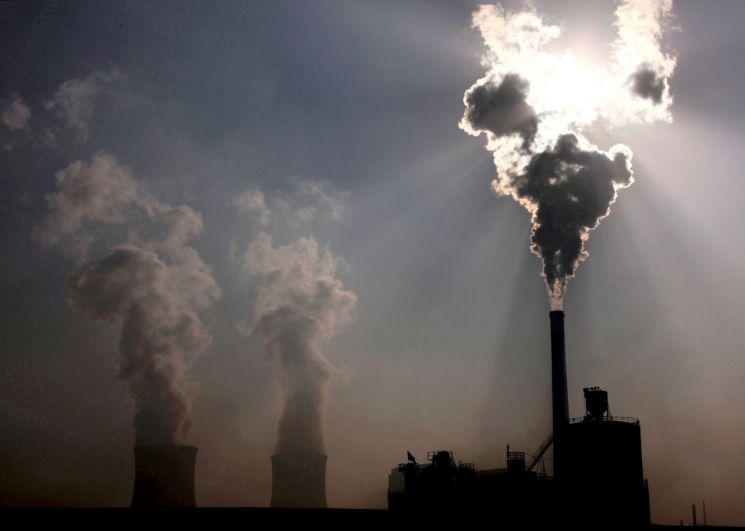
Minister Yadav's emphasis on the 'historic responsibility' of developed countries is analyzed as a reference to this fact.
Developed countries, which have caused air pollution while achieving economic growth until now, should not impose the burden of environmental response on developing countries that are just beginning to develop their economies.
Minister Yadav stated that at this COP26, India will fight for 'climate justice' and will push for measures to make wealthy countries pay for actions to mitigate global temperature rise.
India also expressed that it does not exclude its own carbon reduction efforts.
India has previously set and is pursuing its own goals to reduce carbon emissions, such as securing 450GW of power from renewable energy by 2030.
Minister Yadav emphasized, "India is achieving its targets without the promised financial support from wealthy countries."
Regarding setting new goals for climate change response, he said, "All options are on the table."
Earlier, India's Ministry of Finance estimated the cost of achieving the country's climate goals at $2.5 trillion (approximately 2,925 billion KRW) in 2019.
Minister Yadav stated, "India is committed to finding solutions related to climate change response at this conference (COP26)."
© The Asia Business Daily(www.asiae.co.kr). All rights reserved.
![Clutching a Stolen Dior Bag, Saying "I Hate Being Poor but Real"... The Grotesque Con of a "Human Knockoff" [Slate]](https://cwcontent.asiae.co.kr/asiaresize/183/2026021902243444107_1771435474.jpg)
















