Memory Semiconductors Reach 20.83 Trillion Won... Highest Since Q3 2018
DRAM Quarterly Shipment Sets New Record... Foundry Also Achieves Record Sales
IM Division Up 25% from Previous Quarter... Galaxy Z Fold and Flip3 Drive Success
[Asia Economy Reporters Hyunjin Jeong and Minyoung Cha] Samsung Electronics' record-breaking sales in the third quarter of this year are attributed to outstanding performance across all semiconductor sectors, including memory and foundry (semiconductor contract manufacturing). Semiconductor sales reached an all-time high, surpassing the 2018 "super cycle" (long-term boom), signaling a positive outlook for Samsung Electronics' strong annual performance this year.
Amid expectations of continued parts supply disruptions and uncertainties due to COVID-19 in the fourth quarter of this year and next year, Samsung Electronics has set a strategy to focus on securing technological competitiveness and strengthening profitability.
Memory, the ‘Strength,’ Soared... Foundry Also Achieved Record Sales
Among Samsung Electronics' semiconductors, memory semiconductors, which hold the largest share, recorded sales of 20.83 trillion KRW in the third quarter. This is the highest memory semiconductor sales since surpassing 21 trillion KRW in the third quarter of 2018. In particular, DRAM shipments reached a quarterly record high. NAND flash sales also showed growth due to increased demand for server solid-state drives (SSD) and others. Jinman Han, Vice President of Samsung Electronics' Memory Business Division, explained, "We actively responded to customer demand, expanded the proportion of advanced processes to reduce costs, and achieved significantly improved results compared to the previous quarter."
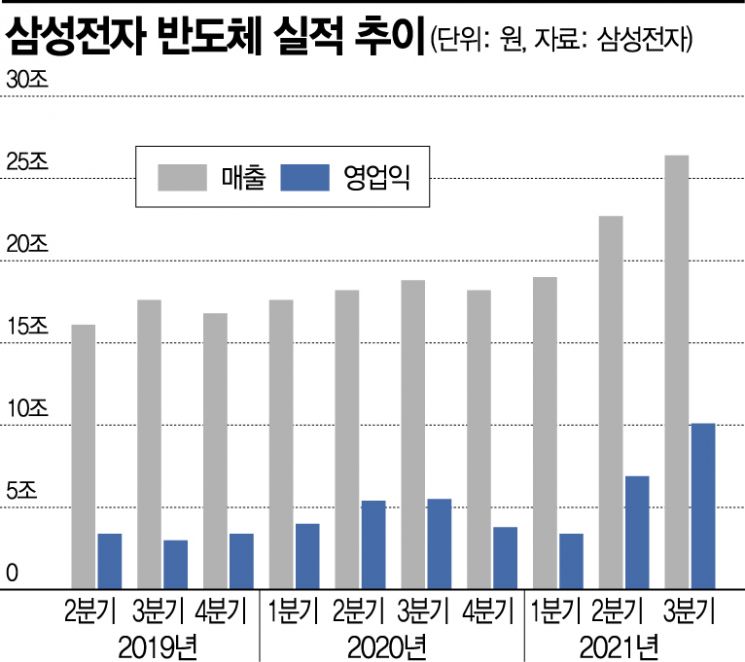
In foundry, Samsung Electronics also recorded its highest-ever sales in the third quarter this year. The expansion of mass production at the Pyeongtaek S5 line significantly increased the supply of advanced process products for global customers. Additionally, Samsung announced that it secured additional advanced process customers and completed the development of the first-generation gate-all-around (GAA) process and design infrastructure for early mass production of 3-nanometer (nm; 1 nm = one billionth of a meter) technology next year.
Whether Samsung Electronics' record-breaking third-quarter performance can continue into the fourth quarter and next year remains uncertain. Although foundry is expected to experience cost increases, global parts supply shortages persist, and there are short-term concerns about price and demand declines for DRAM and NAND. Samsung Electronics stated, "The memory outlook for next year is difficult to specify due to various macro uncertainties such as parts supply issues, the impact of widespread vaccination, and raw material prices," but added, "Demand is expected to remain strong as server and PC capacities increase and corporate IT investments expand."
Foldable Phone Boom, but Parts Supply Remains a Concern
The IT/Mobile (IM) division's sales decreased by 7% year-on-year but increased by 25% compared to the previous quarter. Operating profit also declined by 1.1% compared to the same period last year but improved by 0.12% quarter-on-quarter. Despite industry-wide parts supply issues, the wireless business notably improved its performance compared to the previous quarter.
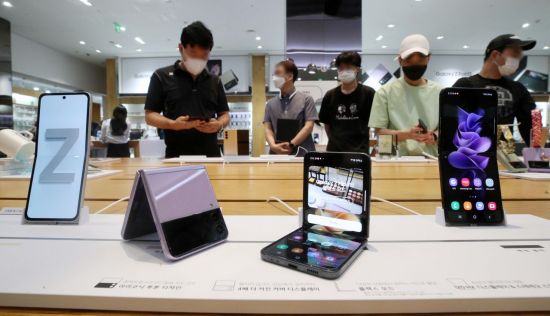
This was largely due to the success of Samsung Electronics' third-generation foldable phone models, the Galaxy Z Fold3 and Galaxy Z Flip3, launched in August. Domestic sales of the Z Flip3 and Z Fold3 surpassed one million units within 39 days of release, marking the third-fastest sales record following the highly successful Galaxy Note10 and Galaxy S8. Growth in the Galaxy ecosystem product lineup and mid-range models such as the Galaxy A series also supported the performance.
However, for the fourth quarter, concerns about a slowdown in the smartphone market due to ongoing semiconductor supply shortages have deepened Samsung Electronics' worries. Market research firm Counterpoint Research recently revised its smartphone sales forecast for this year down to 1.41 billion units, with an annual growth rate of 6%. This is a downward adjustment from the previous forecast of approximately 1.45 billion units, representing about a 9% increase year-on-year. Samsung Electronics plans to expand sales with the Bespoke Edition and maintain momentum for the Galaxy S series to increase premium segment sales.
The display division also achieved record third-quarter profits due to improved profitability from increased sales of high-performance products, including foldable displays. However, results varied by product category. Small and medium-sized displays saw increased performance due to new product launches by major smartphone customers, while large displays continued to incur losses due to price declines in liquid crystal displays (LCDs). Samsung Electronics expects sales and operating profit growth in the fourth quarter through new product demand from major customers for small and medium-sized displays and expanded sales of laptops and gaming devices. For large displays, the focus is on the full-scale mass production of the first quantum dot (QD) display products. The consumer electronics (CE) division saw reduced profitability due to the waning "pent-up" demand effect from COVID-19 and increased burdens from rising raw material and logistics costs.
Samsung Electronics stated that, keeping in mind the expansion of offline sales with the "gradual return to normal life (With COVID-19)" policy, it will accelerate the global expansion of the customized home appliance Bespoke line and strengthen promotional activities targeting the year-end shopping season to enhance profitability.
© The Asia Business Daily(www.asiae.co.kr). All rights reserved.
![Clutching a Stolen Dior Bag, Saying "I Hate Being Poor but Real"... The Grotesque Con of a "Human Knockoff" [Slate]](https://cwcontent.asiae.co.kr/asiaresize/183/2026021902243444107_1771435474.jpg)

















