Recommendation to Establish Emergency Measures Regulation in Sexual Violence Punishment Act
Currently, Only Requests to the Korea Communications Standards Commission Are Possible
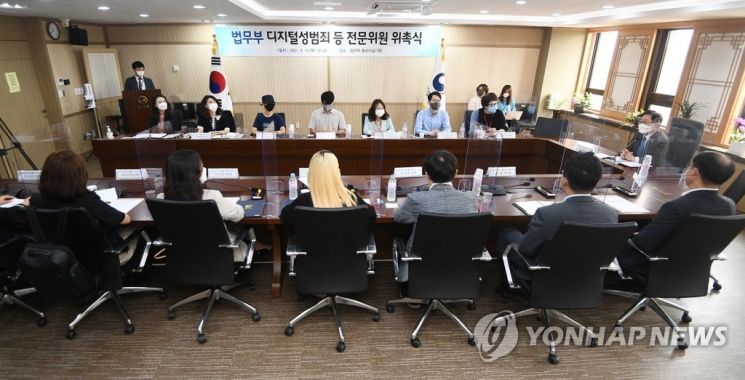 On the morning of August 12, the 'Digital Sex Crime Expert Committee Appointment Ceremony' was held at the Gwacheon Ministry of Justice building.
[Asia Economy Choi Seok-jin, Legal Affairs Specialist Reporter] The Ministry of Justice is considering the establishment of an emergency measure clause that allows investigative agencies to directly request information and communication service providers to delete or block victim videos in order to enable rapid initial response to the continuously increasing digital sex crimes.
On the 28th, the Ministry of Justice announced that the Ministry of Justice Digital Sex Crime Expert Committee (Chairperson Byun Young-joo) deliberated and resolved a plan to establish an 'Emergency Measure for Digital Sex Crimes' with this content as the main point on the 20th.
According to the Ministry of Justice, the committee recommended the establishment of emergency measure regulations related to the deletion and blocking of victim videos in the Sexual Violence Punishment Act, etc., to quickly prevent the spread of harm in the early stages of digital sex crimes.
Specifically, ▲introducing an emergency measure system that allows investigative agencies to actively intervene by requesting 'deletion/blocking of illegal videos' or issuing 'warnings for restraint and punishment of criminal acts' when receiving reports of digital sex crime victims or discovering crime scenes ▲reviewing and developing technical measures to display 'warnings for restraint and punishment of criminal acts' on closed platforms such as the dark web, and recommending the establishment of a system that can enhance the effectiveness of emergency measures through the deployment of specialized personnel and preparation of detailed manuals.
Under the current Information and Communications Network Act and the Korea Communications Commission Act, investigative agencies, despite recognizing victimization relatively early in the case, lack legal grounds to directly request internet service providers to delete or block victim videos, and must request this through the Korea Communications Standards Commission. Subsequently, the Korea Communications Standards Commission requests voluntary regulatory measures from internet service providers or, after review, issues correction demands, and only if these are not complied with can deletion orders be issued.
The committee explained the background of the recommendation, stating, "Although digital sex crimes continue to increase due to the widespread internet environment, victim videos are not deleted or blocked promptly, and even during judicial procedures against perpetrators or deletion/blocking processes, victim videos remain exposed to the risk of distribution. Therefore, it is necessary to take proactive measures at the initial stage to prevent the spread of victim videos."
It added, "Due to the nature of digital sex crimes, early blocking and deletion of victim videos is very important, and for victim protection and prevention of victim video spread, rapid and direct action by investigative agencies at the early stages of reporting and recognition is necessary."
The committee recommended the establishment of Article 14-4 concerning emergency measures in the Sexual Violence Punishment Act.
The emergency measure regulation includes obligating judicial police officers who receive reports related to sexual crime victim videos or discover violations or suspected violations to immediately take actions such as ▲evidencing victim videos and requesting deletion/blocking of the videos or bulletin boards from information and communication service providers or bulletin board managers/operators ▲restraining criminal acts and issuing punishment warnings ▲guiding related procedures such as victim reporting and deletion requests ▲and, if the victim consents, transferring the victim to counseling centers or protection facilities.
However, the Ministry of Justice stated that this recommendation has not yet been finalized as a Ministry of Justice proposal and that legal reviews and consultations with related ministries will be discussed as part of the legislative process.
According to the Supreme Prosecutors' Office Crime Trend Report, the number of camera-related filming offenses increased by 448% from 1,153 cases in 2010 to 5,168 cases in 2020. During the same period, obscene acts using communication media increased by 200% from 1,031 cases to 2,071 cases.
According to the Korea Communications Standards Commission's review status of digital sex crime information, the number of reviews sharply increased from 17,486 cases in 2018 to 25,992 cases in 2019, and 35,603 cases last year.
The committee stated that through the establishment of such emergency measure regulations, it expects not only to strengthen the effectiveness of victim support but also to reduce social costs by preventing the spread of secondary damage.
© The Asia Business Daily(www.asiae.co.kr). All rights reserved.
![Clutching a Stolen Dior Bag, Saying "I Hate Being Poor but Real"... The Grotesque Con of a "Human Knockoff" [Slate]](https://cwcontent.asiae.co.kr/asiaresize/183/2026021902243444107_1771435474.jpg)
















