Korea National Oil Corporation Sells Half of Overseas Resources Including US Anchor Offshore Oil Field Hastily
Moon Administration's 'MB Resource Diplomacy Cancellation' Impact... Concerns Over Undervalued Sales Amid Rising Oil and Mineral Prices
Insufficient for Financial Structure Improvement... Resource Policy Needs Reestablishment for Resource Security Perspective
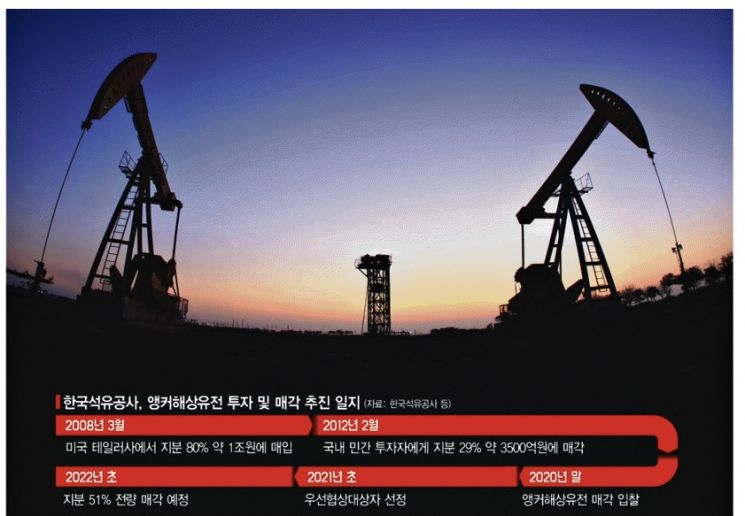
[Sejong=Asia Economy Reporter Kwon Haeyoung] Korea National Oil Corporation (KNOC) recently views the surge in international oil prices as an opportunity to sell oil fields. With prices surpassing $80 per barrel, reaching the highest level in seven years, and amid intensifying resource acquisition competition, KNOC’s stance to hasten asset sales remains unchanged. Most of the investment costs were financed through borrowing, severely deteriorating the financial structure, prompting the company to accept principal losses to proceed with sales. Although KNOC’s lack of large-scale investment experience and reckless overseas asset shopping during the MB (President Lee Myung-bak) administration largely contributed to the current difficulties, there are calls to reconsider sales at a time when resource importance is emphasized. Additionally, some advise revisiting the current administration’s resource policies, which have been left unattended after completely scrapping the previous government’s resource policies labeled as 'deep-rooted evils.'
◆ Offshore Oil Reserves of 28.3 Million Barrels... Forced Sales= According to KNOC on the 28th, the company produces an average of 3,600 barrels of oil and gas per day from the Anchor offshore oil field in the U.S., based on its share, with reserves amounting to 28.3 million barrels. The West Texas Intermediate (WTI) price was $82.6 per barrel on the 27th (local time), valuing KNOC’s share of the Anchor offshore oil and gas reserves at approximately $2.338 billion (about 2.74 trillion KRW). KNOC explains that the need to improve financial structure and declining economic viability of the oil field make sales inevitable, and the recent rise in oil prices has created a favorable environment. However, considering the oil field’s value, there is a high possibility of a 'fire sale.'
Concerns also exist that the original investment principal may not be recovered. KNOC has invested $898 million in the Anchor offshore oil field so far and recovered $574 million. To break even, it needs to receive more than $324 million, but the current sale price under discussion is reported to be below this amount. The government anticipates potential sale losses and has allocated a budget to compensate general investors who invested in this oil field through a fund. This is due to the introduction of an investment risk guarantee program in 2006 to partially compensate for investment losses and activate overseas resource development funds.
The future looks even more problematic. KNOC is currently pushing to sell assets in 6 countries and 13 blocks, nearly half of the 31 blocks it holds across 17 countries. While it is necessary to dispose of poor assets, there are considerable concerns that even prime assets might be sold off prematurely given the nature of resource development, which requires mid- to long-term investment in exploration and development costs. Earlier this year, KNOC sold Sabia Peru, a Peruvian oil company it purchased in 2009 for 800 billion KRW, for 2.8 billion KRW. Similarly, the Korea Resources Corporation sold the Santo Domingo copper mine in Chile at the beginning of the year for $120 million, half of the purchase price of $250 million.
Professor Kang Cheong-gu, a visiting professor in the Department of Energy Resources Engineering at Inha University, pointed out, "Most resource development targets existing blocks and oil fields, and profitability can be sufficiently improved through technological and equipment advancements. Selling overseas assets cheaply at this point, citing declining economic viability of blocks, is not advisable."
◆ Insufficient for Financial Structure Improvement... Resource Development Must Continue= The rushed sale of overseas assets by resource public enterprises, including KNOC, stems from the current government’s 'complete cancellation of MB’s resource diplomacy.' The 'Overseas Resource Development Innovation Task Force (TF)' established under the Ministry of Trade, Industry and Energy in 2017, the year the Moon Jae-in administration began, recommended in 2018 that Korea Mineral Resources Corporation (now Korea Mine Reclamation Corporation) sell all its overseas assets. In April this year, it issued a recommendation for KNOC and Korea Gas Corporation to prioritize selling overseas assets according to their own roadmaps, and if sales do not proceed, to allow third-party intervention. This effectively stigmatized all overseas resource development relying on borrowing as 'non-performing' and completely discarded the previous government’s resource policies.
However, even with KNOC’s successive overseas asset sales, it is insufficient to improve the current poor financial structure. At the end of 2020, KNOC posted a net loss of 2.4392 trillion KRW and had a capital deficit of 1.1409 trillion KRW, entering a capital erosion state for the first time since its establishment in 1979. Its liabilities stand at 18.645 trillion KRW, and interest expenses to be borne from this year through 2025 amount to 2 trillion KRW. This exceeds the level that KNOC can manage through overseas asset sales.
Experts advise the government to reestablish mid- to long-term resource policies from the perspective of 'resource security.' They suggest halting sales of prime overseas assets with development potential through a thorough evaluation of overseas assets held by resource public enterprises such as KNOC, and that the government actively support management normalization alongside these companies’ self-help efforts. There are also growing calls to integrate KNOC and Korea Gas Corporation in the mid- to long-term to restore resource exploration and development functions and strengthen resource security capabilities.
Countries like China and Japan are fiercely competing to secure key resources, almost resembling a resource war. Resource development is essential to prepare for the global trend of resource weaponization. Russia, despite soaring natural gas prices in Europe, had not increased gas supply but on this day ordered the state energy company Gazprom to supply gas to storage facilities in Europe.
Professor Kang said, "Resource development is a business where it takes 10 to 20 years to see results even if you start now. For the future, the government should pursue policies to reengage in resource development."
© The Asia Business Daily(www.asiae.co.kr). All rights reserved.
![Clutching a Stolen Dior Bag, Saying "I Hate Being Poor but Real"... The Grotesque Con of a "Human Knockoff" [Slate]](https://cwcontent.asiae.co.kr/asiaresize/183/2026021902243444107_1771435474.jpg)















