Conflicting Evaluations of 'President Roh Tae-woo'... Controversy Over 'State Funeral'
Government to Hold State Funeral but President Moon to Skip Condolences
Progressive Camp and Gwangju 5·18 Groups "Strong Regret Over State Funeral Decision"
Debate Over 'State Funeral' Among Citizens
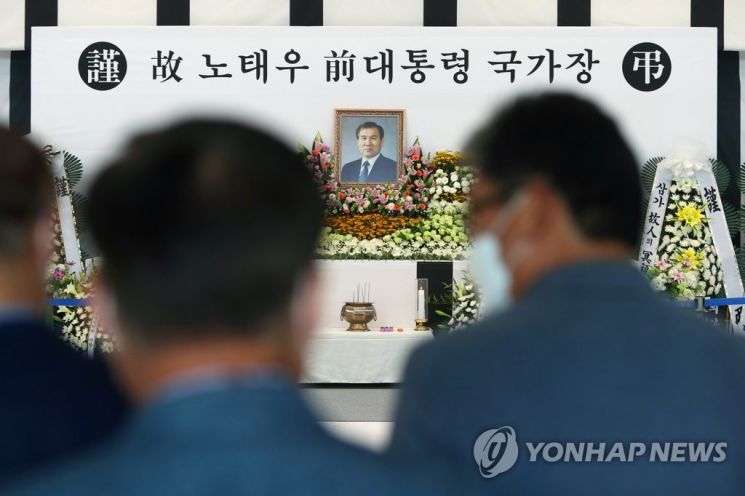 On the 27th, when the government decided to hold the state funeral for former President Roh Tae-woo for five days, citizens are paying their respects to the deceased at the state funeral altar set up at the An Byeong-geun Olympic Memorial Judo Gymnasium in Dalseo-gu, Daegu.
 [Image source=Yonhap News]
[Asia Economy Reporter Yoon Seul-gi] Former President Roh Tae-woo passed away on the 26th at the age of 89 after a long illness. The government decided to hold a state funeral in recognition of Roh’s contributions as president, including the introduction of direct presidential elections and the Northern Policy. However, some progressive groups and 5.18 organizations have opposed this, arguing that such honors are inappropriate for someone who violated the constitutional order. Among citizens, opinions on Roh’s achievements are divided, sparking debates over the state funeral.
On the morning of the 27th, the government held a Cabinet meeting and decided to hold Roh’s funeral as a state funeral but not to inter him in the National Cemetery. On the same day, President Moon Jae-in stated, "Former President Roh Tae-woo had significant historical faults, including the forced suppression of the May 18 Democratic Movement and the December 12 military coup, but he also had achievements such as the successful hosting of the 1988 Seoul Olympics, the promotion of the Northern Policy, and the adoption of the South-North Basic Agreement."
However, President Moon decided not to pay a personal condolence visit. This appears to be a decision that respects the deceased’s merits while being mindful of criticism regarding historical faults such as the May 18 civilian massacre.
The state funeral is stipulated to be held when a former or incumbent president or a person who has made remarkable contributions to the nation or society and is revered by the people passes away. The Minister of the Interior and Safety requests the Cabinet’s deliberation, after which the president decides whether to hold a state funeral.
The Ministry of the Interior and Safety announced that Prime Minister Kim Boo-kyum will serve as the funeral committee chairman for former President Roh Tae-woo’s state funeral, and Minister Jeon Hae-cheol of the Ministry of the Interior and Safety will serve as the funeral execution committee chairman. Prime Minister Kim presided over the Cabinet meeting and said, "The government will hold this funeral as a state funeral to honor the deceased’s achievements and ensure proper respect together with the people."
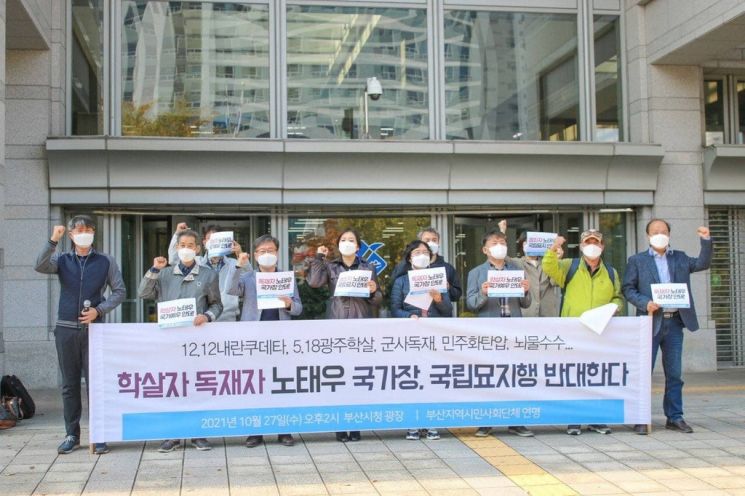 Busan civic groups are holding a press conference opposing the state funeral for Roh Tae-woo.
 [Image source=Yonhap News]
◆ "Historical Judgment Not Over"... Progressive Camp and Gwangju 5.18-Related Groups Oppose
Despite the government’s 'compromise' of holding a state funeral for Roh but omitting President Moon’s condolence visit, dissatisfaction with the state funeral remains. On the 27th, when Roh’s state funeral was decided, all Democratic Party lawmakers from the Gwangju region (Min Hyung-bae, Song Gap-seok, Yoon Young-duk, Lee Byung-hoon, Lee Yong-bin, Lee Hyung-seok, Jo Oh-seop) issued a statement opposing the state funeral, saying, "The historical judgment is not over, and we oppose Roh Tae-woo’s state funeral."
They said, "The State Funeral Act aims to contribute to national unity by solemnly conducting the funeral of a person who has made remarkable contributions to the nation or society and is revered by the people. The honor of a state funeral cannot be accepted simply because he was a former president. Roh Tae-woo was the second-in-command of the new military regime that seized power through the December 12 military rebellion alongside Chun Doo-hwan, was one of those responsible for violently suppressing the May 18 Democratic Movement, and is a serious criminal convicted of rebellion, treason, and murder for the purpose of rebellion."
Regarding the introduction of direct presidential elections, which is cited as one of Roh’s achievements, they argued, "The direct presidential election system, created through the devoted blood of the people and democratic martyrs, is being falsely portrayed as Roh Tae-woo’s benevolence. For those resting in the graves of young national democratic martyrs who sacrificed their youth and lives for democracy, Roh Tae-woo’s state funeral is nothing but a luxury."
Democratization movement-related organizations also opposed the government’s decision. The May 18 Memorial Foundation, the Bu-Ma Democratic Uprising Memorial Foundation, and the Democratization Movement Commemoration Association issued a joint statement saying, "Roh Tae-woo, along with Chun Doo-hwan, staged the December 12 military rebellion, violated the constitutional order, and was one of those responsible for violently suppressing the May 18 Democratic Movement. In 1997, he was sentenced by the Supreme Court to 17 years in prison and fined over 260 billion won for charges including treason and bribery." They expressed strong regret over the government’s decision.
Twenty-five civic groups in Busan, including the Busan People’s Solidarity and the Catholic Diocese of Busan Justice and Peace Committee, held an emergency press conference in front of Busan City Hall the same afternoon, claiming, "Holding a state funeral and considering interment in the National Cemetery for the main actors of the December 12 coup, the May 18 massacre perpetrators, and military dictators is a crime against history."
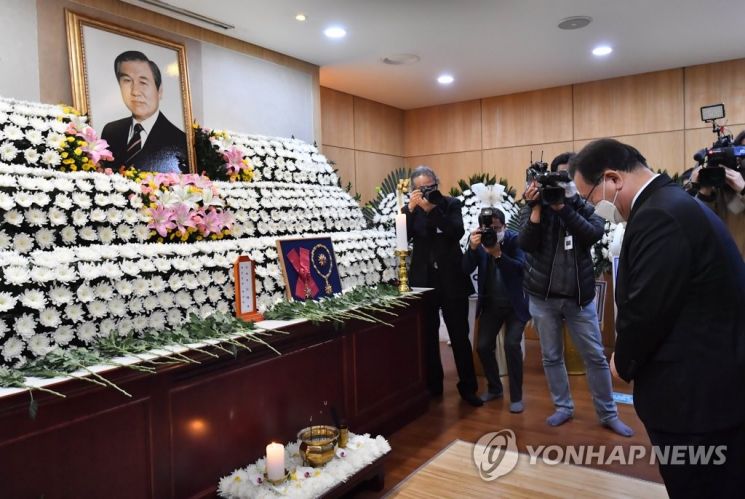 Prime Minister Kim Boo-kyum is paying his respects at the funeral hall of the late former President Roh Tae-woo, set up at Seoul National University Hospital in Jongno-gu, Seoul, on the 27th.
 [Image source=Yonhap News]
◆ 'Roh Tae-woo State Funeral,' Mixed Reactions Among Citizens
As evaluations of Roh’s merits and faults differ, debates over the state funeral have ignited among citizens. A 20-something office worker, Mr. A, said, "There are unforgivable faults. Roh Tae-woo is not a candidate for a state funeral," adding, "He was blinded by lust for power, staged a coup with Chun Doo-hwan, and massacred civilians in Gwangju. Although Roh’s son apologized again, I don’t think forgiveness is possible."
A 40-something office worker, Mr. B, also said, "It is hard to accept the government’s decision to hold a state funeral. I don’t think it is appropriate." He added, "If this precedent is set, I worry that Chun Doo-hwan will also be given a state funeral. Both Chun and Roh are equally responsible for the Gwangju massacre, so how can they be honored with a state funeral?"
However, some believe Roh’s achievements as a former president should be recognized. A 20-something university student, Mr. C, said, "It is true that President Roh left an indelible wound in Gwangju, but since he was a president, he should be given at least minimal respect. His Northern Policy and diplomatic achievements are also facts."
Meanwhile, Roh’s son, Roh Jae-heon, revealed his father’s last will on the 27th, asking for forgiveness from the May 18 victims. Having visited Gwangju several times to apologize on behalf of his father for the violent suppression of the May 18 Democratic Movement, Roh Jae-heon said, "My father had great thoughts and responsibility toward the nation and considered all his actions, good and bad, as his unlimited responsibility. Especially regarding the painful parts related to the May 18 victims and various incidents during his tenure, he hoped for generous forgiveness if there were any responsibilities or faults."
Meanwhile, the government’s stance on the controversy over Roh’s state funeral is to review his merits and faults and engage in social deliberation. Prime Minister Kim said, "As I have repeatedly said, I believe it is time to evaluate our history by recognizing merits as merits and faults as faults. (The state funeral for former President Roh) can be seen as a step forward in overcoming the twists and turns of our modern history." He added, "According to what the bereaved son conveyed, the deceased left many words of apology to the people, and the bereaved family also reflected on the historical faults and offered sincere apologies. These were the grounds for the government’s decision to hold a state funeral."
© The Asia Business Daily(www.asiae.co.kr). All rights reserved.
![Clutching a Stolen Dior Bag, Saying "I Hate Being Poor but Real"... The Grotesque Con of a "Human Knockoff" [Slate]](https://cwcontent.asiae.co.kr/asiaresize/183/2026021902243444107_1771435474.jpg)

















