GM and Ford Q3 Net Profit Down 40% and 25% Respectively
Warning of Cost Pressure from Rising Raw Material Prices
"Price Increase Inevitable Due to Chip Shortage Impact"
[Asia Economy Reporter Yujin Cho] The two major U.S. automakers, General Motors (GM) and Ford, both saw their profits sharply decline in the third quarter due to the semiconductor chip shortage. The supply chain disruption and rising raw material prices are expected to continue negatively impacting their performance in the fourth quarter and next year.
According to the Wall Street Journal (WSJ) and each company's IR materials on the 27th (local time), GM's third-quarter net profit was $2.4 billion (approximately 2.8128 trillion KRW), down about 40% from $4 billion in the same period last year. Revenue recorded $26.8 billion, a 25% decrease compared to $35.5 billion in the previous year.
The sharp decline in third-quarter net profit is attributed to production cuts and high raw material costs. The spread of the Delta variant in Southeast Asia, including Malaysia, significantly reduced chip supply, leading to production cuts, and the rising prices of semiconductors and various raw materials increased cost burdens.
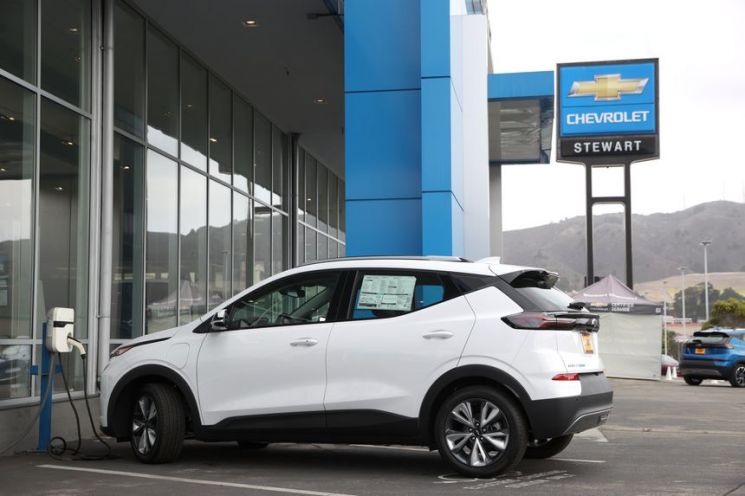
WSJ analyzed that GM minimized the deterioration in performance by focusing production on high-margin sports utility vehicles (SUVs) and trucks. Additionally, GM received $1.9 billion in compensation from LG Chem related to recall costs from fire incidents involving the electric vehicle 'Chevrolet Bolt,' which also helped reduce the decline in profits.
GM Chief Financial Officer (CFO) Paul Jacobson said, "We expect the chip shortage to somewhat ease in the fourth quarter, but we anticipate facing cost pressures due to increased spending associated with the business shift toward becoming a fully electric vehicle company and rising raw material prices."
CFO Jacobson also stated, "The impact of the chip shortage will gradually ease next year," but warned, "Due to high demand, it will be difficult to build up inventory, so consumer prices are expected to rise."
Last month, GM predicted that production in the second half of this year would decrease by 200,000 units compared to the first half due to semiconductor shortages and other supply chain issues. Most of the damage was concentrated in the third quarter, with GM's production volume hitting a low. GM's shipments in North America dropped to about 423,000 units, half of the same period last year.
GM, seeking transformation into an electric vehicle company, also revealed plans to catch up with the leader Tesla within four years. CEO Mary Barra said in an interview with CNBC, "We will definitely catch up with Tesla in terms of sales volume by 2025."
However, regarding the semiconductor supply shortage, she noted, "There is still volatility," and predicted that "the situation will continue into the first half of next year."
Meanwhile, Ford also saw profits sharply decline amid semiconductor supply shortages but posted results better than market expectations. Ford's third-quarter revenue was $35.7 billion, down 5% from $37.5 billion in the same period last year, and net profit was $1.8 billion, a 25% decrease from $2.4 billion the previous year.
Earnings per share were 51 cents, nearly double the market consensus of 27 cents compiled by financial information firm Refinitiv.
Ford CFO John Lawler said, "The chip shortage remains fluid, but North American shipments have increased since the second quarter," and raised the full-year adjusted EBIT forecast from $9 billion?$10 billion to $10.5 billion?$11.5 billion.
However, he warned that rising steel and aluminum prices are expected to cause a $1.5 billion cost burden next year and that inflationary pressures will broadly impact business activities.
Earlier, Tesla, the first among U.S. automakers to announce earnings, recorded six consecutive quarters of revenue growth despite the semiconductor shortage. Tesla announced on the 20th that its third-quarter revenue was $13.76 billion, more than 50% increase from $8.77 billion in the same period last year.
This marks six consecutive quarters of record revenue since the second quarter of last year, surpassing Wall Street analysts' expectations of $13.63 billion. Quarterly net profit for the same period was $1.62 billion, nearly four times (389%) higher than $331 million in the previous year.
Due to the strong performance and resulting stock price surge, Tesla's market capitalization exceeded $1 trillion on the 26th. Based on the closing price that day, Tesla's market cap was $1.042 trillion, about 12 times that of GM ($78.7 billion) and Ford ($61.9 billion).
© The Asia Business Daily(www.asiae.co.kr). All rights reserved.
![Clutching a Stolen Dior Bag, Saying "I Hate Being Poor but Real"... The Grotesque Con of a "Human Knockoff" [Slate]](https://cwcontent.asiae.co.kr/asiaresize/183/2026021902243444107_1771435474.jpg)
















