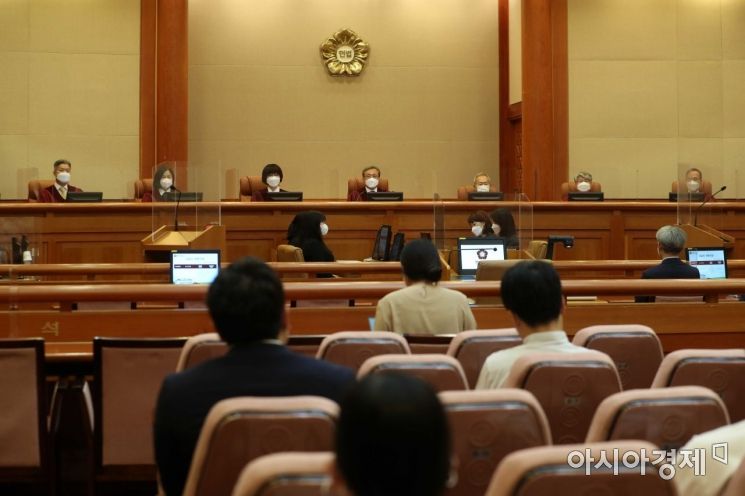
 On August 10, Yoon Nam-seok, Chief Justice of the Constitutional Court, and the justices attended the final arguments of the impeachment trial of former Chief Judge Lim Seong-geun at the Grand Bench of the Constitutional Court in Jaedong, Jongno-gu, Seoul, waiting for the trial to begin. Photo by Moon Ho-nam munonam@
[Asia Economy Reporter Choi Seok-jin, Legal Affairs Specialist] The decision on whether to dismiss former Busan High Court Chief Judge Im Seong-geun, who is accused of involvement in three trials including the defamation case of former Sankei Shimbun Seoul Bureau Chief Kato Tatsuya, will be made on the 28th.
This case, the first impeachment of a judge in constitutional history, draws attention as it contains important constitutional issues such as whether dismissal is possible for a public official who has already retired and the limits of judicial independence.
The Constitutional Court will hold a ruling session on the impeachment petition against former Chief Judge Im at 2 p.m. on the same day at the Grand Bench of the Constitutional Court in Jaedong, Jongno-gu, Seoul.
Former Chief Judge Im was impeached on charges of unlawfully interfering in trials by requesting an interim judgment in the case of former Bureau Chief Kato Tatsuya and requesting revisions after the verdict was delivered in the case involving lawyers from the Lawyers for a Democratic Society (Minbyun) who were charged with assault during an arrest. In the professional baseball player gambling case, he is also accused of calling a judge who referred a summary order case to a formal trial procedure and encouraging him to seek more opinions from surrounding judges.
In the criminal trials conducted for the same reasons, former Chief Judge Im was acquitted of abuse of authority charges in both the first and second trials.
The impeachment system is a procedure to remove from public office presidents, prime ministers, cabinet members, judges, etc., whose constitutional status is guaranteed by the Constitution, if they violate the Constitution or laws during the execution of their duties.
Therefore, if the Constitutional Court accepts the respondent’s argument that “a dismissal decision for former Chief Judge Im, who has already retired due to term expiration, is impossible and there is no benefit to the trial,” it will issue a dismissal decision.
On the other hand, even if the Constitutional Court finds that a dismissal decision for former Chief Judge Im is impossible, it may recognize exceptional trial benefits if it deems that judging whether his actions infringed judicial independence has constitutional significance, or if it considers that retroactive dismissal decisions are possible for retired public officials, thereby issuing a substantive ruling.
At the previous hearing, the petitioner (prosecutor) argued that former Chief Judge Im, in his position as Chief Criminal Judge, exercised influence over judges belonging to the same Seoul Central District Court, constituting an unconstitutional act that infringed on judicial independence through “instructions” or “coercion.” They also emphasized that an order form that retroactively dismisses him before the expiration of his term is possible.
In contrast, former Chief Judge Im’s side rebutted by presenting testimonies from junior judges submitted in his criminal trial and statements made in court, arguing that it was merely “advice” or “recommendation” from a senior judge with whom he had a close relationship and could not be seen as an infringement of judicial independence, and that dismissal of a public official who has already retired is impossible.
The Constitutional Court requires the approval of six or more justices to accept the impeachment petition.
However, even if the majority of the Constitutional Court justices issue opinions for dismissal, or if five of the nine justices support acceptance but fall short of the six votes needed for a decision to accept, and the Court issues a dismissal or rejection decision, it is widely expected that the dissenting opinions contained in the decision documents, apart from the official court opinion (the Constitutional Court’s final stance), will point out the unconstitutionality of former Chief Judge Im’s involvement in the trials.
© The Asia Business Daily(www.asiae.co.kr). All rights reserved.
![Clutching a Stolen Dior Bag, Saying "I Hate Being Poor but Real"... The Grotesque Con of a "Human Knockoff" [Slate]](https://cwcontent.asiae.co.kr/asiaresize/183/2026021902243444107_1771435474.jpg)















