National Research Institute Service Report Mentions Pros and Cons
"Excessive" "Wealthy Tax Cuts" Tense... Full-Scale Reform Discussions Not Easy
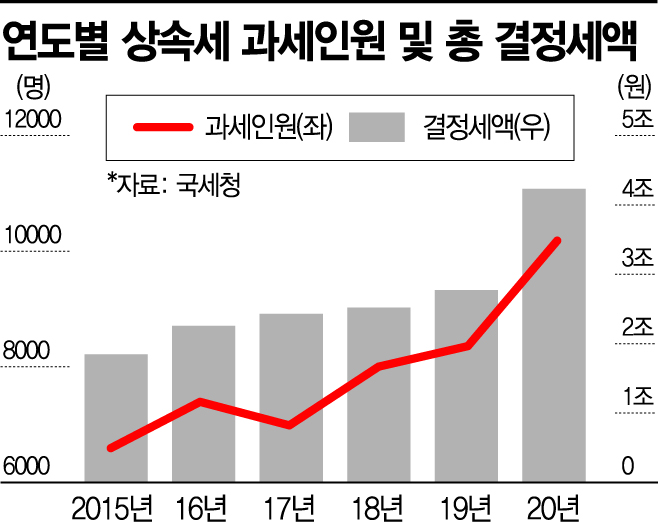
[Sejong=Asia Economy Reporter Kim Hyunjung] Discussions on inheritance tax reform are expected to be passed on to the next government. This is because concerns about excessive tax burdens and criticisms that the tax cuts favoring the wealthy exacerbate polarization are clashing, and the research report, which is expected to be submitted to the National Assembly soon, is likely to lean toward a 'neutral' stance. In particular, since the ruling party is also lukewarm, even if the government submits the research report to the National Assembly next month, full-scale reform discussions are unlikely to proceed easily. Some businesspeople who had hoped for benefits such as the business succession deduction are pointing out that the period of false hope may only be getting longer.
According to the government and the National Assembly on the 27th, the research report on inheritance tax reform commissioned by the Ministry of Economy and Finance to the Korea Institute of Public Finance will be completed within this month and submitted to the National Assembly early next month.
After the death of the late Lee Kun-hee, chairman of Samsung Group, it became known that his heirs would have to pay more than 12 trillion won in inheritance tax, which is over half of the total estate, raising concerns mainly among the business community and the market that the tax burden is excessive. On the other hand, some argue that under the current system, only a very small number of heirs (2.4% as of 2019) pay inheritance tax, and that tax cuts for the very top could further deepen polarization.
Within the Democratic Party and the government, it is widely expected that the research report will present a 'neutral proposal' describing the pros and cons, and that the government will use this as a basis to pass the responsibility to the National Assembly. A ruling party official said, "The Korea Institute of Public Finance's research will likely neutrally describe the advantages and disadvantages of each option," adding, "Based on this, the Ministry of Economy and Finance will present the opinion that it is a matter for the National Assembly to decide."
Inheritance tax reform emerged as an issue when Deputy Prime Minister and Minister of Economy and Finance Hong Nam-ki mentioned at the National Assembly's Budget Committee audit earlier this month that "a plan to reform the inheritance tax system is being developed." When Democratic Party lawmaker Yang Hyang-ja pointed out the burden of corporate inheritance tax, Hong explained, "We are reviewing the entire inheritance tax system this year." He also added regarding the introduction of an estate acquisition tax, "We will consider it together when reviewing the overall system."
The key issues include ▲ adjustment of inheritance tax rates and taxable income brackets ▲ transition to an estate acquisition tax system ▲ consistency with gift tax, among others. The inheritance tax rate system, which imposes a top rate of 50% on taxable income exceeding 3 billion won, has been maintained for 22 years since the 1999 tax law revision. There are conflicting views between those who argue that the function of inheritance tax should be strengthened amid worsening wealth inequality and those who believe the current inheritance tax burden is excessive. South Korea's inheritance tax rate is the second highest among OECD countries after Japan (55%). It is similar to European countries such as Switzerland (50%) and France (45%) and higher than the United States (40%).
The transition to an estate acquisition tax is also a hot topic. Currently, taxation is based on the decedent's total estate, but the main point is that the tax amount should be calculated based on the estate acquired by the heir. Additionally, there are calls to extend the installment payment period for inheritance tax, which is currently up to five years.
The issue of consistency with gift tax is also controversial. If inheritance tax is converted to an estate acquisition tax system, a comprehensive review of the tax system is necessary to maintain consistency with the current gift tax system, which is based on acquisition tax, including taxable income brackets and deductions (income deduction, tax credit).
As the reform process is expected to lack momentum, there are concerns that small and medium-sized enterprises, which had hoped for a reduction in tax burden during business succession, are being given false hope. Under current law, in addition to the basic deduction, the business succession deduction limit is 50 billion won, and for agricultural succession, it is 1.5 billion won. The ruling party is reportedly of the view that once the research report is submitted, a public discussion process should be conducted and the reform should be prioritized after the new government takes office.
© The Asia Business Daily(www.asiae.co.kr). All rights reserved.
![Clutching a Stolen Dior Bag, Saying "I Hate Being Poor but Real"... The Grotesque Con of a "Human Knockoff" [Slate]](https://cwcontent.asiae.co.kr/asiaresize/183/2026021902243444107_1771435474.jpg)















