Partial Amendment to the Private School Teachers' Pension Act
Partial Amendment to the National Health Insurance Act
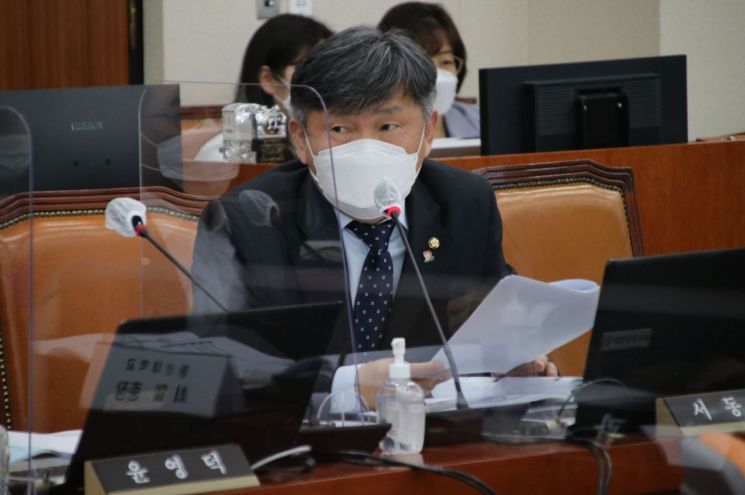
[Asia Economy Honam Reporting Headquarters, Reporter Heo Seon-sik] On the 27th, Seo Dong-yong, a member of the National Assembly's Education Committee from the Democratic Party of Korea (representing Jeonnam Suncheon-si, Gwangyang-si, Gokseong-gun, Gurye-gun), announced that he has taken the lead in proposing the 「Higher Education Finance Grant Act」, the 「Partial Amendment to the Private School Faculty Pension Act」, and the 「Partial Amendment to the National Health Insurance Act」 to overcome the crisis in higher education and expand publicness.
Although South Korea's economy ranks among the top 10 worldwide, public sector investment in higher education stands at only about 0.7% of GDP, significantly below the OECD major countries' average of 1.1%. Excluding national scholarships paid directly to individuals, this figure drops to approximately 0.4%.
Due to insufficient national support for higher education, university finances in South Korea rely excessively on tuition fees, causing students and parents to suffer from having to afford some of the highest tuition fees in the world. To make matters worse, with the rapid decline in the school-age population, universities are struggling even to secure the basic funding necessary for their operations.
In response, Representative Seo Dong-yong has taken the lead in proposing the 「Higher Education Finance Grant Act」, which mandates that a certain percentage of domestic taxes be allocated as grants for higher education, with the total grant amount set to be at least 1.1% of the Gross Domestic Product (GDP). The secured budget will be divided into general grants for university operating expenses and educational and research development, and project grants for university diversification, specialization, and regional balanced development.
The bill also includes provisions to prevent indiscriminate financial support to failing or marginal universities. Universities designated as excluded from national financial support in the university basic competency diagnosis, or those that do not cover a certain amount of their operating expenses as stipulated by law, will be ineligible to receive grants if they fail to fulfill their operational duties and responsibilities.
Representative Seo Dong-yong stated, “The higher education ecosystem is on the brink of collapse due to the rapid decline in the school-age population compounded by the COVID-19 crisis. The crisis in higher education is a crisis in national competitiveness. To enhance the competitiveness and publicness of higher education, public investment must be expanded. By enacting the Higher Education Finance Grant Act, we will establish a support system for the stable and sustainable development of higher education.”
Asia Economy Honam Reporting Headquarters, Reporter Heo Seon-sik hss79@asiae.co.kr
© The Asia Business Daily(www.asiae.co.kr). All rights reserved.
![Clutching a Stolen Dior Bag, Saying "I Hate Being Poor but Real"... The Grotesque Con of a "Human Knockoff" [Slate]](https://cwcontent.asiae.co.kr/asiaresize/183/2026021902243444107_1771435474.jpg)















