Scenario Plan A, Complete Halt of Thermal Power Generation · Plan B, LNG Maintained
NDC 40% Reduction
Government to Announce NDC Target to International Community at COP26 Next Month
[Sejong=Asia Economy Reporter Joo Sang-don] The '2050 Carbon Neutrality Scenario' to achieve net-zero greenhouse gas emissions by 2050 was finalized on the 27th. Two scenarios were ultimately prepared: Plan A, which completely stops coal and liquefied natural gas (LNG) power generation, and Plan B, which maintains some LNG power generation. Additionally, the '2030 National Greenhouse Gas Reduction Target (NDC)' was raised to 40%.
On the 27th, the Ministry of Environment announced that the 2050 carbon neutrality scenario and NDC target containing these details were deliberated and finalized at the Cabinet meeting held that day.
This finalization followed the Carbon Neutrality Committee’s plenary session on the 18th, where the carbon neutrality scenario and NDC target were approved, and was confirmed through the Cabinet meeting. The scenario will be finally confirmed upon the President’s approval.
Earlier in August this year, the Carbon Neutrality Committee added a third plan including a 'net-zero (carbon net emissions of zero)' scenario to the government’s existing Plans 1 and 2. Plans 1 and 2 aimed to maintain coal power generation but reduce net carbon emissions (total emissions minus offsets) to 25.4 million tons (Plan 1) and 18.7 million tons (Plan 2), respectively. Plan 3 aimed for perfect net-zero emissions. The Committee further refined this into two scenarios, Plan A and Plan B, both targeting net-zero greenhouse gas emissions by 2050.
Plan A is a scenario that achieves zero emissions in the transition sector by completely halting thermal power generation including coal and LNG. To achieve this, the share of renewable energy power generation, which was only 6.6% last year, must be increased to 70.8%. The Committee proposed this plan on the condition that laws and compensation measures for halting coal power generation are established. Plan B proposes halting all coal power generation but maintaining some LNG for industrial complexes and residential/public heating supply. In this case, the renewable energy share in 2050 would be 60.9%, lower than Plan A, and LNG would remain at 5.0%, resulting in 20.7 million tons of greenhouse gas emissions in the transition sector.
According to the 'Framework Act on Carbon Neutrality and Green Growth in Response to the Climate Crisis (Carbon Neutrality Framework Act)' enacted in September this year, the confirmed carbon neutrality scenario must be revised and supplemented every five years. However, if necessary due to social or technological changes, it can be changed or newly set before five years have passed. This means the scenario review cycle can be shorter than five years. Previously, Yoon Soon-jin, co-chair of the Carbon Neutrality Committee, stated, "Since the review cycle for various basic plans including the Basic Energy Plan is five years, targets can be set on a five-year cycle, but if the situation changes very rapidly, it does not have to wait five years."
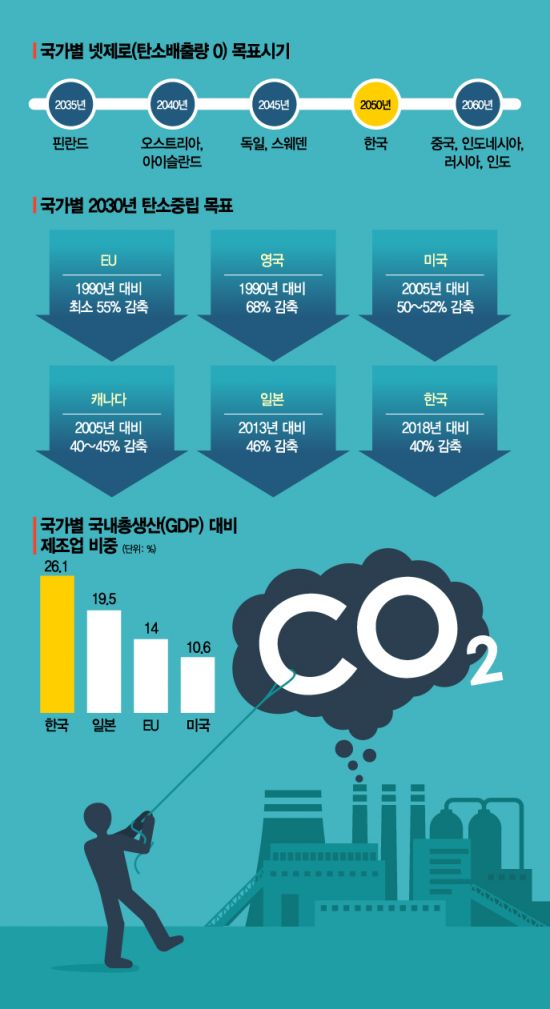
The existing NDC target to reduce emissions by 24.4% by 2030 compared to 2017 was raised to a 40% reduction. An official from the Ministry of Environment emphasized, "The NDC target is not an easy goal considering South Korea’s industrial structure with a high manufacturing ratio and late emission peak," adding, "It reflects the government’s strong policy will." In fact, South Korea’s manufacturing share of GDP was 26.1% in 2020, higher than Japan’s 19.5%, the European Union’s 14%, and the United States’ 10.6%. Regarding emission peaks, the U.S. peaked in 2007 and the U.K. in 1991, earlier than South Korea’s 2018.
To achieve the 40% NDC target, the share of coal power generation must be reduced by about half compared to 2018 (41.9% → 21.8%), while the share of new renewable energy must increase nearly fivefold (6.2% → 30.2%). The goal is to reduce greenhouse gas emissions in the transition sector from 269.6 million tons in 2018 to 149.9 million tons, a 44.4% reduction. The government presented the 2030 power generation shares by energy source reflecting the raised NDC target as nuclear 23.9%, coal 21.8%, LNG 19.5%, and new renewable energy 30.2%.
The raised NDC plan will be announced directly to the international community by President Moon Jae-in at the 26th United Nations Climate Change Conference of the Parties (COP26) held in the UK early next month. The government plans to submit the raised NDC target to the United Nations within this year. Minister of Environment Han Jeong-ae said, "The 2050 carbon neutrality scenario and NDC reduction target will be a milestone for South Korea’s progress toward carbon neutrality," adding, "The government plans to prepare plans to faithfully implement this carbon neutrality scenario and greenhouse gas reduction target, and will actively promote institutional improvements, policy, and financial support for carbon neutrality."
© The Asia Business Daily(www.asiae.co.kr). All rights reserved.

















