KT Network Outage Renders Electronic Payments Useless
Communication Failures More Vulnerable as 'Hyperconnected Society' Deepens
US Classifies Information and Communication Failures as 'Social Disaster'
Experts Say "Clear Accountability Must Be Assigned in Case of Accidents"
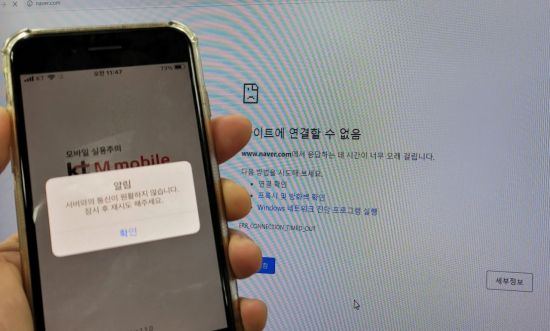 KT's internet network experienced outages in various parts of the country on the morning of the 25th. The photo shows a mobile and PC screen disconnected from the internet on that day. / Photo by Yonhap News
[Asia Economy Reporter Lim Juhyung] KT's wired and wireless internet networks suddenly experienced an outage on the 25th, causing inconvenience to citizens. The connection instability lasted for about 30 minutes, but its impact spread throughout daily life, from card payments to door lock operations. Concerns are emerging that internet instability can become a social disaster in the 'hyper-connected era' where the internet naturally permeates our lives. Experts suggest the need to prepare for potential network failures.
The internet outage occurred around 11:30 a.m. and lasted until about 12:04 p.m. The communication disruption affected a wide range of users, from ordinary households to businesses and financial institutions.
First, the inconvenience to self-employed individuals and customers peaked. Most point-of-sale (POS) devices responsible for electronic card payments stopped working. Nearby automated teller machines (ATMs) were also down, making it impossible to pay by card or withdraw cash.
Meanwhile, securities firms' mobile trading systems (MTS) also experienced connection errors, causing confusion among investors. Students attending online classes and office workers working from home were also reported to have been affected.
◆When Communication Stops, Daily Life Halts
Although the communication outage was brief, citizens expressed frustration over the significant inconvenience that disrupted their daily lives.
A man in his 20s, A, who had to leave the convenience store, recalled, "I went around neighborhood convenience stores to buy coffee, but none of the POS devices were working. When I looked at the ATM to withdraw cash, it was also down. For about an hour, I was practically unable to use money anywhere."
B, a man in his 30s who was at home during the network error, said, "We don't use KT lines, so our internet was mostly unaffected," but added, "I heard that the doorbell system in the apartment, which operates via internet connection, stopped working. I never imagined communication problems could have such a big impact."
Network errors do not only affect internet or phone services. As internet technology becomes widespread, various infrastructure supporting our daily lives are controlled via communication networks. From home appliances to electronic information boards at bus stops, countless electronic devices rely on communication networks.
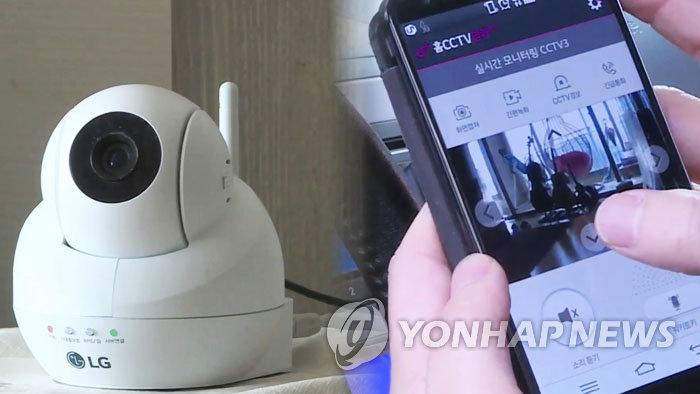 Home appliances controlled by the Internet of Things (IoT). The photo is unrelated to specific expressions in the article. Photo by Yonhap News
The recent popularity of the Internet of Things (IoT) trend is expected to deepen our society's 'communication dependence.' IoT refers to technology that equips various objects with sensors and communication devices to enable wireless communication anywhere. Technologies that detect city air quality in real time or provide traffic congestion information are also based on IoT.
According to a survey by IT market research firm IDC, the domestic IoT market is growing at an annual rate of 7.9%, and is estimated to reach a scale of 38 trillion won by 2025. This essentially means that most major cities will have environments connected by sensors and wireless communication technology.
In this 'hyper-connected era,' even a short period of network instability can cause significant social chaos. This is why concerns are raised that communication outages could become a 'social disaster.'
◆Communication Outages: Beyond Inconvenience to Social Disaster
This is not the first large-scale communication outage. In 2018, a fire at KT's Ahyeon exchange caused network paralysis, leading to major confusion in parts of Seoul. At that time, credit card payments failed at restaurants and shops, causing inconvenience to self-employed individuals.
The internet service paralysis even led to a fatality when a vulnerable person could not receive timely medical treatment. A woman in her 70s, Joo Mo, living in Yonggang-dong, Mapo-gu, experienced symptoms of cardiac arrest. Her husband tried to call 119, but the phone was dead due to the network outage.
Her husband managed to find another phone line using a different carrier and successfully contacted 119. However, by the time the paramedics arrived, more than 30 minutes had passed, and Joo Mo ultimately passed away.
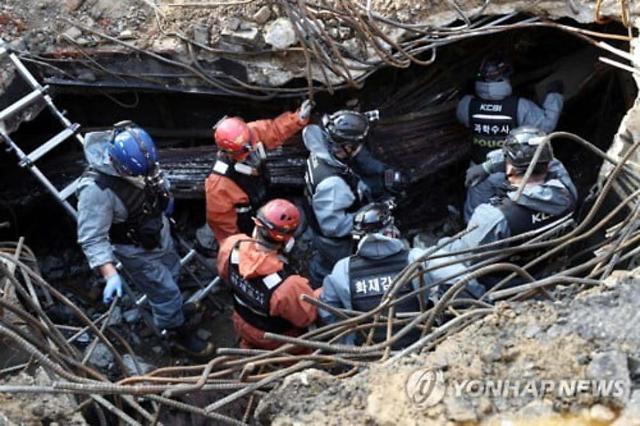 On the morning of November 25, 2018, police officials and others are investigating the cause of the fire that occurred the previous day at the KT Ahyeon Station in Chungjeongno, Seodaemun-gu, Seoul. / Photo by Yonhap News
In an interview with the media while guarding his wife's funeral, the husband said, "We tried everything, including artificial respiration, but ultimately could not save my wife," and expressed frustration, "If communication had been normal and I could have talked to the 119 responders even five minutes earlier, my wife could have been saved."
In advanced countries such as the United States, deficiencies in information and communication are also defined as social disasters and are overseen by the Federal Emergency Management Agency (FEMA). FEMA manages not only national action guidelines when communication networks fail but also manuals for citizens on how to respond.
In South Korea, following the KT Ahyeon exchange fire incident, the government has led the establishment of 'Measures to Prevent Communication Disasters and Strengthen Network Stability,' taking various steps to prepare for disasters that paralyze communication systems. These include installing fire suppression equipment in underground communication ducts vulnerable to fire, direct government inspections of major communication exchanges, and measures such as shared wireless network use among carriers and opening Wi-Fi during communication disasters.
Experts say that network outages caused by equipment errors are very rare but suggest establishing clear backup and accountability systems to prevent worst-case scenarios.
Kim Sahyuk, Deputy Research Fellow at the Digital Economy and Society Research Division of the Korea Information Society Development Institute, explained, "Routing equipment used in today's communication networks is designed with algorithms to prevent errors such as rerouting, so occurrences like this outage are extremely rare," but added, "There is still a possibility of accidents due to operator mistakes or other factors."
He continued, "To prepare for accidents, the government should establish a system to inspect communication companies to ensure double or triple backups of communication systems," and advised, "There should also be improvements to systems that clearly assign responsibility when accidents occur."
© The Asia Business Daily(www.asiae.co.kr). All rights reserved.
![Clutching a Stolen Dior Bag, Saying "I Hate Being Poor but Real"... The Grotesque Con of a "Human Knockoff" [Slate]](https://cwcontent.asiae.co.kr/asiaresize/183/2026021902243444107_1771435474.jpg)

















