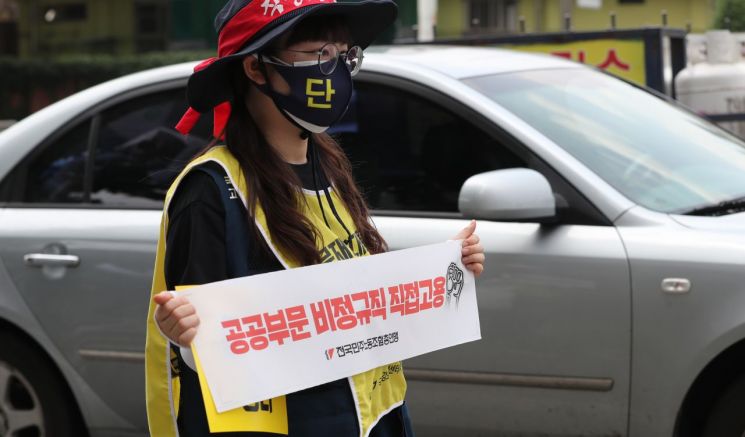
[Sejong=Asia Economy Reporter Kim Hyunjung] The number of non-regular workers has surpassed 8 million for the first time. This means that 4 out of 10 wage workers are non-regular employees, which is interpreted as a result of the government's supply of public jobs targeting the elderly.
According to the "2021 August Economically Active Population Survey Supplementary Survey on Employment Types" released by Statistics Korea on the 26th, the number of non-regular workers as of August this year was 8,066,000. This is an increase of 640,000 compared to a year ago.
This is the first time the number of non-regular workers has exceeded 8 million. The number of non-regular workers was 6.57 million in August 2017, the first year of the Moon Jae-in administration, and increased by about 1.5 million by the end of his term this year. Statistics Korea explained, "Due to changes in statistical standards, data before 2018 and after 2019 are not comparable," but even compared to 2019, the number of non-regular workers increased by 580,000. The number of non-regular workers accounts for 38.4% of the total 20,992,000 wage workers, up 2.1 percentage points from 36.3% last year.
The sharp increase in non-regular workers appears to be influenced by the government's expansion of public employment. Looking at the scale of non-regular workers by age, the number of non-regular workers aged 60 and over increased the most, from 2,132,000 to 2,403,000, an increase of 271,000. Those in their 50s increased by 124,000, from 1,543,000 to 1,667,000.
By industry, increases were seen in health and social welfare services (228,000), education services (85,000), and business facility management, business support, and rental services (66,000), while decreases occurred in public administration, defense, and social security administration (-22,000).
By employment type, temporary workers numbered 5,171,000, an increase of 564,000. Part-time workers (3,512,000) increased by 260,000, and atypical workers (2,278,000) increased by 205,000.
Regarding this, the Ministry of Economy and Finance distributed reference materials and explained, "Although the number of non-regular workers increased, key working condition indicators related to non-regular workers have improved," noting that the proportion of voluntarily chosen non-regular workers increased by 3.3 percentage points to 59.95%, and that average monthly wages (3.4%) and social insurance enrollment rates (employment 6.5 percentage points, health 1.3 percentage points, national pension 0.6 percentage points) also improved.
© The Asia Business Daily(www.asiae.co.kr). All rights reserved.
![Clutching a Stolen Dior Bag, Saying "I Hate Being Poor but Real"... The Grotesque Con of a "Human Knockoff" [Slate]](https://cwcontent.asiae.co.kr/asiaresize/183/2026021902243444107_1771435474.jpg)















