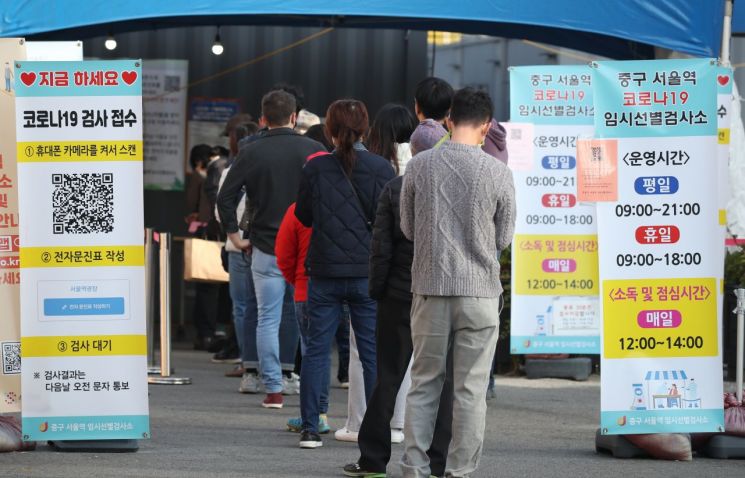
 On the morning of the 24th, citizens are waiting for testing at the temporary COVID-19 screening clinic at Seoul Station in Jung-gu, Seoul. [Image source=Yonhap News]
[Asia Economy Reporter Lee Chun-hee] Regarding concerns about a surge in demand for polymerase chain reaction (PCR) tests required to issue the essential 'negative confirmation certificate' for unvaccinated individuals to use facilities such as gyms and bathhouses during the phased return to normal life (With Corona) starting next month on the 1st, authorities have drawn a clear line, stating that the current testing capacity is sufficient to handle the demand. However, they explained that if home treatment becomes more active, they plan to pursue measures to alleviate the increased workload at frontline public health centers through collaboration with medical institutions.
Ryu Geun-hyuk, the 1st General Coordinator of the Central Disaster and Safety Countermeasures Headquarters (Vice Minister of Health and Welfare), said at the COVID-19 regular briefing on the 26th, "Considering that 70% of the entire population has been vaccinated and the vaccination completion rate is expected to reach 80%, I do not think the volume will be that large. Since we are currently reviewing excluding those under 18 from the vaccination certificate and negative confirmation system, taking the overall situation into account, we believe the current PCR testing capacity can handle the demand."
However, he conveyed the position that they will consider expanding personnel for public health centers, which must manage home treatment in addition to existing PCR testing and epidemiological investigations. Coordinator Ryu said, "It is clear that the role of public health centers will increase during the phased return to normal life," adding, "We are consulting with relevant ministries to ensure that necessary personnel can be supported according to demand." Currently, the government supports 2,127 temporary personnel to address the exhaustion of public health center staff and has hired about 816 regular staff this year to operate.
Measures to distribute related tasks of public health centers to frontline medical institutions are also being promoted. Son Young-rae, head of the Social Strategy Division at the Central Accident Response Headquarters, said, "As COVID-19 prolongs, the workload of public health centers continues, and efforts are ongoing to shift to a collaborative system sharing tasks with frontline medical institutions." He explained that a system is being promoted where consultations and management of home-treated patients are handled not only by public health centers or local governments but also by local clinics and hospitals, and adjustments to health insurance fees are being made for this purpose.
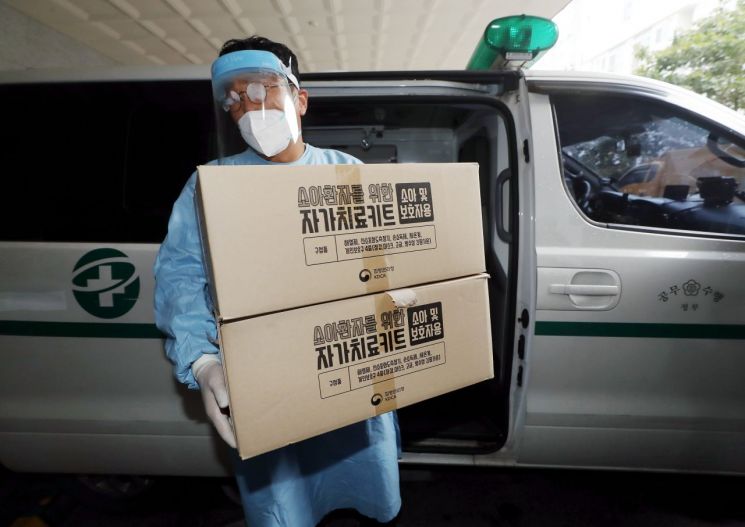 A public health center official is moving to deliver a self-treatment kit to a home treatment patient. [Image source=Yonhap News]
Health authorities expect that such home treatment will significantly reduce the burden on the medical system. Park Hyang, head of the Central Disaster and Safety Countermeasures Headquarters' quarantine division, said, "Currently, severe patients account for about 1.6 to 2.0% of all confirmed cases, moderate patients occupy 20 to 23%, and the remaining 70 to 75% are asymptomatic or mild cases isolated and managed in life treatment centers," adding, "If home treatment expands in the future, the portion isolated and treated in life treatment centers will likely decrease." He further explained that regarding moderate-severity beds, "If home treatment stabilizes further and bed efficiency measures are combined, we expect the proportion of home-treated patients relative to confirmed cases to reach about 40%."
Finally, health authorities expressed their intention to continue efforts to achieve an 80% vaccination completion rate. Coordinator Ryu Geun-hyuk said, "Currently, the first-dose vaccination rate has reached about 79.5%, and the rate of those who received the first dose but not the second is below 0.7 to 1%," adding, "We believe the 80% target will be achieved with the second dose." He added, "There are still many unvaccinated people," and said, "We will continue to actively promote and persuade, providing scientific evidence and information to encourage more vaccinations."
© The Asia Business Daily(www.asiae.co.kr). All rights reserved.
![Clutching a Stolen Dior Bag, Saying "I Hate Being Poor but Real"... The Grotesque Con of a "Human Knockoff" [Slate]](https://cwcontent.asiae.co.kr/asiaresize/183/2026021902243444107_1771435474.jpg)
















