Prolonged Survival Days Amid Sales Transaction Cliff
Meanwhile, Monthly Rent Listings Deplete Quickly
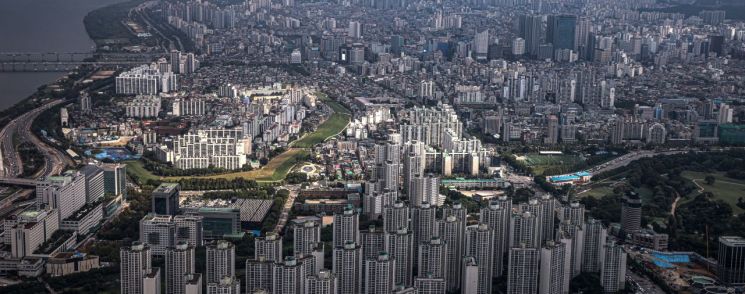 On the morning of the 5th, a view of Songpa and Gangdong districts from the 'Seoul Sky' observatory at Lotte World Tower in Jamsil, Songpa-gu, Seoul
 "A year ago, a house that was worth 1.2 billion won is now listed for 1.5 billion won. Do you think it will sell? It hasn't sold for nearly two months." (Representative of A Real Estate Agency, Dangsan-dong, Seoul)
As the apartment prices surge and loan regulations tighten, a transaction freeze has become a reality, and the 'listing lifespan' of apartments for sale in Seoul has also sharply increased. Until last year, properties were generally sold within about 20 days after being listed, but recently it takes nearly a month. On the other hand, tenants who cannot afford the soaring jeonse (long-term deposit lease) prices are pushed into monthly rent, causing the turnover rate of monthly rental listings to actually accelerate in the market.
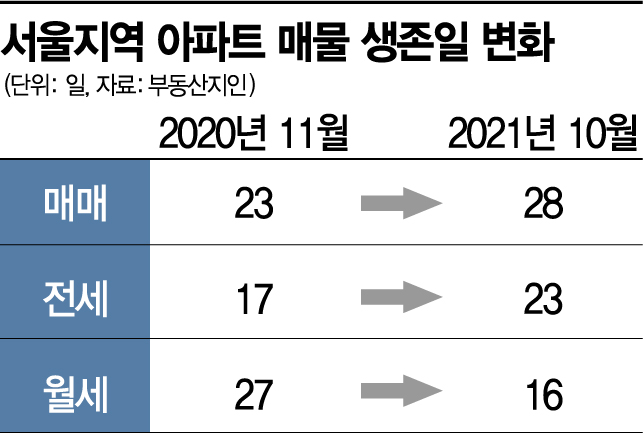
According to Real Estate Jiin, a real estate analysis platform, the average survival days of apartment sale listings in Seoul increased by 5 days from 23 to 28 days over the past year. The listing survival days refer to the period from when a property is listed until it disappears due to a successful transaction or withdrawal.
The rise in average survival days is attributed to the sharp increase in apartment prices this year. According to KB Kookmin Bank's monthly housing price trend time series statistics, the average apartment sale price in Seoul in October was 1.21639 billion won. After surpassing 1 billion won (1.0312 billion won) in September last year, it broke 1.1 billion won (1.11123 billion won) in April this year, and then rose by another 100 million won within six months.
Representative D of a real estate agency said, "Prices have risen too quickly in a short period, and sellers are asking for even higher prices, so buyers are just turning away."
The average survival period of jeonse listings, which surged due to the implementation of the three lease laws including the right to request contract renewal, rent ceiling system, and lease reporting system, also increased. It was 17 days last November but extended to 23 days this month, 5 days longer.
On the other hand, the survival days of monthly rental listings drastically shortened from 27 to 16 days during the same period. This is interpreted as an effect of the 'monthly rent conversion' caused by the jeonse price surge. In fact, lease transactions involving monthly rent such as half-jeonse in Seoul reached 12,567 cases in August, the highest level this year. Tenants who cannot find jeonse or cannot afford the increased jeonse prices seem to be rushing to sign contracts with monthly rent before prices rise further, reluctantly accepting half-jeonse.
Ko Jun-seok, an adjunct professor at Dongguk University Law School, said, "(Due to the impact of the three lease laws) the jeonse supply has decreased and prices have risen sharply," adding, "Risks such as loan regulations also persist, and it appears that demanders who find high-priced jeonse burdensome are turning to monthly rent."
© The Asia Business Daily(www.asiae.co.kr). All rights reserved.
![Clutching a Stolen Dior Bag, Saying "I Hate Being Poor but Real"... The Grotesque Con of a "Human Knockoff" [Slate]](https://cwcontent.asiae.co.kr/asiaresize/183/2026021902243444107_1771435474.jpg)
















