Q3 GDP Growth Limited to 0.3%
BOK Maintains Optimistic Outlook... "Not Deviating from 4.0% Growth Trend"
[Asia Economy Reporter Jang Sehee] With the South Korean economy growing by only 0.3% in the third quarter of this year, the red light has turned on for achieving the annual 4% growth target. The prolonged impact of the fourth wave of COVID-19 and supply bottlenecks significantly contributed to the simultaneous decline in consumption and investment. To reach 4% growth this year, the economy must achieve a growth rate of over 1% in the fourth quarter. However, risks such as ongoing supply chain instability and global economic slowdown due to strong inflation remain, making the outlook challenging.
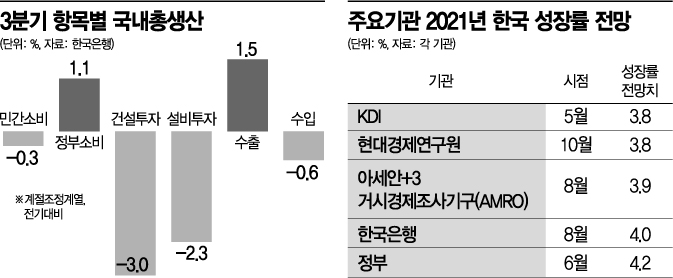
◆ Facility Investment Hits Lowest Since Q1 2019 = According to the Bank of Korea’s release on the ‘2021 Q3 Real Gross Domestic Product (GDP, preliminary data)’ on the 26th, the growth rate in the third quarter this year is the lowest since the negative growth recorded in Q2 last year. The Korean economy rebounded from a -3.2% contraction in Q2 2020 to a 2.2% growth in Q3 2020. This year, growth rates were 1.7% in Q1 and 0.8% in Q2.
The sluggish GDP growth in Q3 was largely influenced by weak investment and consumption. Hwang Sangpil, Director of Economic Statistics at the Bank of Korea, analyzed, "Private consumption decreased due to the resurgence of COVID-19, and the global supply bottleneck caused a wider decline in investment."
Private consumption fell by 0.3% quarter-on-quarter, mainly in food and accommodation, and entertainment and culture sectors. Investment declined by 3.0% in construction and 2.3% in facilities. Notably, facility investment recorded its lowest level since Q1 2019 (-8.3%), before the COVID-19 pandemic.
However, government consumption increased by 1.1%, mainly due to spending on goods, and exports rose by 1.5%, driven by coal and petroleum products, machinery, and equipment. Imports decreased by 0.6%, mainly due to a reduction in transportation equipment.
By economic agents, private sector growth contribution was 0.3%, down from 0.5% in Q2, and government growth contribution shrank from 0.3 percentage points to 0.0 percentage points. The real gross domestic income (GDI) growth rate was 0.3%, the same as the real GDP growth rate (0.3%), as terms of trade remained similar to Q2.
◆ Growing Concerns Over Annual 4% Growth = To achieve 4% GDP growth this year, a growth rate of 1.04% is required in Q4. However, prolonged supply bottlenecks and a slowdown in global growth make this difficult. Jeong Gyucheol, Director of Economic Outlook at the Korea Development Institute (KDI), emphasized, "As global supply chain bottlenecks continue, both exports and imports could be impacted. If inflation rises further, consumption capacity may decrease."
The prolonged global inflation and resulting economic slowdown are also risk factors. The International Monetary Fund (IMF) recently lowered its global growth forecast for this year by 0.1 percentage points. Jeong analyzed, "Especially, the slowdown in China’s growth will negatively affect our economy. Since imports of durable and non-durable goods will decrease, our exports will ultimately decline."
The rebound in private consumption is also expected to be limited. Professor Ahn stated, "Since South Korea’s industrial structure is not centered on face-to-face services, even with the transition to ‘With COVID-19’ (gradual return to normal life), it will be difficult for private consumption to increase significantly."
However, the Bank of Korea remains optimistic about achieving 4% growth. Director Hwang mentioned the transition to ‘With COVID-19’, fuel tax cuts, and supplementary budgets, stating, "The growth trend does not significantly deviate from the annual 4.0% growth forecast made in August." He added, "The key is when global bottlenecks will be resolved. I think they will mostly be resolved around next year with some time lag."
© The Asia Business Daily(www.asiae.co.kr). All rights reserved.
![Clutching a Stolen Dior Bag, Saying "I Hate Being Poor but Real"... The Grotesque Con of a "Human Knockoff" [Slate]](https://cwcontent.asiae.co.kr/asiaresize/183/2026021902243444107_1771435474.jpg)















