Hong Nam-ki Deputy Prime Minister "Price Stability, Top Priority Livelihood Policy"... Points Out "Temporary Measures Have Limits in Price Management"
[Sejong=Asia Economy Reporters Son Seon-hee and Moon Chae-seok] The ruling party and the government’s sudden decision to implement the largest-ever cut in fuel tax is due to the heavy burden of inflation felt by the public amid rising international oil prices. On the 26th, Hong Nam-ki, Deputy Prime Minister and Minister of Economy and Finance, emphasized, "With the relatively high recent inflation trend, the annual inflation rate is expected to exceed 2%," adding, "Price stabilization is the top priority in livelihood policy."
However, it will take some time for the fuel tax cut to be fully reflected, and it is uncertain how long the high oil prices, which have surged to the $80 range for the first time in three years, will continue. Therefore, there are evaluations that it is uncertain whether this temporary measure will achieve fundamental price stabilization.
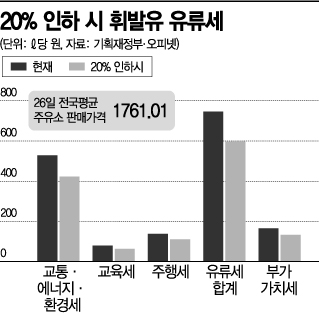
◆ 20% Fuel Tax Cut from the 12th of Next Month = On the 26th, the Democratic Party of Korea and the government held a meeting at the National Assembly to discuss inflation countermeasures and agreed to temporarily cut the fuel tax on gasoline, diesel, and LPG butane by 20% for about six months from the 12th of next month until the end of April next year. For gasoline, this means a potential reduction of up to 164 KRW per liter.
The ruling party and government engaged in a tug-of-war over the reduction rate until the last moment. Initially, the Ministry of Economy and Finance was reportedly considering a '15% reduction plan' based on the 2018 precedent, but the reduction rate increased during the morning meeting on the 26th. The annual fuel tax revenue is usually around 28 trillion KRW, and the tax revenue loss due to this 20% temporary cut is estimated by tax authorities to be about 2.5 trillion KRW.
As the government’s plan to cut fuel tax was announced early, demands for price reductions have already surged on the ground. The government plans to proceed with related enforcement ordinance revisions, Cabinet meeting approvals, and promulgation as quickly as possible.
◆ LNG Tariff Quota ‘0%’... Full Mobilization of Inflation Countermeasures = Along with the fuel tax cut, the government decided to lower the tariff quota rate on liquefied natural gas (LNG) from the existing 2% to 0%. Like the fuel tax cut, this will be temporarily applied for six months. The estimated tax revenue loss from this measure is about 240 billion KRW. The government will reaffirm the principle of ‘public utility fee freeze’ including gas charges until the end of the year and implement comprehensive inflation countermeasures such as discount events for agricultural, livestock, and fishery products and raw material supply support.
Deputy Prime Minister Hong presided over the Emergency Economic Central Countermeasures Headquarters meeting on the day and said, "The government will mobilize all available policy tools for a focused response," adding, "The capacity secured through the LNG tariff quota reduction will be used for freezing gas charges and lowering gas charges for power generation and industrial use."
However, there are criticisms that this temporary government measure cannot be seen as a fundamental inflation countermeasure, and since the reduction does not directly translate into consumer benefits, the actual perceived effect will be limited. Professor Ahn Chang-nam of the Taxation Department at Gangnam University said, "The group that consumes the most fuel is the high-income class, so the benefits from the fuel tax cut are greater for them than for low-income groups," adding, "It will take about a month for the effect to be felt, and it will not be sufficient for vulnerable groups such as small business owners and self-employed citizens to feel the impact."
Along with this, as ‘gradual daily recovery’ begins next month, the government plans to implement measures to revitalize private consumption, including fully resuming the use of consumption coupons. To this end, from early next month, offline use of nine consumption coupons for dining out, accommodation, tourism, sports, movies, and other sectors will be fully permitted. Existing non-face-to-face consumption support policies (such as dining coupons and a policy that refunds 10,000 KRW when ordering four times or more with over 20,000 KRW on delivery apps) will also be continued in parallel.
© The Asia Business Daily(www.asiae.co.kr). All rights reserved.
![Clutching a Stolen Dior Bag, Saying "I Hate Being Poor but Real"... The Grotesque Con of a "Human Knockoff" [Slate]](https://cwcontent.asiae.co.kr/asiaresize/183/2026021902243444107_1771435474.jpg)















