Dr. Kim Geon-woo's Research Team at Korea Institute of Industrial Technology
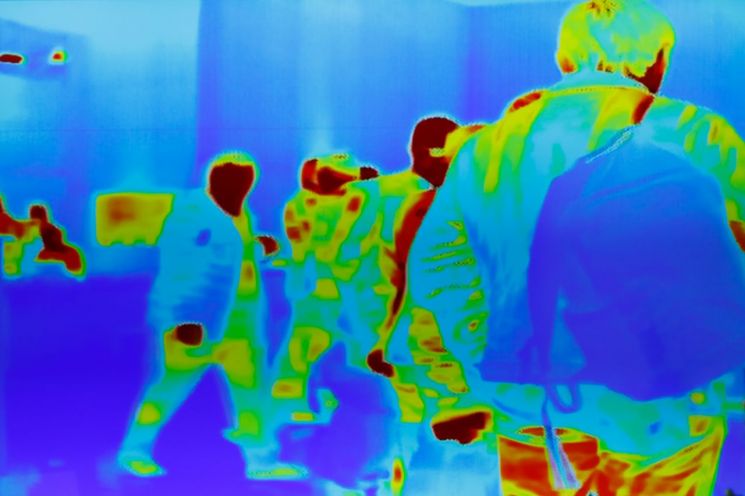
[Asia Economy Reporter Kim Bong-su] An advanced fiber that cools body temperature by more than 10 degrees just by wearing it has been developed. This is because it has a radiative cooling function that reflects external heat and transmits internal heat. Regardless of the outside temperature, it maintains a temperature that the human body can feel comfortable at, making it a cooling fiber that can save energy used for indoor cooling, and it is attracting attention as a fabric material tailored for the 'carbon-neutral' era.
On the 26th, the Korea Research Foundation announced that Dr. Kim Geon-woo's research team at the Korea Institute of Industrial Technology developed a radiative cooling fiber material that reflects external light that can raise body temperature and radiates and transmits radiant heat emitted from the body.
Effective radiative cooling materials must block heat (ultraviolet rays, visible light, near-infrared rays) coming from outside the body and transmit heat (far-infrared rays) emitted from the body. The research team proposed fibers that effectively scatter the short wavelengths of ultraviolet rays, visible light, and near-infrared rays while relatively transmitting far-infrared rays well. Through nanofibers with optimized fiber shapes, they developed fibers with wavelength-selective optical properties that reflect more than 90% of ultraviolet rays, visible light, and near-infrared rays and transmit more than 50% of far-infrared rays. It was proven that the fibers developed in this way have the effect of cooling the surface temperature by more than 10 degrees compared to existing fibers.
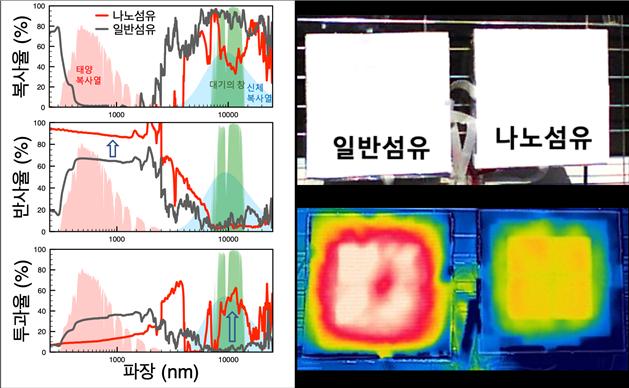 (Left) Optical properties of nanofibers with higher reflectance of solar radiation and higher transmittance in the body radiation and atmospheric window regions compared to conventional fibers (left graph)
 (Right) Photos of conventional fiber and nanofiber samples covered with a surface emitting heat similar to that of a human (50W/m2) (above) and thermal images (below). The closer to red, the higher the temperature.
The research team explained that this fabric is suitable for the 'carbon-neutral era.' Despite various efforts for a sustainable environment through carbon neutrality, energy use is increasing every year, and air conditioning energy accounts for a large proportion, about 5-10% of total energy use. The value of a 1-degree change in room temperature is estimated at more than 400 billion won. Wearing clothes made of such fibers can significantly reduce the use of air conditioning energy for indoor heating and cooling, which is expected to greatly contribute to the carbon-zero goal.
Most polymer materials used to make fibers do not absorb ultraviolet rays, visible light, or near-infrared rays but tend to absorb far-infrared rays well. Therefore, within fiber bundles that have shapes effectively scattering ultraviolet rays, visible light, and near-infrared rays, countless scatterings induce reflection of ultraviolet rays, visible light, and near-infrared rays, while far-infrared rays, which scatter less, pass through the fiber polymer material, reducing far-infrared absorption.
The research team plans to continue research to apply this technology in various fields requiring radiative cooling, such as building materials, automotive materials, and cosmetics, beyond fibers.
The research results were published online on the 18th in the international journal in the field of nanoscience, ‘ACS Nano.’
© The Asia Business Daily(www.asiae.co.kr). All rights reserved.
![Clutching a Stolen Dior Bag, Saying "I Hate Being Poor but Real"... The Grotesque Con of a "Human Knockoff" [Slate]](https://cwcontent.asiae.co.kr/asiaresize/183/2026021902243444107_1771435474.jpg)
















