GDP Growth Rate Decreases by 0.1~0.15%P with 1% Drop in China Growth Rate
BOK Optimistic with Annual 4% Forecast
[Asia Economy Reporter Jang Sehee] As the fourth wave of COVID-19 and supply bottlenecks continued, consumption and investment both declined, resulting in South Korea's economy growing by only 0.3% in the third quarter. With risk factors such as ongoing global supply bottlenecks and a slowdown in the world economy due to global inflation expanding, the achievement of an annual 4% growth rate has turned uncertain. If growth exceeds 1.04% in the remaining fourth quarter, an annual 4% growth is still possible.
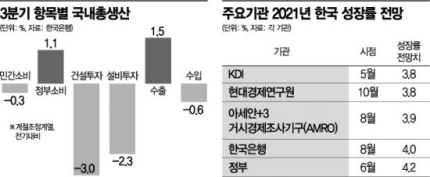
◆ Fourth Wave and Supply Chain Shock... Consumption and Investment 'Plummet' = According to the '2021 Q3 Real Gross Domestic Product (GDP, preliminary)' data released by the Bank of Korea on the 26th, GDP in the third quarter grew by 0.3% compared to the previous quarter. Looking at quarterly growth rates this year, it was 1.7% in Q1, 0.8% in Q2, and has shown a declining trend for three consecutive quarters. This indicates a slowdown in growth. This growth was largely influenced by an expanded decrease in investment and a slowdown in private consumption. Hwang Sangpil, Director of the Economic Statistics Bureau at the Bank of Korea, analyzed, "Private consumption decreased due to the resurgence of COVID-19, and investment decline expanded due to global supply bottlenecks."
Construction investment decreased by 3.0%, mainly in civil engineering, marking the lowest since Q3 last year (-3.9%). Facility investment also fell by 2.3% due to a contraction in transportation equipment. Private consumption, which briefly revived in Q2, decreased by 0.3% quarter-on-quarter due to declines in food and accommodation, and entertainment and culture, turning negative again after two quarters. Government consumption increased by 1.1%, mainly due to expenditure on goods. Exports rose by 1.5%, centered on coal and petroleum products, machinery, and equipment, while imports decreased by 0.6% due to a decline in transportation equipment. By economic agents, private sector growth contribution was 0.3%, down from 0.5% in Q2, and government growth contribution shrank from 0.3 percentage points to 0.0 percentage points. The real gross domestic income (GDI) growth rate was 0.3%, the same as the real GDP growth rate (0.3%), as terms of trade remained similar to Q2.
◆ Prolonged Supply Chain Bottlenecks and Global Growth Slowdown... Increased Uncertainty in Achieving 4% = The prolonged supply bottlenecks and global growth slowdown are expected to negatively impact our economy. The 'supply chain shock' that has affected our economy since Q2 is expected to continue into next year, restricting growth in Q4. Director Hwang stated, "When the global bottlenecks will be resolved is important," adding, "I think they will mostly be resolved around next year with some time lag." Jerome Powell, Chair of the U.S. Federal Reserve, also predicted that supply chain bottlenecks and high inflation could persist until next year, making economic damage in Q4 inevitable. Relatedly, Jeong Gyu-cheol, Head of Economic Outlook at the Korea Development Institute (KDI), emphasized, "As global supply chain bottlenecks continue, both exports and imports may be hit," and "If prices rise further, consumption capacity could decrease."
The prolonged global inflation and resulting world economic slowdown are also potential risk factors. The International Monetary Fund (IMF) lowered its world growth forecast for this year to 5.9%, down 0.1 percentage points, on the 13th. The global economic slowdown causes a decrease in domestic consumption of goods and foreign imports, ultimately impacting exports. Jeong analyzed, "China's growth slowdown will negatively affect our economy," adding, "As imports of durable and non-durable goods decrease, our exports will eventually decline." According to the Bank of Korea, a 1 percentage point drop in China's growth rate results in a 0.1 to 0.15 percentage point decrease in our economic growth rate.
Rising raw material and oil prices are also expected to burden exporters and producers. Professor Ahn Donghyun of Seoul National University's Department of Economics stated, "In the transitional situation where raw materials and oil prices continue to rise, there is a tendency to reduce production." He predicted, "The rise in crude oil prices pushes up consumer price inflation, which can reduce household consumption power."
◆ Bank of Korea's Optimistic Outlook... "Growth Trend Not Significantly Deviated" = The Bank of Korea stated that the annual 4.0% growth forecast made in August will be achieved. Director Hwang said, "The growth trend does not significantly deviate from the annual 4.0% growth forecast made in August," expecting a strong rebound in private consumption due to ▲ transition to With-COVID ▲ reduction in fuel tax ▲ effects of supplementary budget (추경). Professor Ahn commented, "Since South Korea's industrial structure is not centered on face-to-face service industries, even with the transition to With-COVID, private consumption is unlikely to increase significantly," adding, "Consumption had already been conducted online, so some online consumption will likely shift to offline."
Meanwhile, Hong Namki, Deputy Prime Minister and Minister of Economy and Finance, evaluated, "Although the impact of COVID-19 has diminished compared to previous waves, the decline in private consumption has constrained the GDP growth trend so far," adding, "Uncertainties such as global supply disruptions, prolonged inflation, and concerns over U.S.-China economic slowdown remain piled up."
© The Asia Business Daily(www.asiae.co.kr). All rights reserved.

















