Carbon Dioxide Exceeds 10-Year Average Increase
WMO Announces Ahead of COP26
"Carbon Reduction Targets Must Be Significantly Raised"
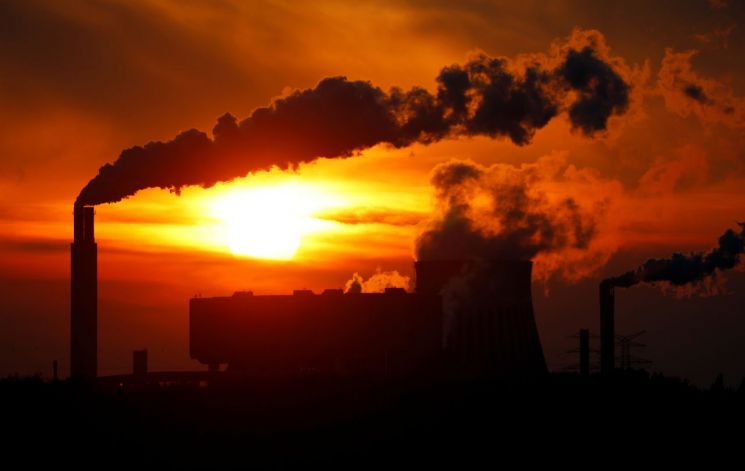
[Asia Economy Reporter Kim Suhwan] The World Meteorological Organization (WMO), a United Nations agency, announced that the concentration of greenhouse gases in the atmosphere reached a record high last year. This has raised concerns that the temperature increase will exceed the goal set to prevent climate disasters, which is to limit the rise to 1.5 degrees Celsius above pre-industrial levels.
As the 26th UN Climate Change Conference of the Parties (COP26) is set to be held in Glasgow, UK, on the 31st of this month, such warnings have prompted calls for the international community to take more proactive measures to achieve carbon reduction targets.
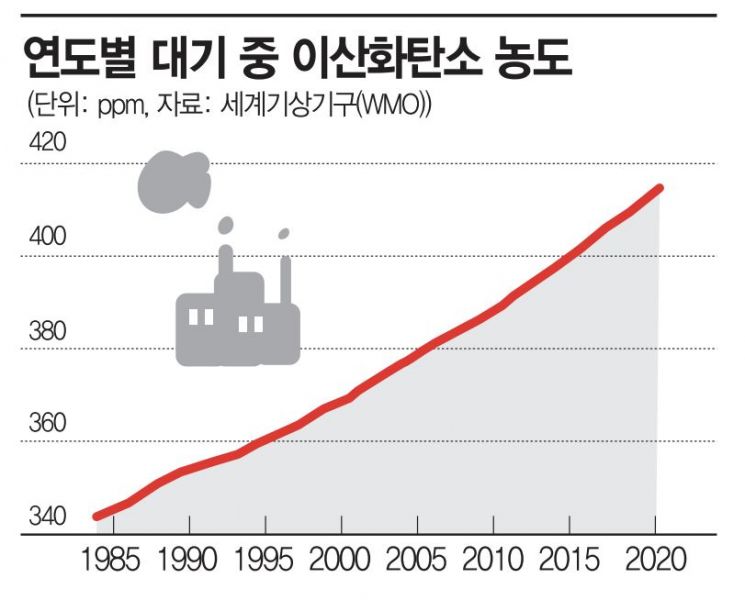
According to the WMO on the 25th (local time), the concentration of carbon dioxide, a major greenhouse gas, reached 413.2 ppm last year, an increase of 2.5 ppm from the previous year. This level corresponds to 149% of the pre-industrial concentration and exceeds the average increase over the past decade, the WMO stated.
Methane, another greenhouse gas, increased by 11 ppb to 1889 ppb during the same period, which is 262% of the pre-industrial concentration, while nitrous oxide rose by 1.2 ppb to 333.2 ppb, reaching 123%.
The WMO expressed concern that despite a temporary decrease in greenhouse gas emissions due to the economic slowdown caused by the COVID-19 pandemic last year, atmospheric concentrations hit record highs. In particular, the WMO pointed out that the reduction in forest area in the southeastern Amazon region, due to deforestation and other factors, contributed to increased carbon emissions.
Petteri Taalas, Secretary-General of the WMO, projected that if the world continues to use fossil fuels indefinitely, the Earth's temperature could rise by more than 4 degrees Celsius by 2100. This far exceeds the 1.5-degree limit agreed upon by the international community during the 2015 Paris Agreement. Experts have previously analyzed that limiting the temperature rise to 1.5 degrees is essential to prevent climate disasters.
Secretary-General Taalas emphasized, "At the upcoming COP26, carbon reduction targets must be significantly increased," adding, "The world is currently off track in efforts to curb temperature rise." He stressed that if efforts to reduce greenhouse gas emissions are made, limiting the temperature increase to 1.5 degrees is possible, and "we need to reconsider the entire industrial, energy, transportation systems, and ways of life."
The UNFCCC analyzed that if the carbon reduction plans officially announced by each country are combined, carbon emissions in 2030 will increase by 16% compared to 2010. This figure falls far short of the 45% reduction in carbon emissions by 2030 compared to 2010, which experts have proposed as necessary to limit temperature rise to 1.5 degrees. The UNFCCC warned, "If this target is missed, the world will become unstable and suffer continuous hardship," adding, "We have not even come close to the target set by science."
Boris Johnson, Prime Minister of the UK, the host country of COP26, also held a press conference on the same day, stating, "Reaching an agreement on the climate pact will be very difficult," and "We are far from seeing the progress we need." Alok Sharma, the COP26 President, criticized that the support fund for developing countries agreed upon during the Paris Agreement is also far below the target.
Previously, developed countries agreed to raise a total of $500 billion (approximately 585 trillion KRW) by 2020 as a fund to help developing countries respond to climate change. However, according to announcements from developed countries such as Germany and Canada, foreign media reported that it is expected that the full $500 billion will be raised by 2023.
President Sharma criticized at the press conference, "(This failure to meet the target) has been a source of dissatisfaction among developing countries," and added, "It is expected to take three more years than originally planned."
© The Asia Business Daily(www.asiae.co.kr). All rights reserved.
![Clutching a Stolen Dior Bag, Saying "I Hate Being Poor but Real"... The Grotesque Con of a "Human Knockoff" [Slate]](https://cwcontent.asiae.co.kr/asiaresize/183/2026021902243444107_1771435474.jpg)
















