[Asia Economy Reporter Seulgina Jo] The nationwide KT wired and wireless internet outage that began Monday morning continues to affect some areas on the 26th. The foundation of KT’s telecommunications network operation and maintenance, which the company has prided itself on, has been shaken, inevitably casting a shadow over KT’s 탈(Tal)-telecommunication ventures that have expanded into new businesses such as artificial intelligence (AI) and media content. Particularly painful for KT is that this internet-related issue has arisen just months after the controversy over KT’s 10-gigabit internet service speed, exposed by YouTuber Itssub in April.
◆Restored in about 85 minutes... Another Outage Three Years After the Ahyeon Incident
According to industry sources, the nationwide service outage was restored in about 85 minutes the previous day, but internet disconnections were still reported in some areas as of the morning of the 26th.
Park, an office worker who arrived early, said, "I came to work early because the office was paralyzed yesterday and I had backlog work, but the internet kept cutting out every 10 minutes, so I couldn’t work properly," adding with a sigh, "Wasn’t everything restored?" On major online communities, posts appeared early in the morning saying, "Is it still not over?", "KT IPTV that was working fine suddenly stopped this morning," and "The internet is down again; is anyone else experiencing this?"
This outage incident highlights how heavily our society depends on the internet and struck a critical point in the untact (contactless) society. Especially since many people have been working from home and attending remote classes due to COVID-19, the impact was even greater. Ironically, it served as a moment to confirm how vulnerable the untact, hyper-connected society we enjoy really is.
KT’s internet outage is not the first. It occurred just three years after the KT Ahyeon fire in 2018, and the affected area was even larger nationwide. At that time, communication failures occurred in Seoul’s Jung-gu, Yongsan-gu, and Seodaemun areas, causing large-scale confusion among small business owners and residents. Despite then KT Chairman Hwang Chang-gyu’s apology promising to implement measures to prevent recurrence of the same accident, a nationwide outage occurred again just three years later.
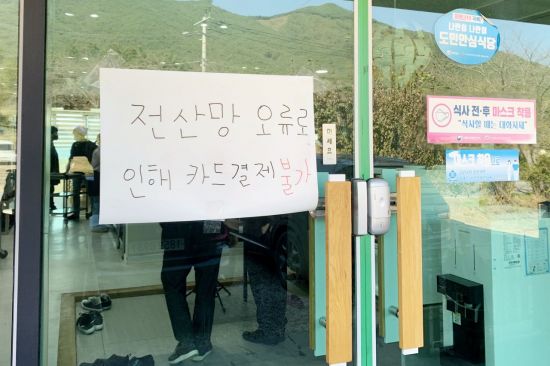 On the morning of the 25th, KT's internet network experienced an outage nationwide for over an hour, and a notice stating "Card payment unavailable due to network error" was posted at the entrance of a restaurant in Masan-myeon, Gurye-gun, Jeollanam-do. 2021.10.25 [Photo by Yonhap News]
◆"Must Fulfill Role as a Core Telecom Operator" Flood of Criticism
Accordingly, criticism is mounting that KT, which has focused on 탈(Tal)-telecommunication, may have neglected the most basic telecommunications network operation and maintenance by concentrating its capabilities only on non-telecom businesses. It is pointed out that KT failed to fulfill its role as the nation’s representative core telecom operator.
Since taking office last year, KT CEO Koo Hyun-mo has emphasized the transition from a "telecom company (telco)" to a "digital platform company (Digico)" by leading with AI, big data, and cloud?collectively called ABC. This was a plan to find new revenue sources as the mobile telecommunications market reached saturation, but there is analysis that KT neglected its core telecom business while expanding investments in new businesses such as media content and robot services.
KT’s second labor union, KT Saenozu, criticized, "The current reality of KT is that a 100-year-old telecom company’s nationwide internet communication is paralyzed due to human error." KT, the telecom industry’s top revenue earner, invested 864 billion won in facilities in the first half of this year, about 10% less than the same period last year.
This is why there is analysis that KT’s 탈(Tal)-telecommunication efforts may be stalled going forward. An industry insider hinted, "Given the strong public criticism surrounding the nationwide outage, KT will have no choice but to focus on strengthening the basic network infrastructure for the time being." KT is also reportedly considering postponing official schedules such as upcoming meetings related to new businesses.
Coincidentally, KT held an online briefing introducing AI services the morning before the outage, where CEO Koo personally declared, "AI will respond 24 hours a day, 365 days a year." At the event, Koo emphasized repeatedly that KT, with sufficient data through telecommunications and platforms and strong AI technology capabilities built through significant investment, could become Korea’s leading AI powerhouse. However, KT lost face immediately afterward due to the nationwide outage.
◆Internet Speed Reduction Controversy Surfaces in the First Half of the Year
Moreover, KT has been struggling with internet-related issues since the first half of this year, including controversy over deliberate reduction of ultra-high-speed internet speeds.
The controversy spread after famous IT YouTuber Itssub exposed on his YouTube channel that the KT 10-gigabit (10 Gbps) internet service he used was actually provided at speeds only about 1/100th of that, around 100 megabits (Mbps). As the issue escalated, KT CEO Koo Hyun-mo issued an official apology, and a government inspection confirmed that the internet speed provided was lower than contracted, resulting in a 500 million won fine.
On major internet communities, dissatisfaction poured out over the outage occurring shortly after the internet speed controversy. One netizen wrote, "My whole family uses KT bundled products for mobile phones, internet, and IPTV, but I started to think that bundled products might actually be unstable." Another netizen said, "I have maintained KT products even after the Itssub incident (ultra-high-speed internet speed reduction controversy), but I am seriously reconsidering."
According to the Ministry of Science and ICT, KT held a 41% market share in wired communications as of February, ranking first, followed by SK Telecom at 29% and LG Uplus at 20%.
Additionally, KT initially hastily attributed the outage to a "large-scale DDoS attack" but corrected this to a "routing (network path configuration) error" just over two hours later. Some criticize this for causing unnecessary confusion and damaging KT’s reputation as a provider of DDoS mitigation products.
Routing refers to selecting the optimal path for transmitting communication data within a network. Telecom companies use this to efficiently manage large-scale traffic and ensure smooth internet operation. Industry insiders speculate that incorrect routing configuration settings may have caused traffic to be concentrated on a specific network.
Meanwhile, starting around 11:20 a.m. the previous day, KT’s wired and wireless internet was paralyzed, causing nationwide outages in companies, hospitals, and schools using business networks. Before lunchtime, restaurants and stores using KT’s network experienced payment system and QR authentication failures, causing inconvenience to citizens. The stock market was further disrupted by home trading system (HTS) outages. The quarterfinals of the '2021 Samsung Fire & Marine Insurance World Baduk Masters,' broadcast live worldwide online, were also interrupted.
The network began partial recovery about 30 to 40 minutes later and was fully restored around 12:45 p.m., approximately 85 minutes after the outage began. However, unstable conditions such as internet disconnections have been confirmed in some areas since then.
© The Asia Business Daily(www.asiae.co.kr). All rights reserved.
![Clutching a Stolen Dior Bag, Saying "I Hate Being Poor but Real"... The Grotesque Con of a "Human Knockoff" [Slate]](https://cwcontent.asiae.co.kr/asiaresize/183/2026021902243444107_1771435474.jpg)
















