7 Seondosan Industrial Complexes Improved by 10%P
Effects of Digital Transformation and Eco-Friendliness
Training of 3,280 Skilled Professionals
Industrial complexes are emerging as key areas for economic recovery in the post-COVID-19 era. This is being driven by the promotion of the "Smart Green Industrial Complex (Smart Green Sandan)," a flagship project of the Korean New Deal. The Korea Industrial Complex Corporation plans to improve the environment of industrial complexes, which serve as the largest hubs for manufacturing production, exports, and employment with over 100,000 companies concentrated, and to strengthen innovation capabilities, thereby establishing these complexes as successful bases for the Korean New Deal policy. In fact, the industrial complexes selected as Smart Green leading complexes and where projects are underway have seen significant improvements in operating rates, concretizing the effects of economic recovery.
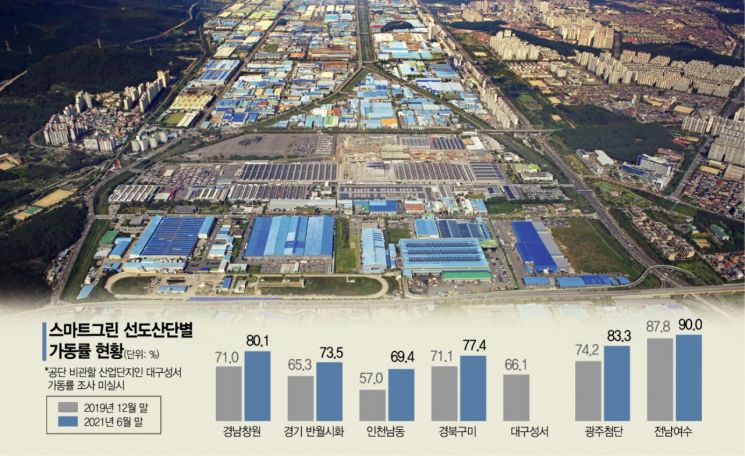
According to the Korea Industrial Complex Corporation (hereafter referred to as KICO) on the 26th, the seven industrial complexes where the Smart Green Sandan project is being promoted have improved their operating rates by around 10 percentage points compared to 2019. For example, the Gyeongnam Changwon National Industrial Complex and the Gyeonggi Banwol·Sihwa National Industrial Complex, which were first designated as leading complexes for the Smart Sandan project in 2019 and began operations, had operating rates of 71.0% and 65.3% respectively at the end of that year, but as of June this year, these rates rose to 80.1% and 73.5%. The Incheon Namdong National Industrial Complex also saw its operating rate increase by 12.4 percentage points during the same period.
◆Industrial Complexes as Bases for the Korean New Deal= The Smart Green Sandan project aims to create competitive and environmentally friendly industrial complexes by promoting digitalization of resident companies and infrastructure, energy self-sufficiency, and eco-friendliness. Specifically, it is carried out by focusing on the components of industrial complexes?industry, space, and people?while considering the characteristics of each complex. This includes digital transformation, expansion of renewable energy, and talent development. For example, in digital transformation, an innovation data center is established to analyze manufacturing data and support productivity improvement. To achieve such innovation, KICO has so far built and operated smart infrastructure in 30 locations and provided 630 support services to companies. Additionally, 3,280 manufacturing innovation specialists have been trained. A KICO official explained, "Beyond individual companies' manufacturing innovation, we aim to maximize synergy by creating digital infrastructure at the industrial complex level reflecting the Korean New Deal and implementing energy self-sufficient models, making industrial complexes the bases for leap and innovation in the post-COVID-19 era."
The seven industrial complexes currently undergoing the Smart Green leading complex project are Gyeongnam Changwon, Gyeonggi Banwol·Sihwa, Incheon Namdong, Gyeongbuk Gumi, Daegu Seongseo, Gwangju Cheomdan, and Jeonnam Yeosu. Operations at the newly added Gunsan National Industrial Complex, Busan Noksan National Industrial Complex, and Ulsan Mipo National Industrial Complex are scheduled to begin in earnest from next year. Furthermore, the project will expand to 15 complexes by 2025 and then be promoted nationwide.
◆Industrial Complexes Driving Economic Growth= Over the past 50 years, industrial complexes have driven South Korea's industrial development and economic growth. Industrial complexes are responsible for 64% of the country's total manufacturing production, 66% of exports, and 49% of employment, playing a pivotal role in national economic development and job creation. As of the end of last year, there were 1,238 industrial complexes nationwide with 106,000 resident companies, 2.203 million workers, production valued at 947 trillion won, and exports totaling 332.4 billion dollars.
In particular, industrial complexes, where companies are concentrated and energy consumption is high, are considered the optimal locations to demonstrate the two major projects of the Digital New Deal and Green New Deal and to ensure the success of the Korean New Deal. This is why the government and KICO are building models for digital transformation of the manufacturing value chain and energy self-sufficiency in industrial complexes through the Smart Green Sandan project.
Kim Jeong-hwan, Chairman of KICO, stated, "Industrial complexes have led the growth of the Korean economy as core hubs for key manufacturing industries and jobs, and currently account for half of South Korea's manufacturing production, exports, and employment, playing a central role in our economy. Building industrial complexes into eco-friendly advanced industrial bases and strengthening the innovation capabilities of resident companies are key to revitalizing manufacturing and ensuring the success of the Korean New Deal."
© The Asia Business Daily(www.asiae.co.kr). All rights reserved.
![Clutching a Stolen Dior Bag, Saying "I Hate Being Poor but Real"... The Grotesque Con of a "Human Knockoff" [Slate]](https://cwcontent.asiae.co.kr/asiaresize/183/2026021902243444107_1771435474.jpg)
















