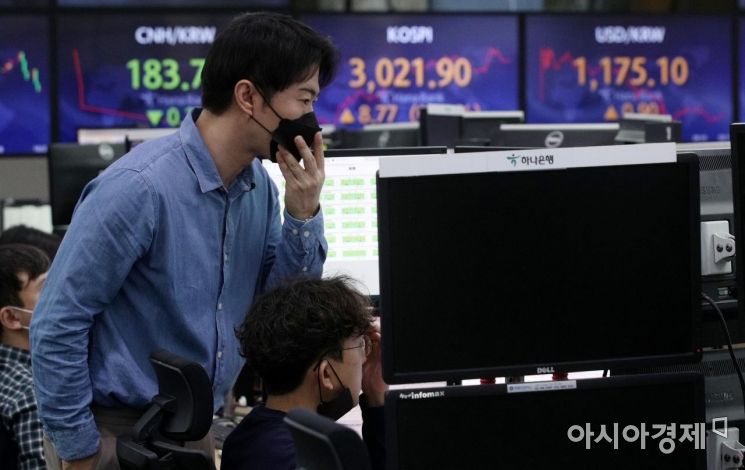
 On the 21st, the KOSPI opened at 3,012.28, down 0.85 points (0.03%) from the previous trading day, then turned to a slight upward trend after early gains. The won-dollar exchange rate opened at 1,175.5 won, up 1.3 won from the previous trading day. The photo shows the dealing room of Hana Bank in Jung-gu, Seoul on the day. Photo by Kim Hyun-min kimhyun81@
[Asia Economy Reporter Ji Yeon-jin] The KOSPI index rebounded on the 25th after four days, supported by simultaneous buying from foreigners and institutions, but the KOSDAQ showed mixed trends as it turned upward just before the market close and then retreated again.
The KOSPI index closed at 3,020.54, up 14.38 points (0.48%) from the previous trading day. The index started the day lower but rebounded due to buying by foreigners and institutions.
Foreigners, who were net sellers in the early morning, switched to net buyers as the won-dollar exchange rate fell shortly after the market opened, expanding their buying momentum, and institutions also joined the buying. Institutions showed strong support by net buying 258.4 billion KRW, while foreigners net bought 37.7 billion KRW but reduced their buying scale just before the market closed.
Initially, the market was expected to be weak due to the influence of the U.S. stock market over the weekend, but the falling won-dollar exchange rate stimulated the investment sentiment of institutions and foreigners. Kim Seok-hwan, a researcher at Mirae Asset Securities, explained, "The won-dollar exchange rate fell, and the won strengthened below 1,170 during the session, which influenced the KOSPI index rebound and the overall strength of emerging market currencies, including the yuan."
Among the top market capitalization stocks on the KOSPI, SK Hynix, which is about to announce earnings, rose 1.52%, regaining the 100,000 KRW mark, and Hyundai Motor and Kia also showed gains in the 1% range. LG Chem, which announced its third-quarter earnings that day, rose 0.32%. Samsung Electronics briefly fell to the 60,000 KRW range during the session but recovered to 70,000 KRW and closed at 72,000 KRW, down 0.28% from the previous day.
Lee Kyung-min, a researcher at Daishin Securities, said, "SK Hynix's sharp rebound early in the session seems to have changed the sentiment toward the semiconductor sector," but added, "It is interpreted more as a rebound buying given the sector had been significantly undervalued rather than a change in the view of the semiconductor industry."
Due to Korea Hydro & Nuclear Power's expected multi-trillion won nuclear power plant orders, Doosan Heavy Industries & Construction rose more than 13%. With rising COVID-19 vaccination rates and growing expectations for the With-Corona policy, airline stocks such as Asiana Airlines (+4.56%) and Korean Air (+3.12%) showed strong performance, and travel stocks like Hana Tour (+6.51%) and Norangpungseon (9.82%) also rose sharply.
The KOSDAQ index closed at 994.31, down 0.76 points (0.08%). Individuals net bought 57.9 billion KRW, and institutions also purchased about 3.3 billion KRW. In contrast, foreigners net sold about 40.7 billion KRW.
The KOSDAQ index showed high volatility that day. It fell below 990 shortly after the opening, then rebounded and fluctuated around the 995 support level. Although it succeeded in turning upward just before the market close, heavy selling at the end led to a decline at the close.
Among the top market capitalization stocks, only Pearl Abyss (+1.21%) and Wemade (+2.49%) closed higher. CJ ENM (-0.22%), which was the only stock showing an upward trend in the early KOSDAQ market, closed lower due to profit-taking selling pressure.
© The Asia Business Daily(www.asiae.co.kr). All rights reserved.
![Clutching a Stolen Dior Bag, Saying "I Hate Being Poor but Real"... The Grotesque Con of a "Human Knockoff" [Slate]](https://cwcontent.asiae.co.kr/asiaresize/183/2026021902243444107_1771435474.jpg)















