Decision for Phased Abolition Without Sale at Board Meeting on 22nd
Clash Inevitable with Labor Union Opposing Partial Sale and Liquidation
Financial Authorities Pre-Notify Enforcement Orders Based on Financial Consumer Protection Act
Actual Withdrawal Expected to Take More Time Depending on Regulatory Approval
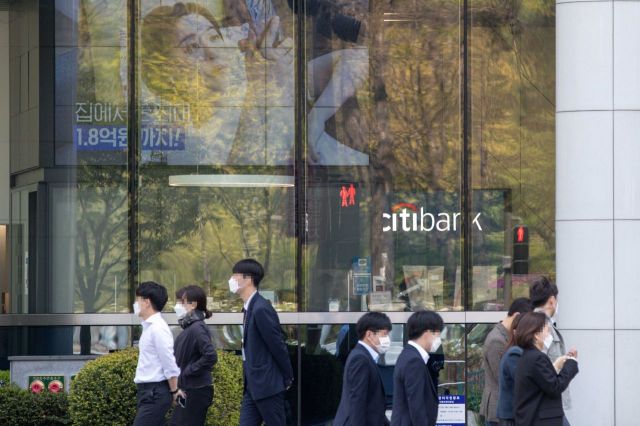
[Asia Economy Reporter Song Seung-seop] Korea Citibank is finally taking steps toward the phased liquidation of its consumer finance business. This decision comes six months after Citigroup announced its exit strategy plan for 13 countries, including Korea. However, there are still many hurdles to overcome before the actual withdrawal, such as negotiations with the labor union and approval procedures from financial authorities. In particular, since the union's persistent demand for a full sale is not accompanied, labor-management conflicts are expected to intensify in the future.
On the 25th, Korea Citibank announced that it would proceed with the phased liquidation process of its domestic consumer finance division. This comes 17 years after entering the Korean market. Liquidation is a process of withdrawing without selling the existing business to another corporation. By withdrawing from the retail finance market that handles individual consumer deposit and loan services rather than corporate entities, Korea Citibank will focus on corporate finance going forward. According to the policy, existing contracts will be honored until maturity or termination, but new subscriptions to consumer finance products and services will be suspended. The suspension date will be announced again soon.
Korea Citibank’s consumer finance withdrawal strategy was formalized last April. Since then, through three board meetings, three options?full sale, partial sale, and phased liquidation?have been weighed. The sale process accelerated as multiple financial firms expressed interest in acquisition. The partial sale method, which involved separating and selling high-quality business units such as credit cards or wealth management (WM), attracted attention but ultimately fell through.
This decision is expected to inevitably lead to clashes between Korea Citibank and the labor union. The union opposes both partial sale and phased liquidation. They argue that if a full sale is difficult, the bank should not rush the withdrawal but rather take several years to prepare for resale. If this proposal is not accepted, the union may escalate to a full-scale confrontation, including large-scale strikes. The right to strike was already secured with a 99.1% approval rate in a vote held last June.
Minimizing Labor-Management Conflict, Financial Authorities’ Approval... Numerous Challenges Before Withdrawal
Negotiations on the voluntary retirement plan, which were ongoing with the union, are also likely to be suspended. At the end of last month, Korea Citibank management proposed a voluntary retirement plan offering up to 700 million KRW in severance pay to employees. Although this was considered unprecedented, the union insisted that the company’s sale policy must be finalized first.
Ultimately, the ‘high labor costs’ and the resulting ‘employment succession’ issues, raised since the early stages of the sale, have become the biggest obstacles. The union estimates that there are about 2,500 consumer finance employees at Korea Citibank. As of the end of last year, the average length of service was 18.2 years, and the average annual salary was 112 million KRW, higher than other commercial banks. Most of the financial firms interested in acquisition reportedly expressed reluctance toward full sale and employment succession due to cost concerns.
The approval from financial authorities is also a concern. The Financial Services Commission announced that it has issued a prior notice of corrective measures under the Financial Consumer Protection Act. This is because there is a high likelihood of consumer inconvenience and reduction of consumer rights. The Commission stated, "We have ordered the bank to thoroughly prepare and implement plans to protect consumer rights and maintain transaction order during the phased liquidation of the retail finance division, and to submit these plans to the Financial Supervisory Service before starting the phased liquidation process."
At a recent National Assembly Financial Services Committee audit, Financial Services Commission Chairman Ko Seung-beom said, "We are reviewing whether the phased liquidation of Korea Citibank’s retail finance business requires approval under the Banking Act," adding, "Regardless of whether it requires approval, we will closely examine it from the perspectives of consumer protection and financial order maintenance." If the authorities do not grant approval, the withdrawal process will inevitably face setbacks. With the presidential election approaching, if large-scale strikes and unemployment occur, there may be political intervention.
Meanwhile, Korea Citibank was established when the U.S.-based Citigroup acquired Hanmi Bank, its predecessor, in 2004 as the International Monetary Fund (IMF) crisis was coming to an end.
© The Asia Business Daily(www.asiae.co.kr). All rights reserved.
![Clutching a Stolen Dior Bag, Saying "I Hate Being Poor but Real"... The Grotesque Con of a "Human Knockoff" [Slate]](https://cwcontent.asiae.co.kr/asiaresize/183/2026021902243444107_1771435474.jpg)















