IKEA Publishes Consumer Survey 'Life at Home Report 2021'
42% of Respondents Say "Improved Family Relationships"... South Korea Shows Increased Positive Perception of Home
Rising Demand for Space Reconfiguration... Preference for Healing Activities to Find Identity
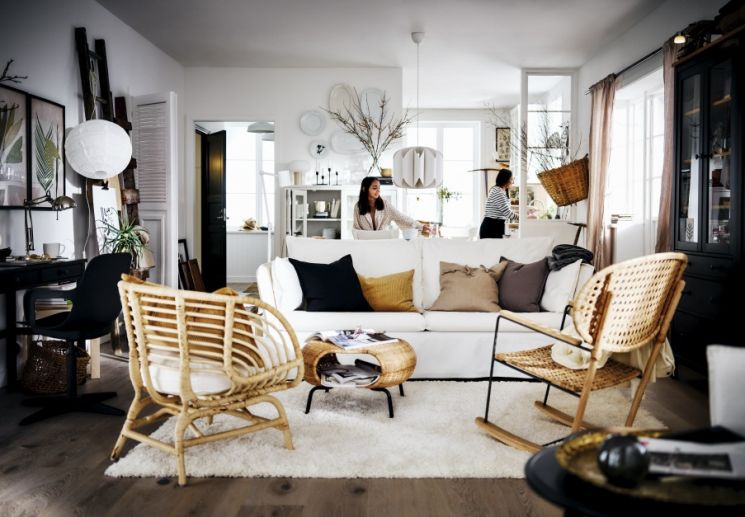
[Asia Economy Reporter Kim Bo-kyung] A survey has revealed that more than four out of ten people reported improved relationships with their families over the past year due to the prolonged COVID-19 pandemic. It was also confirmed that many people desire a 'hybrid space' at home where they can perform work, hobbies, and relaxation all in one place.
Global furniture company IKEA recently released the 'Life at Home Report 2021' containing these findings. Now in its eighth edition, the Life at Home Report is a study on people's lifestyles and perceptions of home worldwide, conducted this year with 34,387 respondents across 34 countries.
42% of Respondents Say "Improved Family Relationships"... Home as the Center of Life
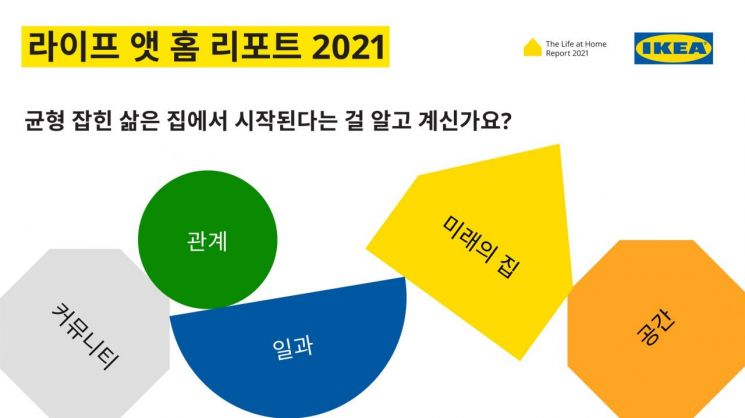
As the pandemic prolonged, the importance of home increased, revealing that the home space plays a crucial role in protecting mental health. Forty percent of respondents who reported increased affection for their homes also said it positively affected their mental health. Notably, 48% of Korean respondents viewed their homes more positively than before COVID-19, significantly higher than the global average of 35%. The home influenced mental health maintenance by becoming the center of life in five key areas: relationships, community, space, work, and the future home.
Forty-two percent of respondents said their family relationships improved over the past year, and 31% indicated that intimacy with family and friends became more important as a condition of an ideal home. Conversely, 19% reported difficulties in friendships due to reduced face-to-face meetings. In-depth interviews revealed that human relationships shifted focus from quantity to quality. Additionally, nurturing plants or caring for pets played a positive role in maintaining meaningful relationships and mental health.
60% of Respondents "Reconfigured Home Spaces"... Desire for Hybrid Spaces
As the role of the home expanded to include work, study, and exercise, 60% of global respondents said they reconfigured their home spaces to better suit necessary activities. With more time spent at home, 28% said having a spacious area inside the home became important, and 27% emphasized maintaining a clean and organized space. Eighty-four percent responded that arranging their homes in new ways became important, confirming that many people want a 'hybrid space' where work, hobbies, and relaxation can all be performed.
Community became an important factor fulfilling social and emotional needs. Seventy-three percent of respondents spent more time in their local area, and 62% said the sense of belonging from various communities helped their mental well-being. During the COVID-19 period, when face-to-face meetings were difficult, community expanded beyond physical distance to include all spaces where people gather to share interests, including online. Particularly, 18% of those aged 18-34 said that playing games together in virtual communities was one of the key factors in maintaining social relationships and mental health.
Increased Importance of Sleep and Rest... Preference for Private Gardens and Balconies
Finding a balance between work and rest at home has become important for mental health and happiness. The most important activities for feeling happy at home were sleep (55%) and rest (53%), followed by reading, watching TV, and listening to music. Many people also expressed a desire to have personal time for self-care or gaming at home. The need to have activities alone at home to learn about oneself and establish identity has grown.
The COVID-19 pandemic prompted people to reconsider what kind of home they want. An IKEA representative stated, "Through this study, we discovered that the ideal future home is perceived as a space for leisure, a space to feel nature, and a space to do what one loves." Important characteristics of an ideal home included having a private garden or balcony (36%), living close to nature (35%), living near family and friends (31%), and having a space for privacy (29%). The full survey results and report of IKEA's 'Life at Home Report 2021' are available on the IKEA Life at Home page.
© The Asia Business Daily(www.asiae.co.kr). All rights reserved.
![Clutching a Stolen Dior Bag, Saying "I Hate Being Poor but Real"... The Grotesque Con of a "Human Knockoff" [Slate]](https://cwcontent.asiae.co.kr/asiaresize/183/2026021902243444107_1771435474.jpg)
















