Samsung Life-Samsung Electronics Internal Transactions Increase by 1 Trillion
Kyobo Also Surpasses 10 Trillion in First Half-Year
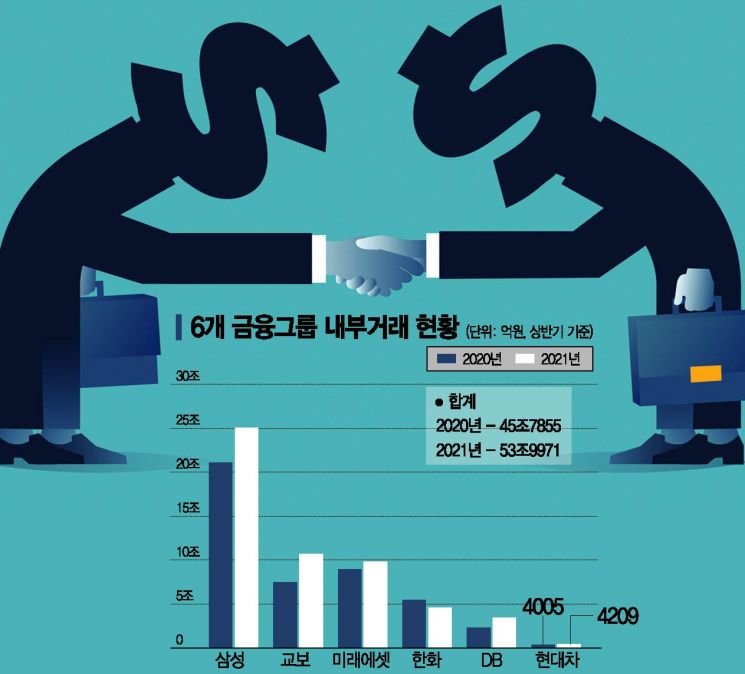
[Asia Economy Reporter Oh Hyung-gil] Internal transactions among six financial groups with financial assets exceeding 5 trillion won each surpassed 50 trillion won in the first half of this year alone. Among them, Samsung Financial Group accounted for nearly half. Kyobo Group also saw its internal transactions exceed 10 trillion won for the first time, indicating a rapid increase in internal transactions within financial groups.
As the volume of internal transactions increases, the possibility of crisis transmission within the group rises, which can adversely affect the overall soundness of the financial group. Therefore, there are calls to strengthen the management of internal transactions.
According to the internal transaction status disclosed on the 22nd by six financial groups?Samsung, Hanwha, Mirae Asset, Kyobo, Hyundai Motor, and DB?the scale of internal transactions in the first half reached 53.9971 trillion won, up 17.9% from 45.7855 trillion won a year earlier. If this upward trend continues in the second half, it is expected to surpass 100 trillion won, exceeding last year's year-end record of 94.9288 trillion won.
The scale of internal transactions within Samsung Financial Group was found to be nearly half of the total internal transactions of all financial groups, amounting to 25 trillion won. It was recorded at 25.0528 trillion won, an 18.5% increase from 21.1242 trillion won a year ago.
Internal transactions between Samsung financial companies amounted to 23.4509 trillion won, a 14.5% increase compared to the same period last year, while internal transactions between financial and non-financial companies surged 145.2%, from 653.2 billion won to 1.6019 trillion won.
Among these, transactions between Samsung Life Insurance and Samsung Electronics alone reached 1.1797 trillion won in the first half, which is attributed to dividends paid by Samsung Electronics last year. During the same period, Samsung Fire & Marine Insurance also recorded internal transactions of 246.9 billion won with Samsung Electronics. Samsung Electronics paid a total of 13.1243 trillion won in dividends for the 2020 fiscal year.
Kyobo Group also saw a significant increase in internal transactions this year. The scale of Kyobo Group's internal transactions, which was 7.4862 trillion won in the first half of last year, rose by 42.6% to 10.6789 trillion won this year. This is the first time internal transactions have exceeded 10 trillion won on a half-year basis.
Financial affiliates such as Kyobo Life Insurance, Kyobo Securities, and Kyobo AXA Asset Management actively conducted securities transactions, with inter-affiliate securities sales reaching 10.5674 trillion won.
Next, Mirae Asset Group's internal transactions amounted to 9.8149 trillion won, a 9.3% increase compared to the same period last year. Similarly, securities transactions among financial affiliates such as Mirae Asset Securities, Mirae Asset Life Insurance, and Mirae Asset Global Investments accounted for most of the internal transactions, totaling 9.6547 trillion won.
Internal transactions of DB Group (represented by DB Insurance) and Hyundai Motor Group (represented by Hyundai Capital) were 3.4284 trillion won and 420.9 billion won, respectively, increasing by 48.0% and 5.0% year-on-year.
On the other hand, Hanwha Financial Group (represented by Hanwha Life Insurance) was the only group among the six whose internal transactions decreased. The scale of internal transactions, which was 5.4831 trillion won last year, dropped by 16.0% to 4.6012 trillion won. Securities transactions among affiliates of Hanwha Investment & Securities decreased by nearly 700 billion won, and internal transactions between financial and non-financial companies also fell by more than 220 billion won.
Internal transactions increased due to securities transactions such as dividends and bonds, which could negatively impact the capital adequacy ratio of financial groups, leading to calls for strengthened management of internal transactions. Next year, in the first half, each financial group plans to calculate the capital adequacy ratio reflecting risk-weighted assets, where the proportion of interconnectedness such as internal transactions and governance accounts for the highest share at 50% in the risk-weighted asset evaluation.
The Financial Conglomerate Supervision Regulations stipulate methods for calculating capital amounts, overlapping capital, and minimum required capital totals.
Considering additional group risks, the evaluation method for risk-weighted assets and the additional ratio based on the evaluation were established. The categories are divided into three: ▲ Affiliate risk (financial risk 20%, non-financial risk 10%) ▲ Interconnectedness (governance and internal transactions, 50%) ▲ Internal control and risk management (20%). The risk-weighted ratios are divided into five evaluation grades (a total of 15 grades), with a maximum additional ratio of 20% applied differentially.
An official from the financial authorities explained, "A high risk-weighted asset ratio indicates a high possibility of risk transmission between groups. Therefore, more capital must be accumulated, which inevitably increases the burden of capital expansion."
© The Asia Business Daily(www.asiae.co.kr). All rights reserved.
![Clutching a Stolen Dior Bag, Saying "I Hate Being Poor but Real"... The Grotesque Con of a "Human Knockoff" [Slate]](https://cwcontent.asiae.co.kr/asiaresize/183/2026021902243444107_1771435474.jpg)
















