Ministry of Economy and Finance "Considering 15% Reduction Over 5-6 Months"
Gasoline Price per Liter from 1,820 Won to Early 1,700 Won Range
Additional Reduction in LNG Quota Tariff Rate
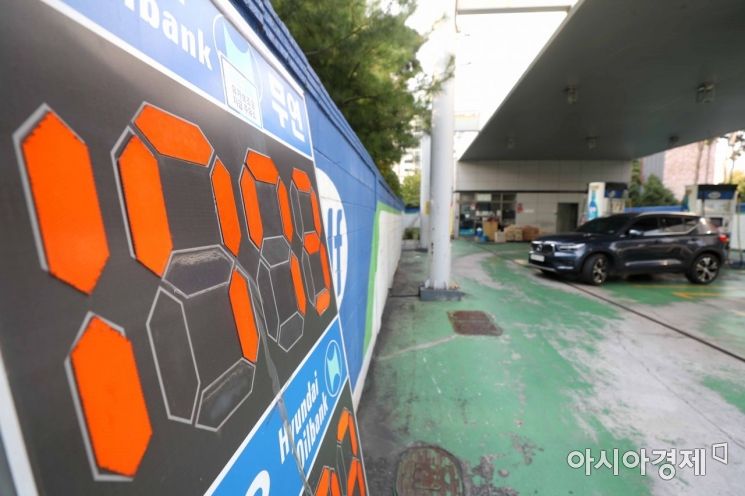
[Sejong=Asia Economy Reporter Moon Chaeseok] The Ministry of Economy and Finance has confirmed that it is considering a plan to reduce the fuel tax by 15% until March next year. Earlier, Hong Nam-ki, Deputy Prime Minister and Minister of Economy and Finance, said regarding the fuel tax cut, "It will be at a level that extends beyond this winter," revealing the outline of the specific timing and reduction rate. The government has officially announced a temporary reduction of the fuel tax.
A Ministry of Economy and Finance official said on the 22nd, "We are considering a plan to cut the fuel tax by about 15% for around six months." Considering that the average gasoline price in Seoul exceeds 1,820 KRW per liter, a 15% reduction in the fuel tax would bring the price down to the low 1,700 KRW range.
The government plans to announce the specific reduction rate and timing next week. Lee Eok-won, the first vice minister of the Ministry of Economy and Finance, presided over the 'Price-related Vice Ministers' Meeting' at the Government Complex Seoul on the same day and said, "We will temporarily reduce the fuel tax," adding, "We will announce the details at the Emergency Economic Central Disaster and Safety Countermeasures Headquarters meeting on the 26th."
If the fuel tax is reduced by 15%, the gasoline price will decrease by up to 123 KRW per liter, diesel by 87 KRW, and liquefied petroleum gas (LPG) butane by 30 KRW. The fuel tax consists of transportation tax, education tax, and driving tax. The statutory rate for the transportation tax is fixed at 475 KRW per liter (based on gasoline). Applying the flexible tax rate under the Enforcement Decree of the Tax Law, the transportation tax for gasoline is 529 KRW, the driving tax is 138 KRW, and the education tax is 79 KRW, totaling 746 KRW per liter of gasoline. Including value-added tax, it becomes 820 KRW. A 15% reduction from 820 KRW is 123 KRW. Considering that the average gasoline price in Seoul is 1,825 KRW per liter as of today, subtracting 123 KRW results in 1,702 KRW.
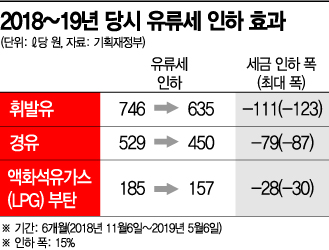
The government can reduce the tax by up to 30% through amendments to the Enforcement Decree. However, if the reduction is too large, it could cause a significant shock to the market after the period ends, so reductions exceeding 20% have been excluded from consideration. The 15% reduction plan was somewhat anticipated from Deputy Prime Minister Hong's remarks. At the National Assembly's Planning and Finance Committee audit the day before, Hong said, "(The fuel tax reduction period) will likely extend beyond winter," adding, "We will refer to the 2018 case." At that time, the average gasoline price, which was in the 1,690 KRW range per liter, dropped to the 1,560 KRW range due to the fuel tax cut.
International oil prices are currently recording over 80 dollars per barrel (about 94,300 KRW), the highest since 2018, and natural gas prices are about 35.3 dollars (about 42,000 KRW), seven times last year's average price.
However, issues related to tax rate adjustments are expected to be controversial. Since the tax rate is uniformly cut, it is difficult to provide more precise support to low-income groups who are more severely affected by rising oil prices. Above all, there are criticisms questioning "Is it really necessary to reduce the fuel tax now?" given that tax revenue is expected to exceed the forecast (31.5 trillion KRW) by about 20 trillion KRW, reaching around 50 trillion KRW.
Professor Park Ki-baek of the Taxation Department at the University of Seoul said, "There may be controversy over the '6 months and 15%' and various complaints about the period being long or short depending on future price fluctuations," adding, "The important fact is that tax revenue is expected to increase by about 20 trillion KRW, and it is questionable whether this should have been diverted to the fuel tax reduction, which applies to the unspecified majority, instead of being used for compensation for losses to self-employed people, etc."
Along with this, the government also decided to further reduce the tariff rate on liquefied natural gas (LNG). Vice Minister Lee said, "In response to the sharp rise in natural gas prices, we will also announce a plan to further reduce the current 2% tariff rate on LNG," adding, "Through this, we will support the alleviation of the burden of living prices on the economy of ordinary people, including energy costs."
© The Asia Business Daily(www.asiae.co.kr). All rights reserved.
![Clutching a Stolen Dior Bag, Saying "I Hate Being Poor but Real"... The Grotesque Con of a "Human Knockoff" [Slate]](https://cwcontent.asiae.co.kr/asiaresize/183/2026021902243444107_1771435474.jpg)
















