Seoul City Lifts Height Restriction Regulations
Revitalizing Redevelopment and Reconstruction
Excluding Hilly Areas and Han Riverbanks
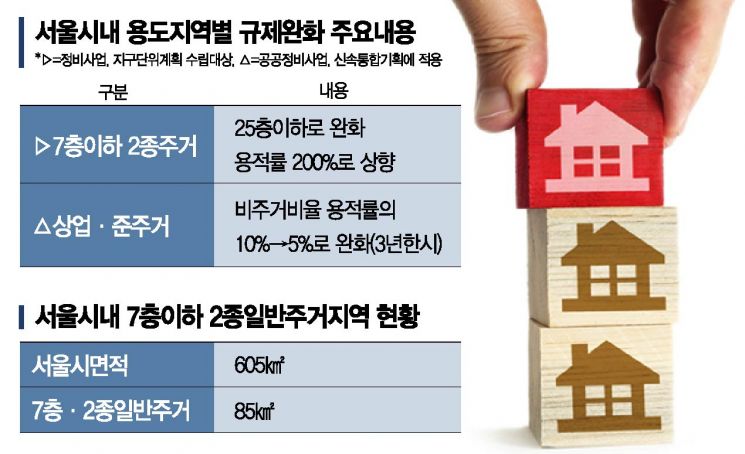
[Asia Economy Reporter Kim Hyemin] The A Villa in Guro-gu, Seoul, consisting of 762 households, is over 30 years old but redevelopment has been slow. This is because the area, including the villa, is designated as a Type 2 General Residential Area with a height limit of 7 floors. However, from now on, apartments up to 25 floors high will be allowed in this area. This is due to Seoul City removing the 7-floor height restriction in Type 2 General Residential Areas to revitalize redevelopment and reconstruction.
According to Seoul City on the 21st, the ‘Seoul City District Unit Plan Establishment Standards,’ which lifts height restrictions in Type 2 General Residential Areas for apartments undergoing maintenance projects or district unit plans, will be implemented from today.
Areas subject to the 7-floor or lower (Type 2 7-floor) height restriction in Type 2 General Residential Areas account for about 14% of Seoul’s total area and about 26% of residential areas alone. In particular, among the 388 sites where maintenance projects were canceled, about 160 are subject to this restriction or partially include Type 2 7-floor areas. A Seoul City official said, "The fact that nearly half are affected means many places faced difficulties in profitability due to the Type 2 7-floor regulation and thus canceled their projects."
However, going forward, areas under the Type 2 7-floor restriction will be subject to the same standards as other Type 2 General Residential Areas when pursuing redevelopment, reconstruction, or establishing district unit plans to build apartments. Apartments can now be built up to a total of 25 floors. The allowable floor area ratio will be raised from 190% to 200%. The condition requiring a mandatory public contribution ratio of 10% or more when changing the land use from Type 2 7-floor to Type 2 General Residential Area has also been removed.
However, areas requiring height and landscape management, such as hilly areas, Han River banks, and natural scenic districts, are excluded from this deregulation. This deregulation applies to areas establishing district unit plans of 5,000㎡ or more or with 100 or more households, and is unlikely to apply to small-scale maintenance projects.
Seoul City also lowered the non-residential facility ratio, such as commercial spaces, from the existing 10% or more to 5% to expand housing supply in commercial and semi-residential areas. A Seoul City official said, "Reducing the non-residential ratio allows for increased housing supply and lowers risks such as unsold commercial spaces." This condition will be prioritized for maintenance projects through rapid integrated planning and those implemented by the public sector.
Lee Eunhyung, Chief Researcher at the Construction Policy Research Institute, predicted, "This deregulation aims to promote maintenance projects and will have a positive effect on revitalizing redevelopment in old and deteriorated areas that need maintenance projects."
© The Asia Business Daily(www.asiae.co.kr). All rights reserved.
![Clutching a Stolen Dior Bag, Saying "I Hate Being Poor but Real"... The Grotesque Con of a "Human Knockoff" [Slate]](https://cwcontent.asiae.co.kr/asiaresize/183/2026021902243444107_1771435474.jpg)















