US Micron to Invest 176 Trillion Won Over 10 Years... Japan Attracts Overseas Companies One After Another to 'Check South Korea'
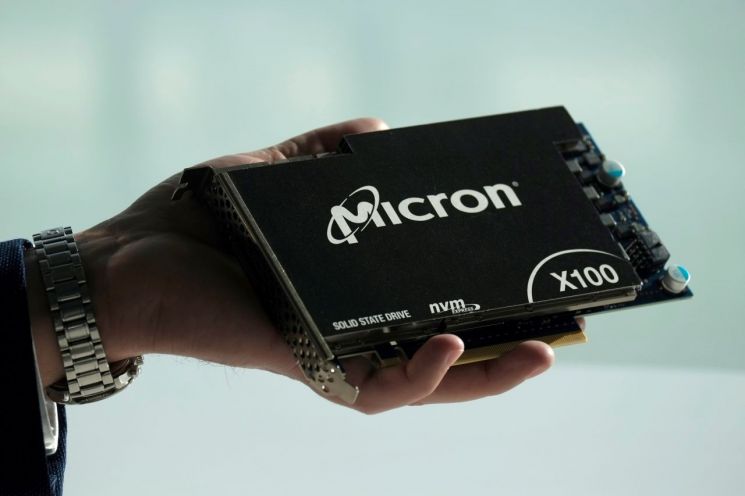
[Asia Economy Reporter Park Byung-hee] Micron, the world's third-largest DRAM manufacturer based in the United States, announced on the 20th (local time) that it will invest $150 billion (approximately 176 trillion KRW) over the next 10 years. The U.S., leading the system semiconductor market with Intel at the forefront, has revealed its ambitions toward the memory semiconductor market, where Korean companies such as Samsung Electronics and SK Hynix are positioned. Japan has also recently been pressuring Korean companies by actively attracting overseas semiconductor firms. As the U.S. strengthens its semiconductor alliance with Japan and Taiwan to counter China, concerns are growing that Korea could become isolated.
On this day, Micron stated that it will invest more than $150 billion in manufacturing and research and development (R&D) over the next decade to meet increasing demand. Sanjay Mehrotra, CEO of Micron, emphasized, "We plan to invest $12 billion in this fiscal year alone, which is more than the historical annual average," adding, "We especially plan to invest $3 billion in R&D." Bloomberg reported that Micron's investment scale has doubled compared to 10 years ago.
Micron's announcement came amid a wave of increased semiconductor investments by governments and companies worldwide. As the semiconductor supply shortage worsens, countries are strategically fostering semiconductors from a national security perspective. This process is intensifying the global semiconductor hegemony competition.
In particular, the U.S. and Japan are understood to be building an alliance in the semiconductor sector and cooperating closely. Although Micron did not specify the location of its new factory, Japan is mentioned as one of the leading candidates. The previous day, the Japanese Industrial Newspaper reported that Micron plans to invest about 8 trillion KRW to build a DRAM factory in Hiroshima Prefecture, Japan. Western Digital, the third-largest NAND flash company in the U.S., is also pursuing the acquisition of Japan's second-largest company Kioxia (formerly Toshiba).
Japan has recently been striving to revive its past semiconductor powerhouse status by attracting foundry (semiconductor contract manufacturing) leader Taiwan's TSMC's factory. The Japanese government is reportedly set to support 500 billion yen (approximately 5.1356 trillion KRW), half of TSMC's new factory investment.
The U.S.-Japan semiconductor alliance primarily targets China's "semiconductor rise," but Korea is also perceived as a target for containment in this process. Pat Gelsinger, Intel CEO, said in a media interview the day before that relying on Korea and Taiwan for semiconductor production causes geopolitical instability and requested subsidies for U.S. semiconductor companies. On the same day, Micron also argued that benefits such as tax reductions and subsidies should be provided to enable production within the U.S.
Meanwhile, China has moved to rescue the large semiconductor design and manufacturing company Tsinghua Unigroup (Tsinghua Group), which went bankrupt in July. Tsinghua Unigroup announced investor recruitment immediately after bankruptcy, and on the 18th, seven companies, including Alibaba Group and six state-owned enterprises, applied to participate as strategic investors in Tsinghua Unigroup. This has led to analyses that the possibility of Tsinghua Unigroup becoming nationalized has increased.
While the original semiconductor powerhouses, the U.S. and Japan, are making large-scale investments aiming to revive their past glory, China, which is pursuing semiconductor self-sufficiency with a 70% target by 2025, appears to be strengthening its independent course.
Meanwhile, Bloomberg noted that although Micron's investment scale has doubled compared to 10 years ago, it is still weak compared to Samsung Electronics. Samsung Electronics' capital expenditure scale is said to be equivalent to Micron's annual sales. It also reported that Samsung Electronics, which dominates the memory semiconductor market, has nearly caught up with Intel in semiconductor division sales this year.
© The Asia Business Daily(www.asiae.co.kr). All rights reserved.
![Clutching a Stolen Dior Bag, Saying "I Hate Being Poor but Real"... The Grotesque Con of a "Human Knockoff" [Slate]](https://cwcontent.asiae.co.kr/asiaresize/183/2026021902243444107_1771435474.jpg)
















