-GIST Research Team Pioneers Control of Functional Oxide Properties by Modulating Substrate Electronic Structure
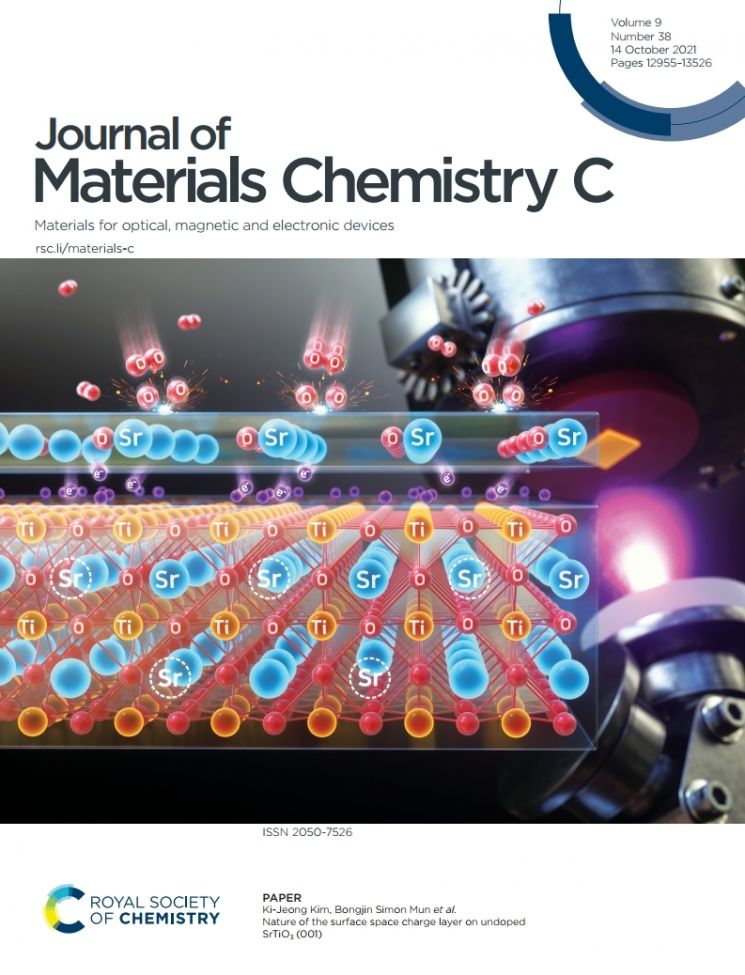 The research team at Gwangju Institute of Science and Technology successfully observed real-time changes in the electronic, chemical, and structural states of a heterojunction complex oxide substrate. The photo shows the cover of the international journal in which the paper was published.
[Asia Economy Reporter Kim Bong-su] The research team led by Professor Moon Bong-jin of the Department of Physics and Optical Science at Gwangju Institute of Science and Technology (GIST) announced on the 21st that they have succeeded in real-time observation of electronic, chemical, and structural state changes in complex oxide heterostructure substrates.
The team discovered chemical composition changes and the formation of space charge layers on the surface of strontium titanate (SrTiO3) substrates exposed to a high-temperature oxygen environment, along with the resulting bending of energy bands, using an ambient pressure photoelectron spectroscopy system based on a synchrotron radiation accelerator.
Complex oxide heterostructures are materials fabricated by stacking oxides with different properties layer by layer, where the constituent materials interact through interfaces to realize excellent electrical, magnetic, thermal, and mechanical functionalities. Key phenomena in next-generation electronic device development, such as giant magnetoresistance, metal-insulator transitions, high-temperature superconductivity, and two-dimensional electron gases, are all characteristics realized within complex oxide heterostructure architectures. However, the principles behind the manifestation of these functionalities and their operating mechanisms have not yet been clearly elucidated.
Since changes in the chemical, electrical, and structural properties of the substrate surface (the interface where interactions between functional oxides and substrate materials occur) under the temperature and pressure conditions used to grow functional oxides significantly influence the performance of the functional oxides grown on top, it is essential to thoroughly understand the surface dynamics of the substrate to design optimal growth conditions for performance enhancement.
The research team conducted in situ analysis of the chemical and electronic structure of strontium titanate substrates terminated with an outermost titanium dioxide (TiO2) layer inside an ambient pressure photoelectron spectroscopy chamber. By controlling the gas environment inside the chamber from ultra-high vacuum to oxygen gas pressure of 0.1 mbar (approximately one ten-thousandth of atmospheric pressure) and the temperature from room temperature to 600°C, they confirmed in real time the formation of space charge layers due to atomic migration and chemical structural changes on the strontium titanate substrate surface and the role of the oxygen environment. Strontium titanate is one of the most widely used substrate materials for growing functional oxides in complex oxide heterostructure fabrication due to its excellent lattice compatibility with other functional oxides and its thermal and chemical stability.
Professor Moon explained, “By excluding doping effects that could influence the electronic, chemical, and structural states of the substrate, we revealed the pure surface space charge characteristics of the strontium titanate substrate,” adding, “This greatly enhances the potential for controlling the properties of substrates and functional materials and their applications as next-generation electronic materials.”
This research was selected as the cover paper (Issue 38) of the prestigious journal Journal of Materials Chemistry C published by The Royal Society of Chemistry in the UK and was published on the 14th.
© The Asia Business Daily(www.asiae.co.kr). All rights reserved.
![Clutching a Stolen Dior Bag, Saying "I Hate Being Poor but Real"... The Grotesque Con of a "Human Knockoff" [Slate]](https://cwcontent.asiae.co.kr/asiaresize/183/2026021902243444107_1771435474.jpg)















