DGIST Research Team Develops Electrolyte That Extends Lifespan by 40%
[Asia Economy Reporter Kim Bong-su] A domestic research team has developed an electrolyte that can solve the lifespan issue of lithium metal secondary batteries, which are attracting attention as next-generation batteries.
The Daegu Gyeongbuk Institute of Science and Technology (DGIST) announced on the 21st that a joint research team led by Professors Lee Hong-kyung and Lee Ho-chun from the Department of Energy Engineering has elucidated the design principles of electrolytes that can secure the performance of lithium metal anodes. The quasi-high-concentration electrolyte developed by the research team can extend the lifespan of lithium metal anodes compared to conventional electrolytes, which is expected to have a positive impact on the development of secondary batteries for electric vehicles in the future.
Lithium metal electrodes can store a large amount of electricity, making them the most ideal anode material for secondary batteries. However, issues such as battery lifespan reduction and ignition remain challenges to be solved. Recently, studies have reported that quasi-high-concentration electrolytes significantly improve the durability of lithium metal anodes, but the effects and mechanisms of quasi-high-concentration electrolytes within the actual operating temperature range of batteries, between -20°C and 60°C, have not been clarified.
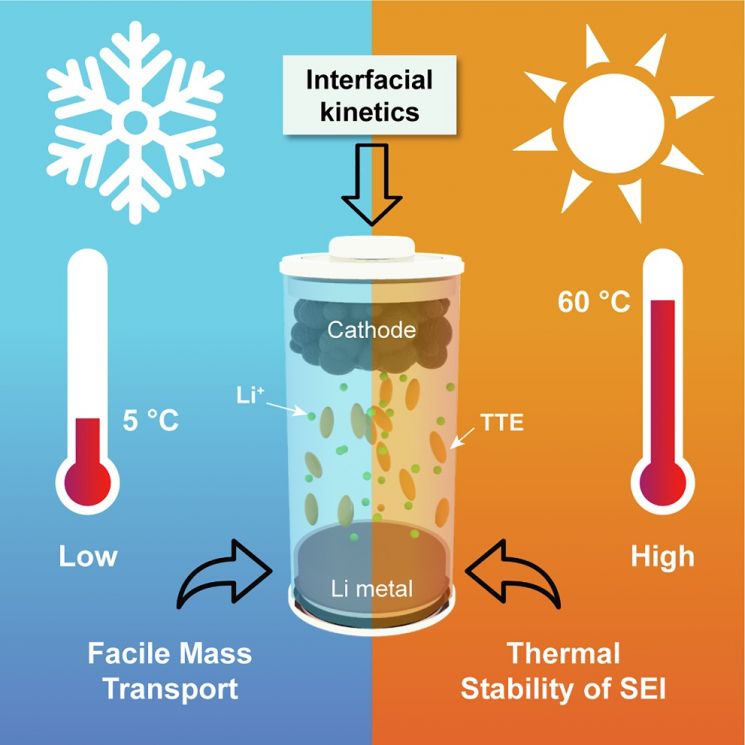
The research team investigated the effects of quasi-high-concentration electrolytes on the durability and long-term lifespan of lithium metal anodes and lithium metal secondary batteries at various temperatures. Compared to conventional high-concentration electrolytes, the application of quasi-high-concentration electrolytes greatly enhanced the durability of lithium metal anodes at low temperature (5°C) and high temperature (60°C), and also confirmed an increase of more than 40% in the long-term lifespan of lithium metal secondary batteries.
Additionally, through electrochemical overvoltage and thermal stability analysis of the lithium anode interface in secondary batteries, the team identified the reasons behind the improvement effects shown by the quasi-high-concentration electrolyte. As a result, all three overvoltage components decreased, with the reduction effect being particularly prominent at low temperatures, which led to improved low-temperature durability.
Professor Lee Ho-chun stated, “The analysis results elucidated this time are a fundamental technology that can serve as a guideline for the design of electrolytes for lithium metal batteries,” and added, “It can also be applied to the design of various next-generation battery electrolyte systems using lithium metal anodes in the future.”
The research results were published online on August 21 in the international academic journal Chemical Engineering Journal and are scheduled for official publication in January next year.
© The Asia Business Daily(www.asiae.co.kr). All rights reserved.
![Clutching a Stolen Dior Bag, Saying "I Hate Being Poor but Real"... The Grotesque Con of a "Human Knockoff" [Slate]](https://cwcontent.asiae.co.kr/asiaresize/183/2026021902243444107_1771435474.jpg)
















