Median Household Income and Housing Price Gap Hits Record High... Increased by 4.4 Years in One Year
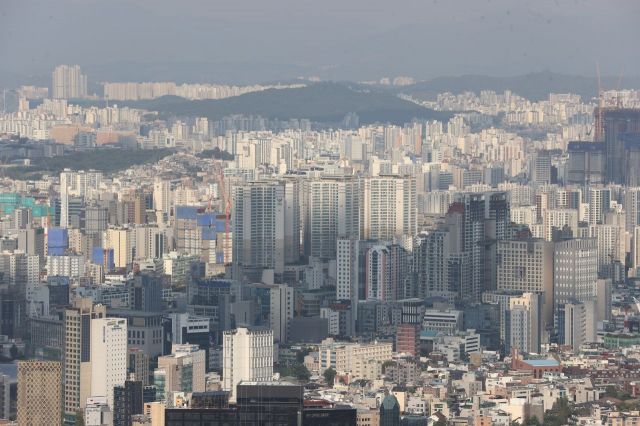
[Asia Economy Reporter Ryu Tae-min] As housing prices soar to unprecedented heights, the gap between the income and housing prices of median households in the Seoul area has widened to an all-time high. The Price-to-Income Ratio (PIR), which was 12.9 as of June 2019, surged to 18.5 in just two years by June of this year. PIR is calculated by dividing the median housing price by the income of the median household, meaning that one would have to save their entire income for 18 years and 6 months without spending a single penny to buy a house.
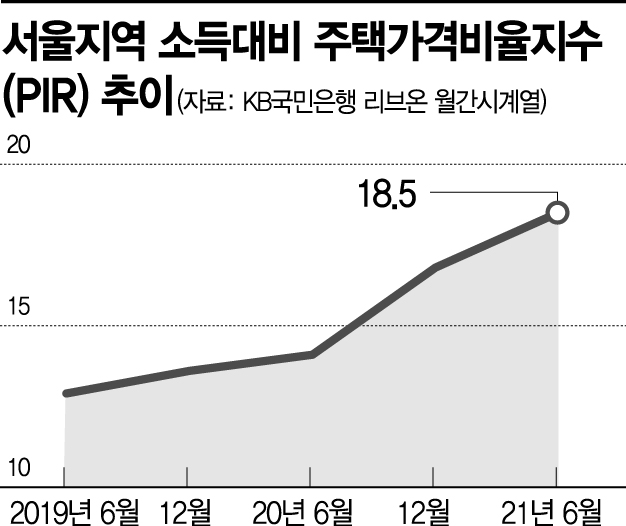
According to KB Housing Price Trends on the 21st, the PIR index for the Seoul area was recorded at a historic high of 18.5 as of June this year. The PIR index was 12.9 in June 2019, rose to 14.1 in June last year, and then increased by 4.4 within just one year. This means that a median household that planned to buy a house last year would now need to save an additional 4 years and 5 months’ worth of income to purchase a home.
The Housing Affordability Index (HAI) also recorded its lowest level ever. According to statistics from the Korea Real Estate Board on the same day, the HAI for apartments in Seoul in the second quarter of this year was 59.4. The apartment HAI for the metropolitan area was 91.7, and both indicators are the lowest since the statistics began in the fourth quarter of 2012. The HAI shows the ability of a household with median income to afford the principal and interest payments on a loan from a financial institution to purchase a median-priced home. An HAI of 100 means that median-income households earn enough to cover loan repayments, indicating that they can purchase homes without difficulty. The closer the index is to 50, the more than half of the income is used for loan repayments.
A representative from the Korea Real Estate Board explained, “The rapid rise in housing prices has far outpaced income levels. On top of this, loan regulations have been tightened, making it even more difficult for the middle class to own homes.”
Experts believe that the recent sharp contraction in housing transactions is also due to housing prices exceeding affordable levels combined with stricter loan regulations. A representative from the Korea Construction Industry Research Institute said, “Considering that the average interest rate on newly executed mortgage loans this month is approaching 2.9%, and that the scale of mortgage and jeonse loans is shrinking, it has become even harder for the housing non-owners to enter the existing housing market.”
Due to fatigue from price increases, a transaction freeze continues not only in Seoul but also in the metropolitan area’s sales market, leading to a slowdown in the rate of price increases. According to the Korea Construction Industry Research Institute, the monthly apartment price change rate in the metropolitan area last month was 0.5%, the lowest since September 2019 (1.54%). Compared to the monthly increase rate of 2.34% in January, it has dropped to about a quarter.
© The Asia Business Daily(www.asiae.co.kr). All rights reserved.
![Clutching a Stolen Dior Bag, Saying "I Hate Being Poor but Real"... The Grotesque Con of a "Human Knockoff" [Slate]](https://cwcontent.asiae.co.kr/asiaresize/183/2026021902243444107_1771435474.jpg)

















