Young Family Caregivers Devoting Their Youth to Supporting Relatives
Defined as 'Young Carers' Overseas... Support Policies Underway
Domestic Surveys on the Situation Are Inadequate
"Urgent Need for Surveys and Assessment of Care Service Demand"
 Books capturing the voices of young people who have recently taken on the responsibility of supporting their parents at an early age have been published, drawing attention. The photo is unrelated to specific expressions in the article. / Photo by Pixabay
[Asia Economy Reporter Lim Juhyung] "At the hospital, I was called a 'guardian,' at public institutions a 'proxy' or 'support obligor.' People around me also called me a 'filial son.' Before I knew it, I became the 'head of the household' responsible for two lives, and money, work, illness, and caregiving overwhelmed or exceeded me."
This is the sentiment recorded in the memoir "I Became My Father's Father," published in 2019 by writer Jo Gihyeon. Jo has endured about nine years caring for his father, who was diagnosed with dementia at the young age of 20. He confesses that he had to live as a "high school graduate dirt spoon support obligor," giving up all opportunities such as education and self-development to take care of his father.
Youth support obligors who had no choice but to waste their youth caring for bedridden parents are raising their voices. This is because, as the aging and low birthrate society accelerates, the number of young people caring for their parents from an early age is gradually increasing. Japan and Western advanced countries, which experienced aging societies earlier than Korea, refer to these individuals as "young carers" and have been actively implementing various support measures, but the situation in Korea remains insufficient.
Jo is not the only one who has published a book about the hardships of supporting family members from a young age. Last year, "Protecting a Ninety-Year-Old Superwoman" (Yoon Ijae), a memoir about caring for a grandmother, was published. On the 8th, KBS 1TV's "Current Affairs Direct" aired a program focusing on cases of young support obligors, drawing attention.
The increase in the number of young people bearing the burden of parental care seems closely related to the rapidly approaching aging and low birthrate society. In the past, when parents were ill, multiple children could take turns providing care, but now one or two children must bear the full responsibility. Also, as the average age of parents having their first child rises, the age of children becoming support obligors tends to decrease.
In Japan, which experienced an aging society earlier than Korea, a clear correlation between the aging society and young support obligors is evident. In September, Saitama Prefecture conducted a household survey and found that about 4.5% of middle school students in the city were support obligors responsible for family care.
 Saitama Prefecture in Japan, which experienced aging earlier than Korea, has about 4.5% of local middle school students bearing the burden of family care. The photo is unrelated to any specific expression in the article. / Photo by Yonhap News
As a result, Japan and Western advanced countries have long been focusing on managing young caregivers. For example, in the UK, youths under 18 who support their families are called "young carers." In 2014, the "Children and Families Act" legally defined young carers, and since 2019, various policies such as subsidies have been implemented. Australia, a member of the Commonwealth like the UK, includes youths up to 25 years old as young carers.
These welfare-advanced countries already provide support for young carers through health authorities. The UK's National Health Service (NHS) details the rights and benefits of young carers on its official website. According to the description, "Young carers can request assistance such as social worker visits from local governments," and "social workers help not only with the care recipient but also with your education, job training, leisure opportunities, and future."
Japan, which is already a super-aged society with a national average age of 48.4 years as of last year, has also established a welfare system for young carers. The Japanese government provides services such as household labor support and caregiving for young carers struggling with their studies and offers online counseling.
Unlike advanced countries, Korea has yet to conduct a proper household survey, so the exact number of young carers is unknown.
However, in Korea, the perspective that parental support is a "social collective responsibility" rather than solely a family matter is gradually increasing, leading to calls for active discussions on supporting young carers.
According to a social survey by Statistics Korea from 2002 to 2018, the change in public perception regarding "who should be responsible for parental support" is clearly revealed.
In 2002, 70.7% of respondents said the family should be responsible for support, a majority, but in the most recent 2018 survey, this dropped to 26.7%. Conversely, 54.0% answered that society or others should take responsibility. This indicates that more people recognize caregiving as a "public domain."
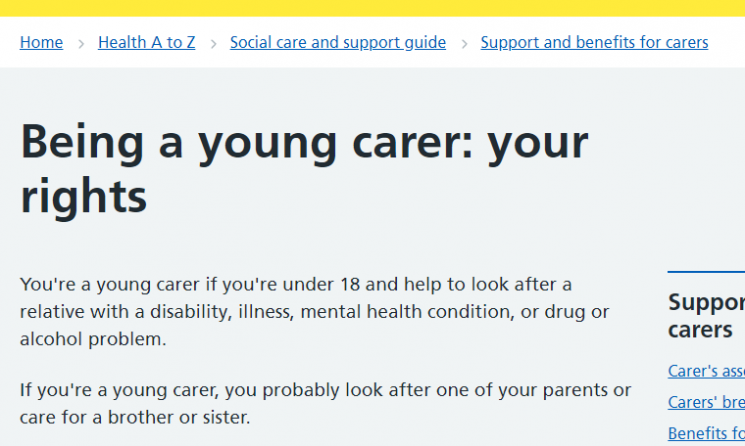 In 2014, the UK health authorities legally defined young carers through the 'Children and Families Act' and have already implemented related support policies. The photo shows an explanation of the rights and benefits for young carers from the UK's National Health Service (NHS). / Photo by NHS official website capture
Civilians also voiced that the state should bear some responsibility for family support. A 20-something office worker, A, who once cared for a grandmother with dementia, said, "I had to handle job preparation and grandmother's care simultaneously, and I was exhausted from studying while nursing her. Since I was the only one with free time at home, I did it without complaint." He emphasized, "There must be many families worse off than mine, and I think the state should step in to ease the burden for such people."
Another office worker, B (31), said, "The twenties are one of the most important periods in life for education and building credentials, so if all that time is wasted on caregiving, how can one find a job?" He urged, "Caregiving should be considered an important part of the social safety net, and the state must take action."
Voices calling for urgent national attention to young carers also emerged in the political sphere. Kim Seongju, a member of the National Assembly's Health and Welfare Committee from the Democratic Party, said on the 6th, "In Korea, there is no legal definition or support basis for young carers, so basic status surveys or statistical compilations have not been conducted. Australia, with about half our population, has identified approximately 250,000 young carers through surveys."
He added, "Our government must actively prepare support measures for young carers," emphasizing, "The Ministry of Health and Welfare and related departments should jointly conduct a young carer survey and simultaneously identify and support care service demands tailored to characteristics such as caregiving and household help."
© The Asia Business Daily(www.asiae.co.kr). All rights reserved.
![Clutching a Stolen Dior Bag, Saying "I Hate Being Poor but Real"... The Grotesque Con of a "Human Knockoff" [Slate]](https://cwcontent.asiae.co.kr/asiaresize/183/2026021902243444107_1771435474.jpg)

















