Homework of K-Art Seen Through Kia Pro
Galleries Keep Sales Prices Confidential
Aggregate Sales Figures Calculated from Bulk Notifications
If Only a Few VVIPs Bought High-Priced Works
It Cannot Be Seen as Art Fair Success
Even with VVIP Tickets, Second Priority
VVVIP Customers Bought Works Before Opening
General Audience Feels Deprived Seeing 'Red Tags'
Class Consciousness Grows, Failing to Garner Public Sympathy
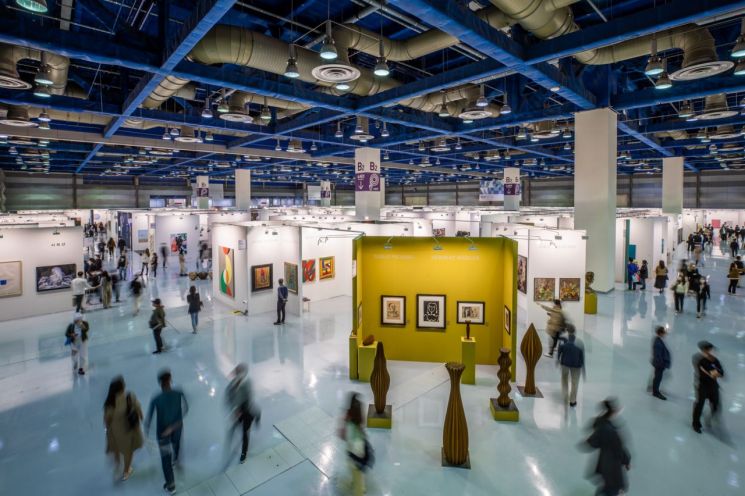 The exhibition hall view of the 'Korea International Art Fair (KIAF)' held from the 13th to the 17th at COEX, Samseong-dong, Gangnam-gu, Seoul. (Photo by Korea Gallery Association)
[Asia Economy Reporter Donghyun Choi] Korea International Art Fair (KIAF), the largest art market in Korea, closed with a record-breaking sales figure of 65 billion KRW, the highest in the history of domestic art fairs. The factors behind this success can be summarized as the abundant liquidity in the market, the entry of MZ generation (Millennials + Generation Z) collectors, and the rising appeal of Seoul amid the restructuring of the Asian art market. However, beneath this unprecedented boom lie numerous challenges that the domestic art community must address. Experts warn that if long-standing issues such as the industry's inherent closed nature and information asymmetry are not resolved, 'K-Art' will remain mere empty rhetoric.
Still Ambiguous Art Market Statistics... "Losing Trust Means the Boom Ends"
The Korea Gallery Association, which organizes KIAF, issued a press release on the afternoon of the 17th, after the event closed, announcing that this year's KIAF achieved sales of 65 billion KRW. When asked for the top 10 list of artworks and their prices, the association said it was difficult to provide such information because galleries do not disclose exact sales prices. As a result, the association calculated total sales by aggregating daily sales figures unilaterally reported by each gallery.
The number of artworks sold was not disclosed either. The association revealed that on the opening day, which was also the VVIP viewing day on the 13th, sales exceeded half of the total, reaching 35 billion KRW, with 5,000 visitors attending. However, this sales figure could be achieved if just 10 super collectors (VVIPs) each purchased one artwork worth 350 million KRW. Some works by Takashi Murakami and George Condo, estimated to be worth 2 to 4 billion KRW, were traded before and on the opening day and counted in the VVIP statistics. If only a few among the 5,000 VVIPs bought high-priced artworks by a small number of artists, the event's success would be far from certain.
The art market, operated in the dark, is bound to lose trust in the long run. Stocks have disclosures and charts, and real estate has official prices and actual transaction prices. But such basic statistical data are completely absent in the art market. Although there are price ranges per artist, the general public cannot know them, and the price of artworks is set by galleries or artists. One art collector pointed out, "Gallery A raised the price of artworks by 2.5 times without any change in the price per piece, yet they sold out, and based on this, prices have recently increased," adding, "The art market is precisely a place where so-called manipulation groups can operate easily."
Art critic Junmo Jeong (former curator at the National Museum of Modern and Contemporary Art) said, "To explain the boom in the art market, accurate statistics and evidence must support it, but only ambiguous numbers are rampant," and warned, "If this situation continues, the driving force sustaining the art market boom will inevitably weaken."
Still an Exclusive 'Their' League
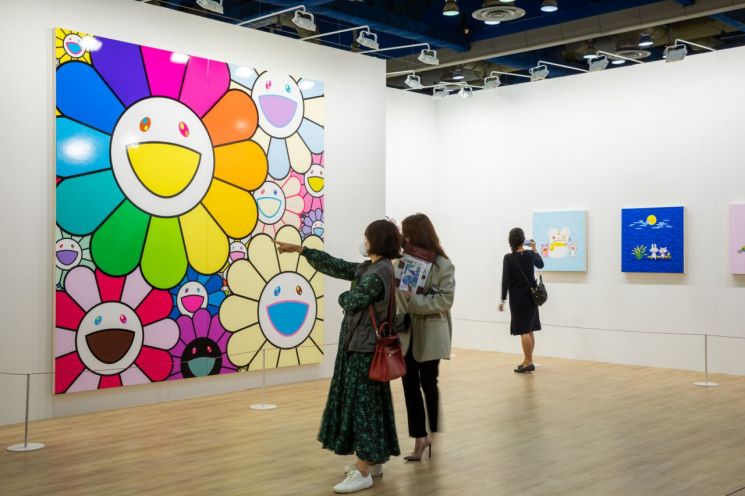 Visitors are exploring the 'Korea International Art Fair (KIAF)' held from the 13th to the 17th at COEX in Samseong-dong, Gangnam-gu, Seoul. (Photo by Korea Gallery Association)
Following the global success of K-pop, K-movies and K-dramas such as Parasite and Squid Game have recently gained worldwide attention. One common factor behind the success of Parasite and Squid Game is their critique of the 'winner-takes-all society' and 'class inequality.' These issues are global phenomena, and empathy has spread rapidly regardless of country. BTS, the leader of K-pop, has also gained worldwide popularity through critical messages about racial discrimination and hatred, as well as musical communication and harmony that transcend nationality and language.
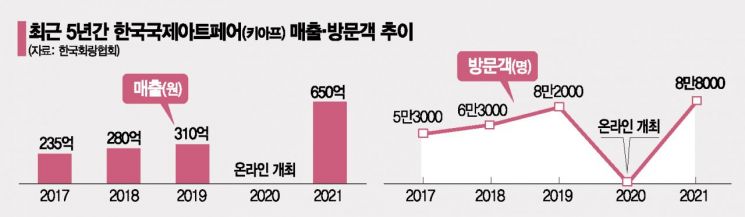
But what about 'K-Art'? As confirmed once again through this KIAF, the domestic art world has rather reinforced its own 'class consciousness,' failing to gain public empathy. Compared to 2019, when the offline market was held, the number of visitors increased by only 7% (6,000 people). Although COVID-19 was a special circumstance, considering the unusual boom in the art market and the 'with corona' policy, the atmosphere was different from past events where tens of thousands of visitors increased annually. There is also criticism that the event failed to properly integrate the 30-40 age group, the main drivers of this year's art market boom, with the existing major collector group of 50-60s.
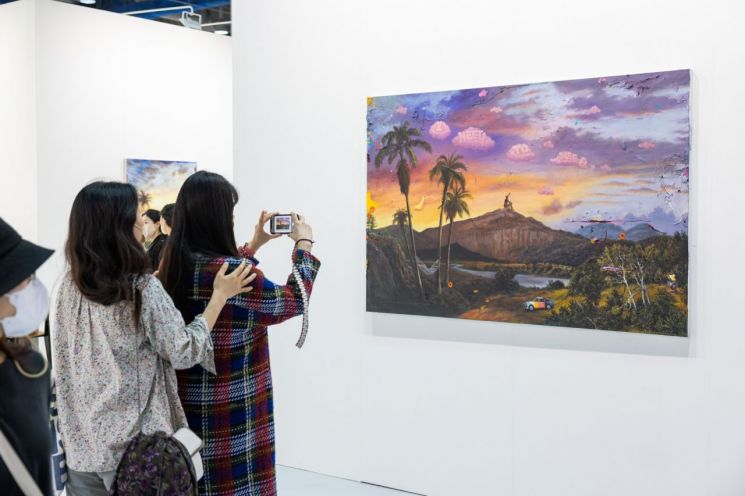 Visitors are appreciating artworks at the 'Korea International Art Fair (KIAF)' held from the 13th to the 17th at COEX, Samseong-dong, Gangnam-gu, Seoul. (Photo by Korea Gallery Association)
A representative example is the newly introduced VVIP ticket this time. It is a premium that allows viewing and purchasing artworks a day before the VIP day. Most VVIP tickets were distributed by galleries exhibiting at KIAF. Although sold on the market for 300,000 KRW each, they were limited to 100 tickets.
The problem was that even those who managed to get VVIP tickets faced invisible 'barriers.' These were super collectors already recognized for their 'purchasing power' by galleries. They bought major artworks at discounted prices even before the opening. This is comparable to pre-listing purchases in the cryptocurrency market. A collector in their 40s who participated in this KIAF with a VVIP ticket said, "I got a VVIP ticket but learned this time that there is a VVVIP ahead of that," adding, "Super collectors, mostly elderly with rich gallery networks, swept up popular works before the opening," expressing frustration. Suyeon Lee, a 30-something office worker who attended during the general viewing period, said, "Seeing red stickers indicating that VVIPs and VIPs had already purchased many artworks in the galleries made me feel deprived," and added, "It was also disappointing not to see expected artworks due to replacements after sales."
Yunseop Kim, CEO of IF Art Management Research Institute, pointed out, "It is true that programs to ensure that visitors do not leave disappointed and become potential customers were insufficient," and emphasized, "Customer-centric services should be further developed through online platforms and the changing media environment."
© The Asia Business Daily(www.asiae.co.kr). All rights reserved.
![Clutching a Stolen Dior Bag, Saying "I Hate Being Poor but Real"... The Grotesque Con of a "Human Knockoff" [Slate]](https://cwcontent.asiae.co.kr/asiaresize/183/2026021902243444107_1771435474.jpg)


















