Integrated Provision of Lifecycle Welfare Service Information for Over 3,000 Types
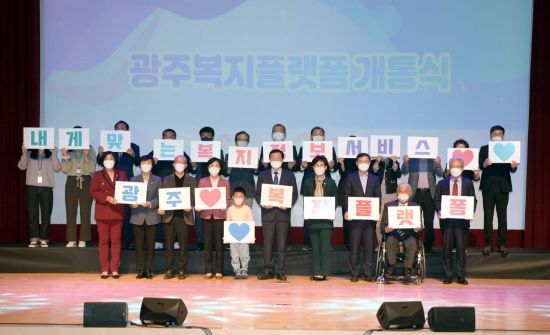
[Asia Economy Honam Reporting Headquarters Reporter Yoon Jamin] Gwangju Metropolitan City has established the ‘Gwangju Welfare Platform,’ where over 3,000 types of customized welfare information by life cycle can be viewed in one place, and began service on the 18th.
On the same day, Gwangju City announced that it held the opening ceremony of the Gwangju Welfare Platform with about 50 attendees including Mayor Lee Yong-seop, heads of social welfare-related organizations, welfare activists, and citizens.
The opening ceremony proceeded in the order of screening major achievements and promotional videos of Gwangju welfare innovation, demonstration of the Gwangju Welfare Platform, and the opening performance of the Gwangju Welfare Platform.
Mayor Lee said, “The Gwangju Welfare Platform will support the success of the ‘Gwangju-type welfare model’ by conveniently providing citizens with the information they want when they need it, offering jobs to those who can work and providing customized welfare to those who cannot. We will unite regional capabilities to realize a Gwangju community where no one is excluded or discriminated against and all citizens are happy.”
The Gwangju Welfare Platform is a project promoted to establish a welfare integrated computer network based on big data to digitalize welfare demand and supply and to enable customized welfare services according to individual life cycles. It underwent a one-month pilot operation period.
In the case of Gwangju City, although the welfare-related budget has rapidly expanded to account for 40% of the total budget, there have been continuous criticisms that citizens’ perception of welfare is low.
Accordingly, the Gwangju Innovation Promotion Committee directly under the mayor proposed the ‘Direction for Establishing the Gwangju-type Welfare Model’ in June 2019 and recommended the need to build the ‘Gwangju Welfare Platform’ to reorganize the welfare delivery system from a supplier-centered to a demand-centered approach.
The Gwangju Welfare Platform is a portal system that comprehensively covers various welfare information contained on welfare websites by sector. It integrates and provides information on more than 3,000 welfare services offered by the national government, local governments, and private welfare facilities by life cycle, and is designed so that individuals can easily find welfare information tailored to their household situation or areas of interest.
In addition, the platform has built big data based on the welfare total volume survey results conducted by the Gwangju Welfare Institute, welfare statistics by sector, and information on about 3,000 welfare institutions in the region. It also provides a ‘Welfare Status Map’ that allows users to see local welfare facilities and welfare statistics at a glance using infographics.
Furthermore, it links welfare-related news and welfare-related job information provided by Worknet, enabling real-time checking. Through the corporate facility management system, it discloses information such as social welfare facilities’ budgets and settlements, and details of donations, which is expected to contribute to improving transparency and integrity in facility operations.
Especially, when signing up as a member, if users enter their ‘areas of interest,’ they can receive welfare information tailored to their household situation or topics of interest through the ‘AI Customized Notification Service.’ It also offers online welfare service applications and simulation calculation functions in connection with the Ministry of Health and Welfare’s ‘Bokjiro’ system.
The city is conducting a membership registration event on the website until the 6th of next month to promote citizen use and will provide prizes to 50 people selected by lottery.
The event can be checked through the event banner and notices on the Gwangju Welfare Platform homepage.
© The Asia Business Daily(www.asiae.co.kr). All rights reserved.
![Clutching a Stolen Dior Bag, Saying "I Hate Being Poor but Real"... The Grotesque Con of a "Human Knockoff" [Slate]](https://cwcontent.asiae.co.kr/asiaresize/183/2026021902243444107_1771435474.jpg)















