Environmental Science Institute, International Joint Field Survey
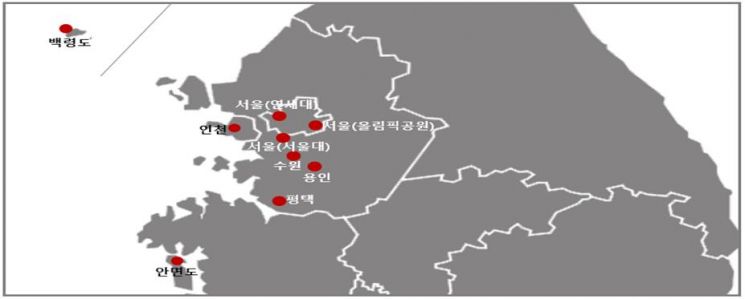
[Asia Economy Reporter Joo Sang-don] The National Institute of Environmental Research under the Ministry of Environment announced on the 17th that, together with 25 domestic and international research teams including NASA, it will conduct the Global Monitoring Air Pollution 2021 (GMAP2021), an international joint preliminary survey of air quality, from the 18th to November 26th to identify the distribution of air pollutants in the Seoul metropolitan area.
This survey is a preliminary investigation for the second international joint air quality survey scheduled for 2022 to 2024. The purpose is to create a three-dimensional pollution map by observing air pollutants in the metropolitan area three-dimensionally using ground, aircraft, and satellite measurements.
In this preliminary survey, the main components and causative substances of ultrafine dust, such as nitrate and organic aerosols, will be measured and analyzed to elucidate the formation mechanism of secondarily generated ultrafine dust.
Additionally, the distribution of air pollutants measured using ground (vehicles), aircraft, and sondes will be compared and analyzed with satellite data to improve the reliability of environmental satellite-derived concentration information for fine dust, nitrogen dioxide, and other pollutants.
Based on the results derived from this preliminary survey, the National Institute of Environmental Research plans to carry out the second international joint air quality survey from 2022 to 2024. The first international joint air quality survey (KORUS-AQ) was conducted with NASA in May-June 2016, producing results such as the amount of secondarily generated ultrafine dust and key factors in ozone formation through measurement and analysis of air pollutants including ultrafine dust. The second international joint air quality survey will be promoted together with the United States, Europe, and Asian countries preparing to launch geostationary environmental satellites similar to Korea, as well as those within the environmental satellite observation area. The research target area will also be expanded to the Korean Peninsula and Asia to conduct air pollution research and environmental satellite validation.
Jung Eun-hae, head of the Climate and Atmospheric Research Division at the National Institute of Environmental Research, said, "Through this international joint preliminary air quality survey, we expect to clarify the formation process of fine dust in the metropolitan area, suggest future directions for air quality management policies, and secure international reliability of environmental satellite data to contribute to the improvement of the Asian atmospheric environment."
© The Asia Business Daily(www.asiae.co.kr). All rights reserved.
![Clutching a Stolen Dior Bag, Saying "I Hate Being Poor but Real"... The Grotesque Con of a "Human Knockoff" [Slate]](https://cwcontent.asiae.co.kr/asiaresize/183/2026021902243444107_1771435474.jpg)
















