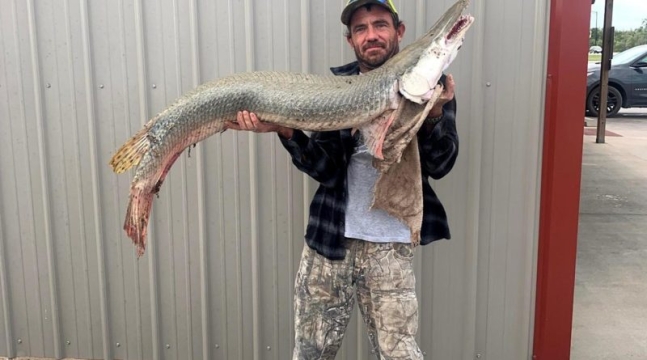
 On the 20th of last month, Danny Lee Smith, who was fishing in the Neosho River flowing through Kansas, USA, caught an alligator gar measuring 1.37 meters in length and weighing 17.97 kilograms.
 [Photo by KDWP]
[Asia Economy Reporter Sumi Hwang] The "Alligator Gar," also known as a "living fossil," was discovered in the Neosho River in the United States, raising concerns that it could disrupt the local ecosystem.
According to recent reports from CNN and others, on the 20th of last month, Danny Lee Smith, who was fishing in the Neosho River in Kansas, caught an alligator gar measuring 1.37 meters in length and weighing 17.97 kilograms.
The alligator gar is a primitive ray-finned fish whose fossil records date back about 100 million years. It is characterized by a snout that resembles that of a crocodile.
Typically, alligator gars are mainly found in the swamps of the southeastern United States, Mexico, and Nicaragua, and can grow up to approximately 4 to 6 meters. It remains unclear how the alligator gar discovered this time is living in the Neosho River.
Additionally, unlike other native species commonly seen in Kansas such as the longnose gar, shortnose gar, and spotted gar, this is reported to be an invasive species.
Smith also said that although he had previously seen longnose gar, shortnose gar, and spotted gar around Kansas, this was the first time he had seen an alligator gar, adding, "This is definitely a once-in-a-lifetime event."
The alligator gar is considered one of the dangerous fish species capable of attacking humans. Because of this, there are concerns that if the alligator gar is introduced, it could destroy the surrounding ecosystem.
Kansas authorities are investigating the possibility that someone might have released it into the wild after keeping it as an ornamental fish.
© The Asia Business Daily(www.asiae.co.kr). All rights reserved.

















