US New Unemployment Claims Enter 200,000 Range
"Recovery Slows Due to Delta Variant but Anxiety Significantly Eases"
Expected Inflation Key... Stable in Long Term
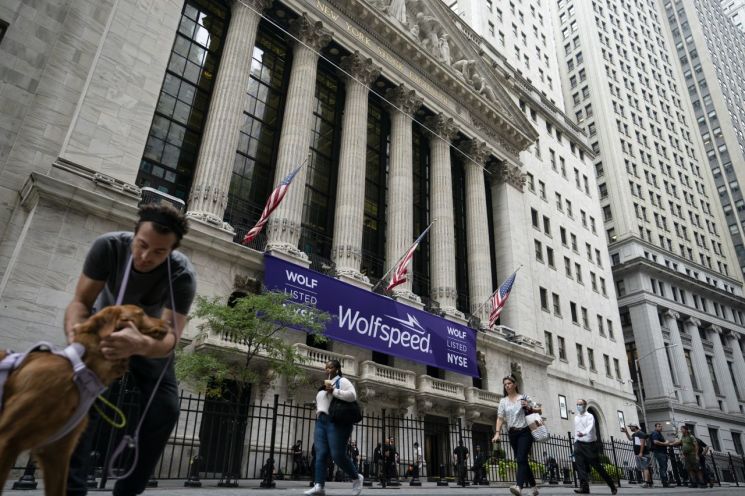 On the 4th (local time), pedestrians are passing in front of the New York Stock Exchange building in Manhattan, New York City, USA. [Image source=Yonhap News]
[Asia Economy Reporter Minwoo Lee] Concerns over the COVID-19 Delta variant are expected to have a limited impact on the economy and stock market. Analysts suggest that attention should be paid to long-term inflation expectations going forward.
On the 16th, KB Securities forecasted that concerns related to the Delta variant would not pose a problem until next year, provided there is no resurgence of COVID-19. The employment market is already gradually improving. The U.S. Department of Labor announced on the 14th (local time) that new unemployment claims for the week of October 3?9 totaled 293,000, a decrease of about 36,000 from the previous week. This marks the first time since the second week of March last year, when the employment market was shocked by the spread of COVID-19, that claims have fallen into the 200,000 range. The figure is also significantly below the expert forecast of 320,000 compiled by Bloomberg News.
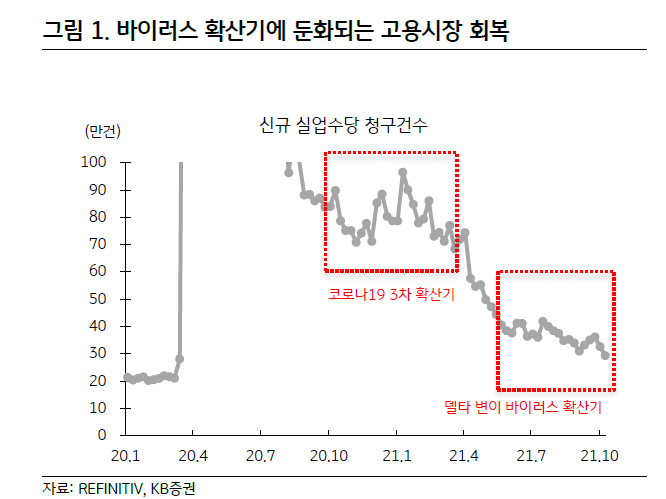
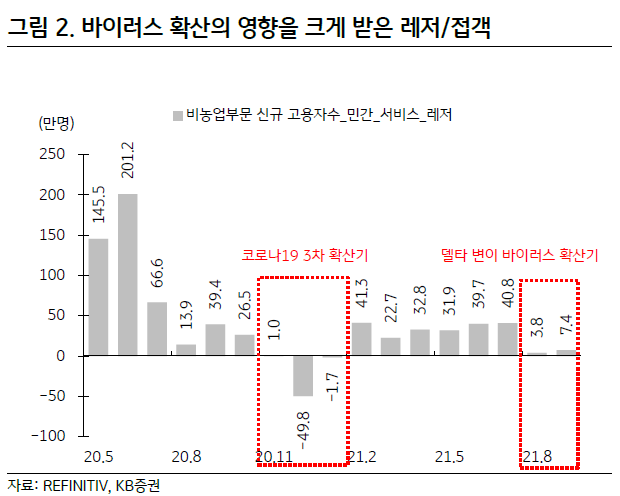
However, the rate of decline has somewhat slowed since claims first entered the 300,000 range weekly in May. The weakening momentum in the employment market recovery is attributed to the spread of the Delta variant. The poor U.S. employment data last month is also seen in this context. Earlier, the U.S. Department of Labor announced on the 8th (local time) that nonfarm payrolls increased by 194,000 in September, less than half of the market expectation of a 500,000 increase compiled by Dow Jones. This was the smallest monthly increase so far this year.
Kim Ilhyuk, a researcher at KB Securities, explained, "Looking at the fact that employment in the leisure and hospitality sectors, which were heavily affected by the COVID-19 pandemic from late last year to early this year, did not increase in August and September, it is clear that the Delta variant had an impact. Although it is unfortunate that monthly indicators free from the influence of the Delta variant have not yet appeared, the fact that new unemployment claims have entered the 200,000 range means that concerns about the employment market have significantly eased."
He analyzed that the key issue is long-term inflation expectations. At the beginning of this year, central banks and markets generally viewed price increases as temporary. However, recently, concerns have grown that inflation may not be temporary. Researcher Kim explained, "It was expected that COVID-19 would soon be controlled, but as the timing of escaping the influence of COVID-19 was delayed due to the spread of the Delta variant, the upward trend in inflation also continued."
The concern about sustained inflation is based on inflation expectations. If expected inflation, which reflects economic sentiment on the ground, rises, it can actually drive up prices. The median one-year expected inflation surveyed by the New York Federal Reserve in September recorded 5.3%, marking an 11th consecutive month of increase. The median three-year expected inflation also rose for the third consecutive month to 4.2%. Both are the highest since the survey began in 2013.
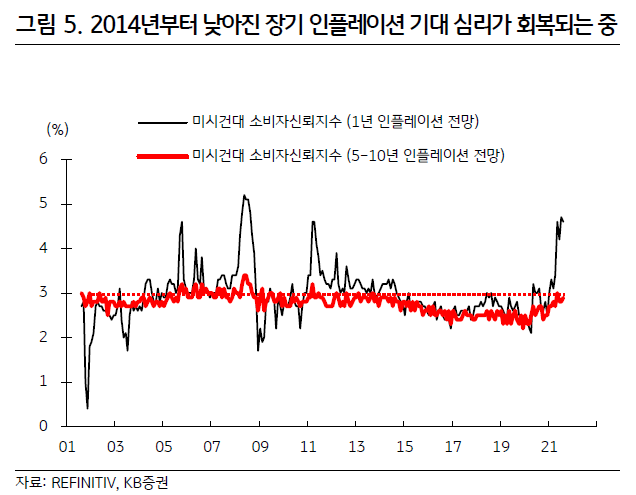
However, Jerome Powell, Chair of the U.S. Federal Reserve (Fed), recently downplayed the significance of the New York Fed’s 'consumer expectations survey' during a press conference following the Federal Open Market Committee (FOMC) meeting, noting that the survey has only been conducted for eight years. The New York Fed also did not express major concerns about the rise in short- and medium-term inflation expectations. According to a research report published by the New York Fed last month, while one- and three-year inflation expectations have increased, five-year inflation expectations have not significantly changed compared to pre-pandemic levels.
Researcher Kim said, "The fact that long-term inflation expectations are well anchored aligns with the assessment of Charles Evans, President of the Chicago Fed, that 'inflation increases due to supply disruptions will not raise long-term inflation expectations.' Although close observation is necessary going forward, if the upward trend in inflation begins to slow, long-term inflation expectations are expected to remain well anchored as they are now."
© The Asia Business Daily(www.asiae.co.kr). All rights reserved.
![Clutching a Stolen Dior Bag, Saying "I Hate Being Poor but Real"... The Grotesque Con of a "Human Knockoff" [Slate]](https://cwcontent.asiae.co.kr/asiaresize/183/2026021902243444107_1771435474.jpg)

















