Vulnerable Groups Pushed to the Edge
Direct Hit from COVID-19-Induced Unemployment
Unable to Repay Debt Even After Selling Assets
High Risk of Default
"Selective Financial Support" Public Opinion
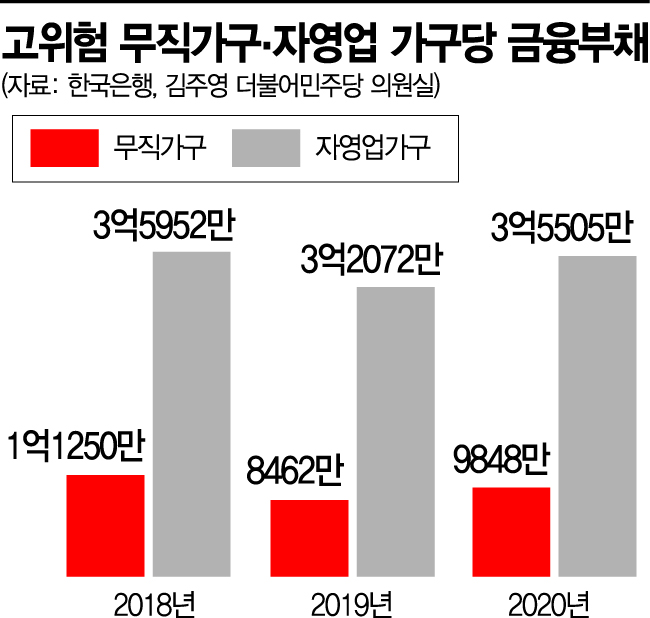
[Asia Economy Reporter Jang Sehee] The increase in high-risk unemployed households can be interpreted as meaning that vulnerable groups are being pushed to their limits. Since the COVID-19 outbreak, face-to-face jobs have decreased, while low interest rates have made borrowing easier, creating a foundation for the rise in high-risk unemployed households. However, as the Bank of Korea has announced plans to normalize the base interest rate in line with improvements in financial and economic conditions, concerns are emerging that debt repayment by these vulnerable groups during the interest rate hike period could become a weak link in financial instability.
◆‘COVID-19-induced Employment Freeze’... Unemployed Households Account for 16.4% = According to the ‘Status of the Proportion of Unemployed Households among High-Risk Households’ submitted by the Bank of Korea on the 15th to the office of Assemblyman Kim Ju-young of the National Assembly’s Planning and Finance Committee, the proportion of unemployed households among all high-risk households increased from 13.1% in 2018 to 16.4% last year. This means that more than 3 households out of 100 have become unemployed households over two years. The debt per household for these groups was 98.48 million KRW last year, an increase of 13.86 billion KRW compared to 2019.
More serious than the increase in debt is the fact that even if these households sell all their assets, such as real estate, they cannot repay their debts. Professor Andonghyun of Seoul National University’s Department of Economics stated, "Unemployed households currently have no income, so the risk of default is relatively high," adding, "If they incur additional debt, they will ultimately have no choice but to declare insolvency."
The sharp increase in the number of unemployed households during the COVID-19 period is closely related to the economic recession and deterioration of the labor market. According to the employment trend data released by Statistics Korea for December last year and the annual report, the number of employed persons decreased by 218,000 in 2020, marking the largest decline since 1998. The annual number of unemployed persons last year was 1.11 million, the highest since 2000.
The risk of default among high-risk households also appeared in ‘self-employed’ households. Last year, the financial debt per self-employed household among high-risk households was 355.05 million KRW, a 10.7% increase from the previous year (320.72 million KRW). The total financial debt of self-employed households has been continuously increasing from 30.2 trillion KRW in 2018 to 38.7 trillion KRW last year.
However, the Bank of Korea currently does not have data on the status of ‘vulnerable borrowers’ who are multiple debtors with low income or low credit and are either self-employed or unemployed. This is because it is difficult to identify the borrower’s employment type through the household debt database managed by the Bank of Korea.
◆"Selective Fiscal Support Needed"= Experts point out that the increase in financial debt among unemployed households could lead to defaults at the financial institutions involved. They argue that ‘selective fiscal support’ is necessary. Professor Sung Tae-yoon of Yonsei University emphasized, "The increase in debt among unemployed households restricts consumption and is likely to lead to loan defaults," adding, "Since the unemployed have a low chance of recovery, selective support through fiscal measures is needed."
The Bank of Korea also analyzed in its ‘Business Status’ report submitted to the National Assembly’s Planning and Finance Committee on the same day that if household debt exceeds an appropriate level, consumption could be constrained due to the burden of debt repayment.
Professor Jeong Se-eun of Chungnam National University’s Department of Economics said, "Monetary policy is decided by looking at the overall financial situation, not just one group," adding, "While raising interest rates, it is necessary to consider selective support for unemployed households at risk." She also emphasized, "It is important to supplement financial welfare networks and employment welfare networks as needed."
Professor Ahn also stated, "The increase in financial debt among unemployed households leads to an increased risk of default across the entire financial market," and added, "It is necessary to carefully assess repayment ability and carry out some restructuring." Assemblyman Kim said, "The central bank should also consider ways to financially support vulnerable sectors facing difficulties."
© The Asia Business Daily(www.asiae.co.kr). All rights reserved.
![Clutching a Stolen Dior Bag, Saying "I Hate Being Poor but Real"... The Grotesque Con of a "Human Knockoff" [Slate]](https://cwcontent.asiae.co.kr/asiaresize/183/2026021902243444107_1771435474.jpg)















