[Asia Economy Reporter Su-yeon Woo] Recently, as the shipping market recovers, global shipping companies have significantly increased new ship orders, but the transportation capacity of South Korean shipping companies remains at the level of five years ago.
According to the report "International Comparison and Implications of the Shipping Industry" released by the Federation of Korean Industries (FKI) on the 14th, South Korea's share of shipping capacity was 3.9% as of 2020, remaining around 4% for five years since 2016. The FKI emphasized that the share of shipping capacity, which indicates shipping transportation capability, declined following the bankruptcy of Hanjin Shipping in 2016 and has yet to recover. They stressed the urgent need to improve systems to enhance the stability of South Korea's shipping industry and facilitate smooth investment.
The shipping industry is classified as a market of intense competition aimed at cost reduction, with low service differentiation among shipping companies. During the prolonged downturn in the shipping market in the past, a "chicken game" of low freight rates occurred, causing shipping companies without cost competitiveness to drop out, and Hanjin Shipping was also liquidated during this period. Meanwhile, global major shipping companies gradually strengthened their dominance through aggressive mergers and acquisitions (M&A), leading to market oligopoly dominated by a few large shipping companies.
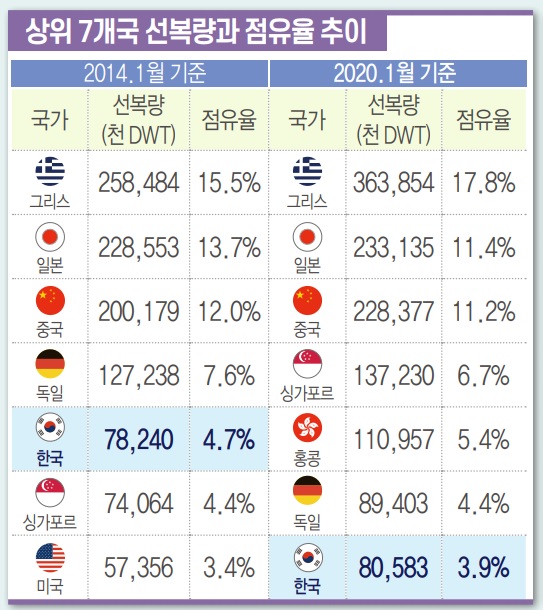
Meanwhile, amid recent increases in cargo volume and rising shipping rates, global shipping companies have significantly increased new ship orders, but the order volume of South Korean shipping companies is far below the global leading level. According to Clarkson Research, this year's global container ship orders have surpassed the largest scale since records began in 1996, and the world's second-largest shipping company, Swiss MSC, is reported to have recently placed new orders totaling 900,000 TEU, which is even larger than the entire capacity of South Korea's HMM (830,000 TEU).
On the other hand, South Korea has yet to recover its shipping capacity and route share since the bankruptcy of Hanjin Shipping. This year, the market share of the top two domestic shipping companies on the Asia-West Coast of the United States route was 7.3%, down 4.1 percentage points from 11.4% in 2016.
Recently, as demand rapidly rebounded after COVID-19, global cargo volume has explosively increased, causing ongoing logistics crises, but Korean shipping companies have not benefited from this. The so-called "Korea Passing" phenomenon is also occurring, where fleet formation is concentrated in Chinese companies that have achieved economies of scale. At the same time, freight rates from Busan to LA have surged 3.4 times compared to the previous year, and rates to Hamburg have increased 6.2 times, continuing to burden export companies.
The FKI emphasizes that to survive global competition, South Korean shipping companies need to expand their shipping capacity and market share. To this end, securing the domestic shipping companies' cargo loading rate for domestic cargo, which is lower than in other countries, is essential, and the establishment of ship financing to support capital investment in shipping companies is necessary.
They also argued that support for ship financing, such as tax benefits for investors, should be strengthened to facilitate ship investments for domestic shipping companies that face difficulties in financial procurement due to high debt ratios. They added that regulations prohibiting the entry of large cargo owners into the shipping industry should be improved to allow equity investment by large cargo owners or public institutions in shipping companies.
Yoo Hwan-ik, head of corporate policy at the FKI, said, "The 'Korea Passing' phenomenon that emerged during the COVID-19 crisis has provided an opportunity to recognize the importance of the shipping industry again," and emphasized, "Shippers and shipowners should create a stable win-win cooperation structure and seek long-term growth strategies for the shipping industry."
© The Asia Business Daily(www.asiae.co.kr). All rights reserved.
![Clutching a Stolen Dior Bag, Saying "I Hate Being Poor but Real"... The Grotesque Con of a "Human Knockoff" [Slate]](https://cwcontent.asiae.co.kr/asiaresize/183/2026021902243444107_1771435474.jpg)















