Last Year, Auto Insurance Fraud Accounts for 42.6% of All Insurance Fraud...Detected Amount Reaches 383 Billion KRW
Diverse Intentional Accident Methods Such as 'Boheombbang', 'Dwitkung', 'Sonmokchigi'
Experts Call for Measures to Shut Down Recruitment of Fraud Conspirators via SNS and Establish Enhanced Penalty Provisions
 Traffic accident. Unrelated to specific expressions in the article. / Photo by Asia Economy DB
[Asia Economy Reporter Kim Soyoung] Intentional car accidents aimed at claiming insurance money are occurring frequently, requiring caution. In some cases, accomplices who can participate in the crime together are even recruited. Their criminal methods vary, including the so-called 'dwigkung'?deliberately rear-ending vehicles. Experts emphasize that harsher penalties should be imposed on these criminals.
According to the Financial Supervisory Service, last year, 42.6% of all insurance fraud cases were automobile insurance fraud, with detected amounts reaching 383 billion KRW. The National Police Agency’s National Investigation Headquarters conducted a "First Half-Year Special Crackdown on Fraud Crimes" from February 1 to June 30, resulting in 1,796 insurance fraud cases, 5,602 arrests, and 65 detentions. By type, false or exaggerated treatment fraud in indemnity insurance was the most common with 863 cases (2,443 people), followed by automobile insurance fraud due to intentional traffic accidents with 505 cases (2,009 people).
On the 13th, Gumi Police Station in Gyeongbuk announced that they arrested nine suspects, including A (22), on charges of receiving insurance money by deliberately colliding with vehicles changing lanes while driving expensive imported cars at intersections (under the Special Act on the Prevention of Insurance Fraud).
They are all seniors and juniors who, from December 2018 to July 2020, used eight vehicles to cause about ten traffic accidents and embezzled approximately 70 million KRW in insurance money.
On the 12th, Busan Police Agency arrested a man in his 20s, A, on charges of violating the Special Act on the Prevention of Insurance Fraud and sent a man in his 40s, B, to prosecution without detention on the same charges. A is accused of causing 37 intentional accidents by colliding with vehicles that changed lanes or violated traffic laws while driving a used imported car, claiming 190 million KRW in insurance money.
B is accused of causing 23 intentional accidents around Busan city since April and pocketing 13 million KRW from insurance companies. Since February last year, Busan police have expanded their traffic crime investigation team to two teams and, as of September, have arrested 142 people and detained eight in 34 cases.
On the 28th of last month, Dongbu Police Station in Gwangju arrested C (20) on charges of fraudulently receiving insurance money worth 16.7 million KRW by causing an intentional traffic accident while carrying his four-month-old daughter (violations of the Special Act on the Prevention of Insurance Fraud and the Child Welfare Act), and his accomplice wife was sent to prosecution without detention.
They are accused of causing accidents twice on August 31 and October 10 last year at an intersection near an apartment complex in Sansu-dong, Dong-gu, Gwangju, by deliberately colliding with vehicles making unprotected left turns and receiving 16.7 million KRW in insurance money. On July 26, A also caused an intentional accident alone at the same location using the same method and received 1.7 million KRW in insurance money.
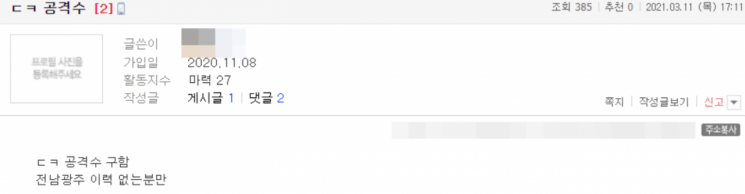 A post seeking accomplices for intentional collisions known as 'dk (Dwitkung)'. Photo by Online Community
Intentional accidents using shared rental cars are also frequent. Looking at the insurance fraud detection amounts by the Rental Car Mutual Aid Association over the past three years, the detected scale has sharply increased: 2.8 billion KRW in 2018, 4.6 billion KRW in 2019, and 7.1 billion KRW in 2020. This is attributed to the fact that rental cars can be easily rented as long as the age requirement is met, and lessees do not bear the burden of increased insurance premiums in case of accidents.
This is mainly carried out as 'conspiracy fraud' involving unspecified many people, where accomplices are gathered through social networking services (SNS) to commit crimes together. Targeting mainly late teens to early twenties, 'dwigkung'?recruiting co-passengers for insurance fraud and deliberately causing accidents?is rampant. Other methods include 'insurance bbang,' which pretends an accident occurred to claim insurance money, and 'wrist tapping,' where the wrist is lightly tapped by passing vehicles in narrow alleys, among various other tactics.
Under the current Special Act on the Prevention of Insurance Fraud, those caught committing insurance fraud face imprisonment of up to 10 years or fines up to 50 million KRW.
Intentional accidents are problematic as fraudulent acts themselves but can also lead to serious accidents, requiring caution. Choi, a man in his 20s, said, "Even if the accident is caused to claim insurance money, I hope people remember that it can put everyone in danger," adding, "Fraud is fraud, but making money in such a risky way is really a big problem."
Experts emphasize the need for institutional measures to prevent this. Kim Hyungkwan, team leader of the Rental Car Mutual Aid Association, said in an interview with YTN Radio's "Wise Radio Life," "Institutional measures should be established to shut down harmful sites recruiting insurance fraud conspirators through SNS, such as by the Broadcast Communications Review Committee," and suggested, "In addition, the Financial Services Commission and the Korea Traffic Accident Compensation Promotion Agency should be granted the right to request data to eradicate insurance fraud, and provisions for aggravated punishment under the Special Act on the Prevention of Insurance Fraud should be newly introduced."
© The Asia Business Daily(www.asiae.co.kr). All rights reserved.
![Clutching a Stolen Dior Bag, Saying "I Hate Being Poor but Real"... The Grotesque Con of a "Human Knockoff" [Slate]](https://cwcontent.asiae.co.kr/asiaresize/183/2026021902243444107_1771435474.jpg)
















